

October 6, 2025. Nashville Tennessee State Capitol
Finally, a city where one might expect it to be a state capitol (haha). We visited the Tennessee State Capitol on this 551st day of our full-time Airstream journey.
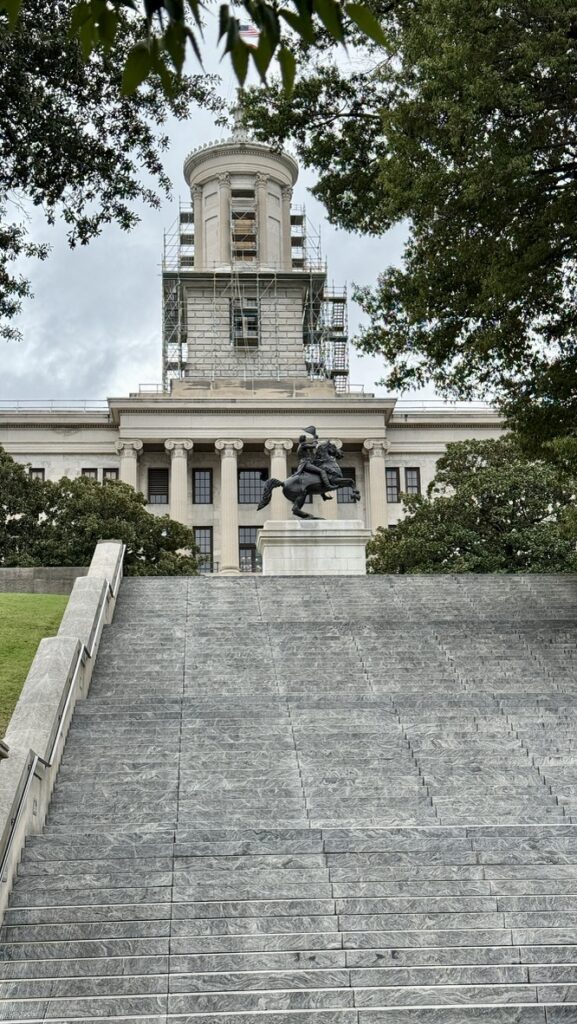
The cornerstone was laid on July 4, 1845, but the building was not completed until 14 years later in 1859. The building is designed in the Greek revival architectural style, with a Cupola typical of that style. Therefore, it has no dome or rotunda as we see in the Roman style.
William Strickland was the first architect on the Capitol; he also built the downtown Presbyterian church, which he designed in Egyptian style. You can see some of that influence on the inside of this building as well.
Our tour guide Hannah was a great teacher, entertainer, and seemed to really enjoy interacting with the crowd. She told us Nashville became known as the “Athens of the south” due to all the schools and learning surrounding the city. Each of the blocks of limestone that makes up this wall weighs four to six tons. The limestone came from a local quarry. The walls are several feet thick, heavy load bearing, and the floor is made of marble. The Capitol has withstood several tornadoes throughout the years.
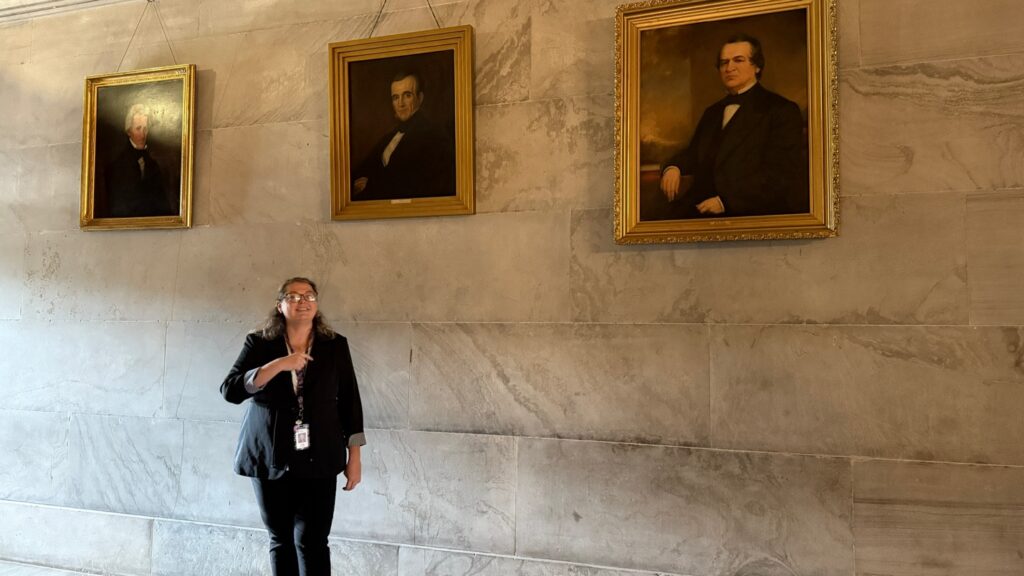
Fifteen enslaved men worked here. They were hired out for a year. All 15 reached emancipation later. The second group of workers consisted of prisoners. They were responsible for digging stone and moving it. A third group of Irish and German Immigrants were stonecutters and painters who painted frescos on the ceiling. The frescos got dirty from gas lamps and cigars, and they whitewashed over the frescos. Many years later, during restoration, they found the frescos under the whitewash and refurbished them. Sadly, I can’t find my pictures of the frescos.
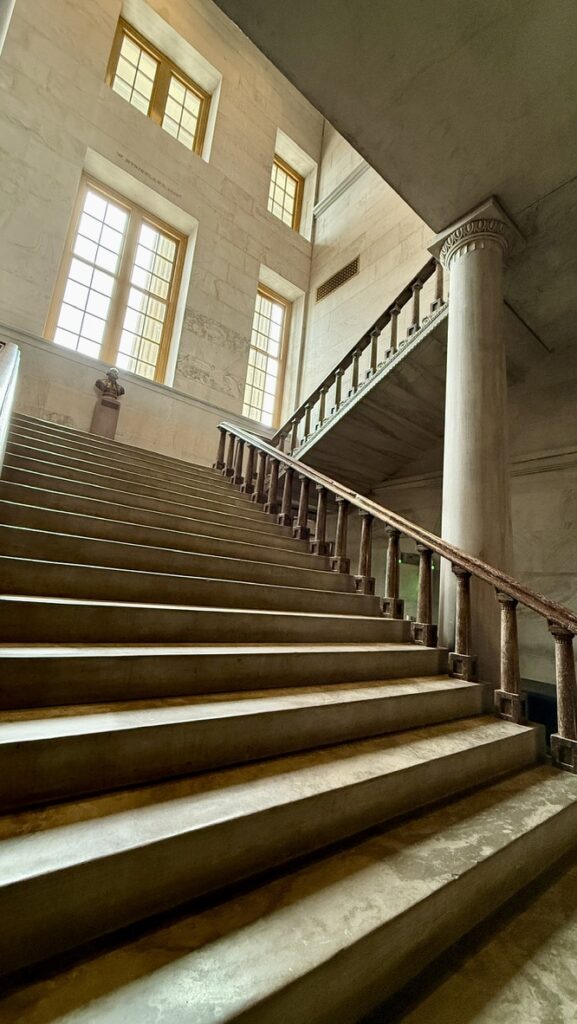
Unlike some Capitol buildings with rotundas, you won’t find an elaborate staircase here. Instead, the staircase highlights marble flooring and an intriguing tale. A chip in the handrail is said to have been caused by a bullet shot from above during a heated dispute over the 14th Amendment in 1866.
Old Supreme Court
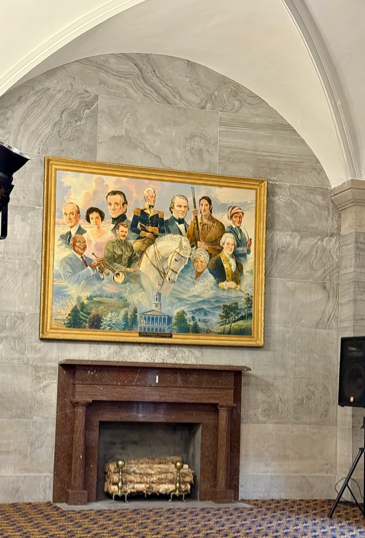
The Old Supreme Court Room, located on the first floor of the Tennessee State Capitol in Nashville, features a prominent 6′ x 8′ oil painting titled “The Pride of Tennessee.
The painting features eleven Tennesseeans notable for their unique contributions to the state and to the nation. Andrew Jackson’s horse is my favorite.
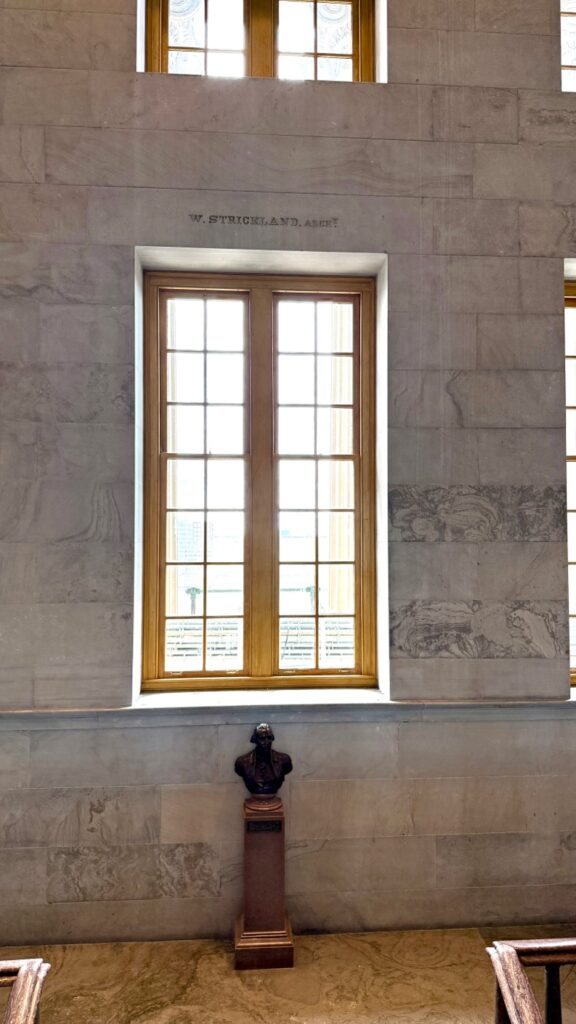
Fun fact…This is the only Capitol building to have someone buried in the wall. The architect (Strickland) didn’t want to leave, and because he felt this was his grandest achievement he made plans to be buried on the Northeast end. He died before the project was finished and was buried in the Capitol after his wishes. The second architect got the same honor, as he didn’t want to be outdone by his predecessor. He was buried in the wall on the southeast end.
They had gasoliers versus chandeliers throughout the building until late 1880s when they installed electricity. The original chandeliers still hang in the hallways and chambers, except for one in the center of the House, which I’ll tell you about in a minute.
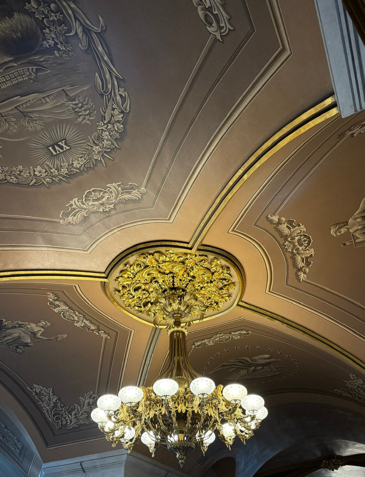
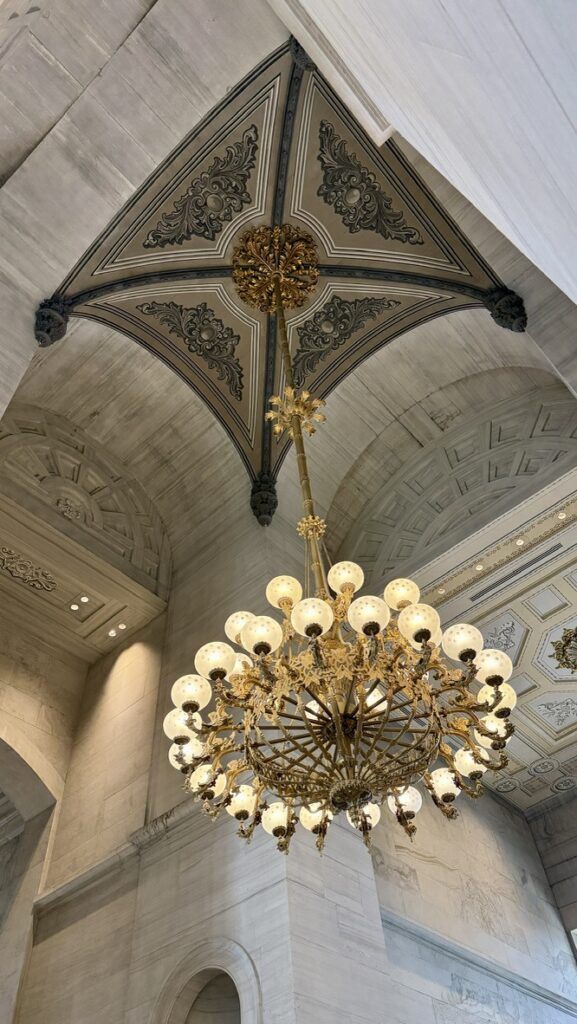
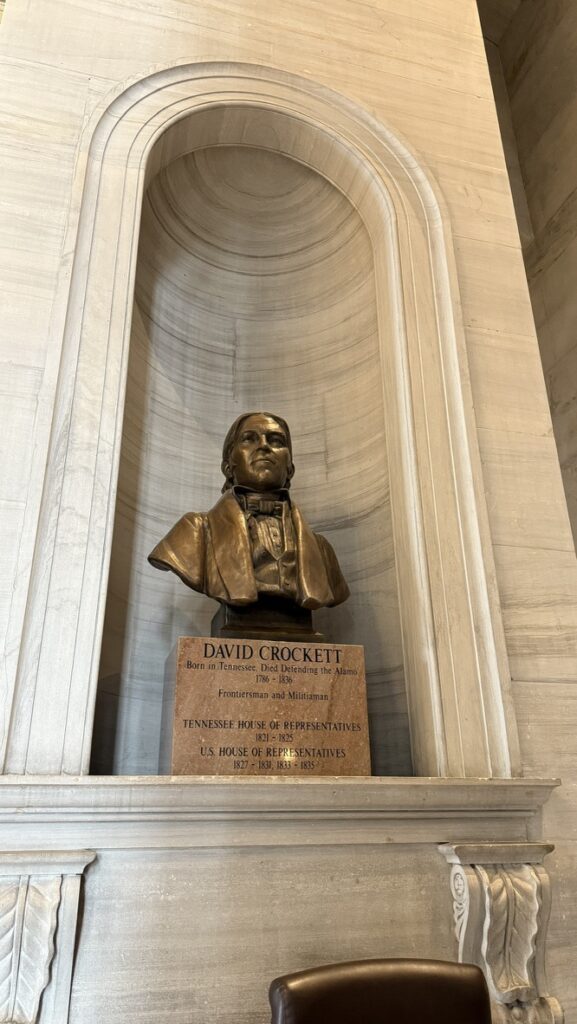
Davy Crockett was born in Tennessee. Of course, he’s also famous in Texas. Remember the Alamo.
House of Representatives
The House of Representatives was our tour guide’s favorite room because of the following story about the 19th Amendment (remember which one it is?), which she told so eloquently. Here’s a recap of the story…
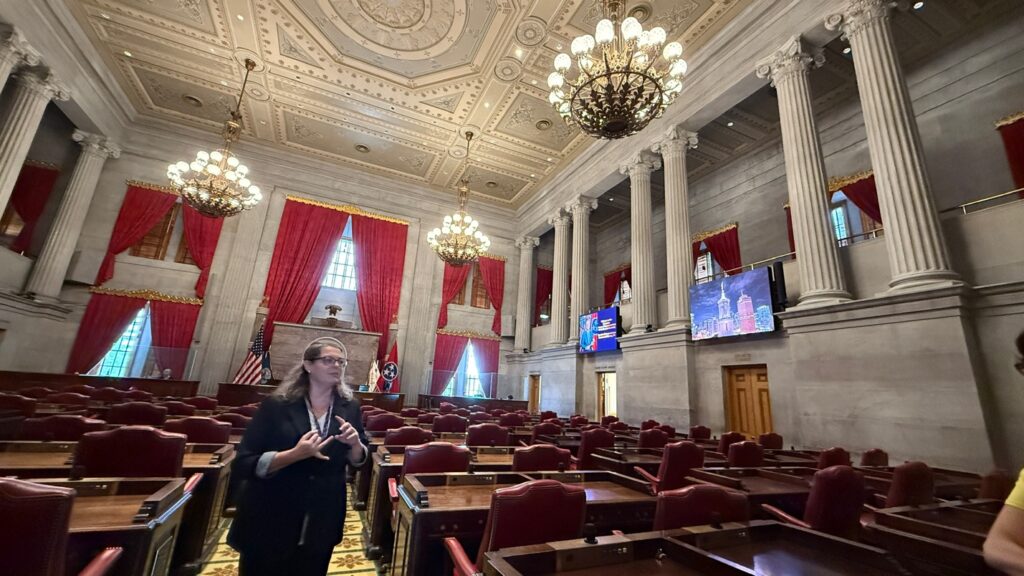
Multiple unrelated historical events in Tennessee have been called the “War of the Roses,” borrowing the name from the 15th-century English dynastic conflict. The most notable instances in Tennessee occurred during the 1886 gubernatorial race and the state’s ratification of the 19th Amendment in 1920.
The 1920 Women’s Suffrage “War of the Roses” was the dramatic final battle over the ratification of the 19th Amendment, which gave women the right to vote.
- The conflict took place in Nashville in August 1920, with supporters of the amendment wearing yellow roses and opponents wearing red ones.
- With 35 states having already ratified the amendment, Tennessee’s vote was the last one needed for it to become law nationwide.
- The vote in the state House of Representatives was tied 48–48. The stalemate was eventually broken by 24-year-old Harry T. Burn, who had been wearing a red rose.
- After receiving a letter from his mother urging him to “be a good boy” and “you know what to do,” (e.g. vote for the amendment), Burn switched his vote to “aye,” making Tennessee the “Perfect 36” and securing the right to vote for women across the country. After the vote, he went up into the cupola and hid from the press for four days. He was questioned and challenged, as they thought he was paid off or threatened, but his response was that he did what every man should do, “listen to his mother.”
Hannah also shared an interesting story about the original chandelier in the House, which was 14 feet wide and hung in the center (see ceiling picture below). When the windows were open, the chandelier would swing from side to side. This scared people who sat beneath it, so in the late 1800s they voted to take it down—after which they learned it was architecturally sound and would not have fallen—but it was too late as the vote was final. Getting it out the door was a challenge, and they ended up breaking it into pieces with axes. So sad, and would have been a site to see, but the historic society did recover some of the beautiful carvings that were a part of that chandelier and it’s in the Tennessee museum.

Senate Chambers
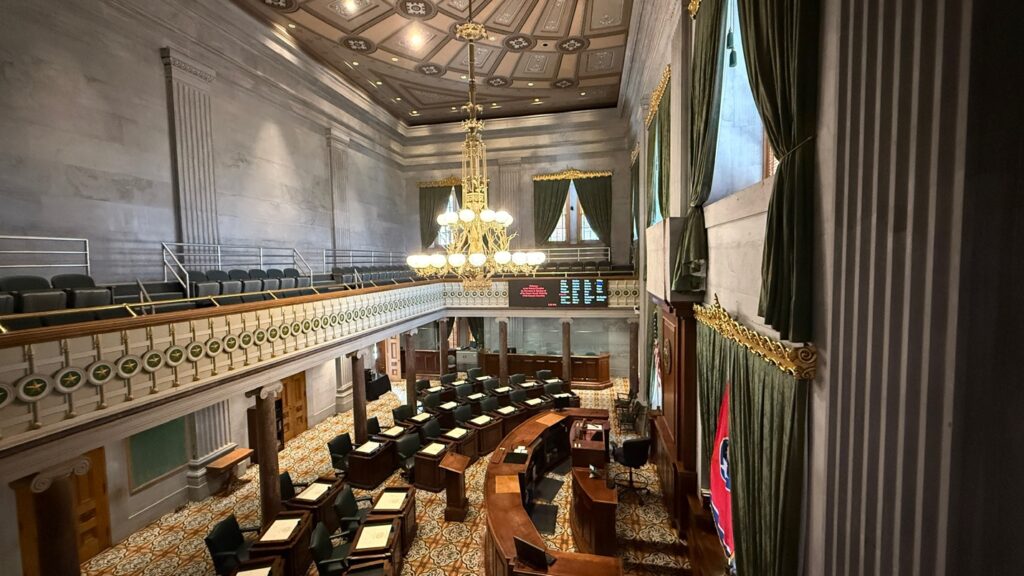
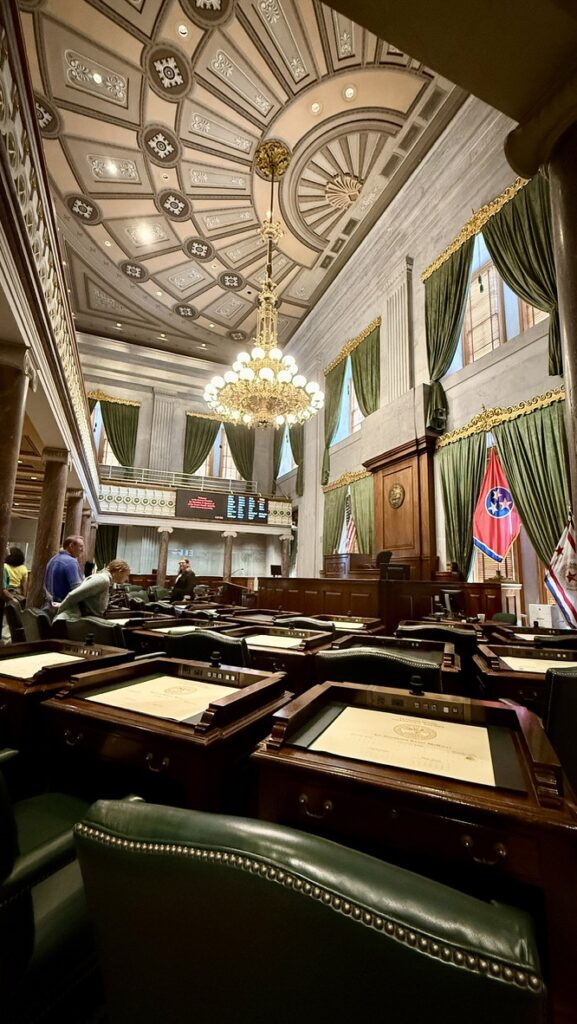
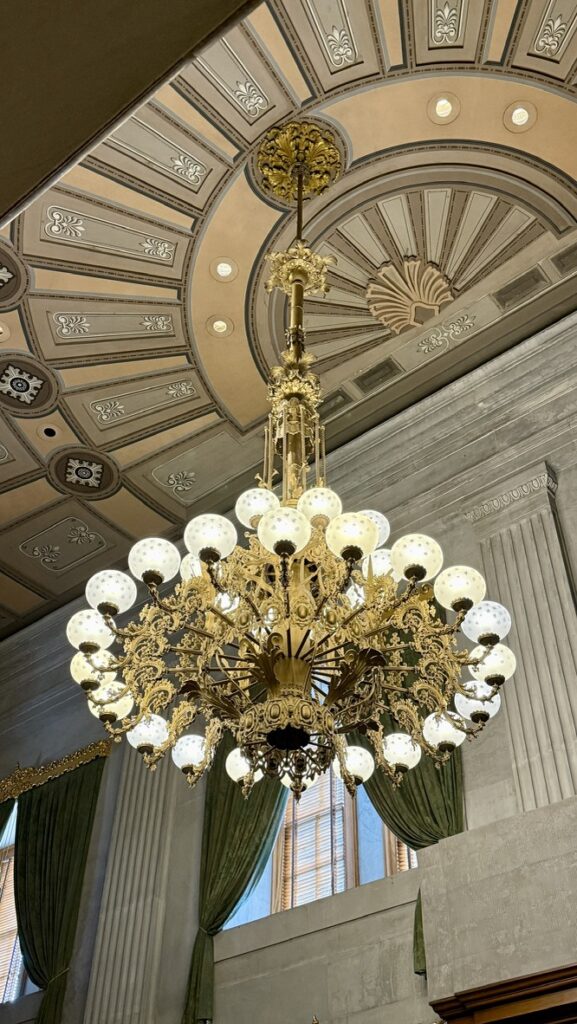
The Senate Chambers is much smaller than the House, as is typical in State Capitols. The columns are made of Tennessee limestone (a/k/a chocolate marble). You can find corn, cotton, and tobacco (three main crops) carvings in the original chandelier, which is still hanging in the chamber.
Legislative Lounge
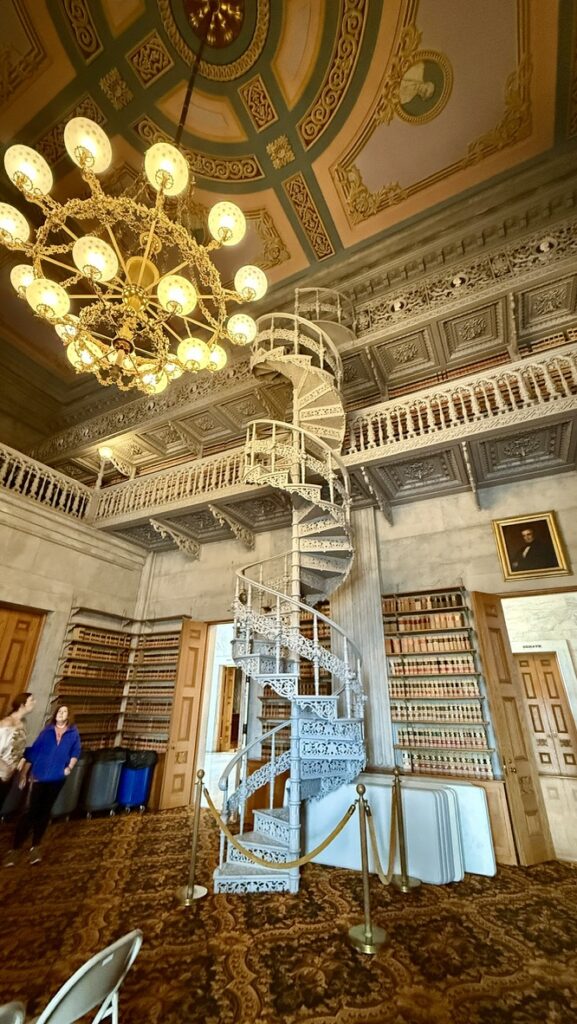
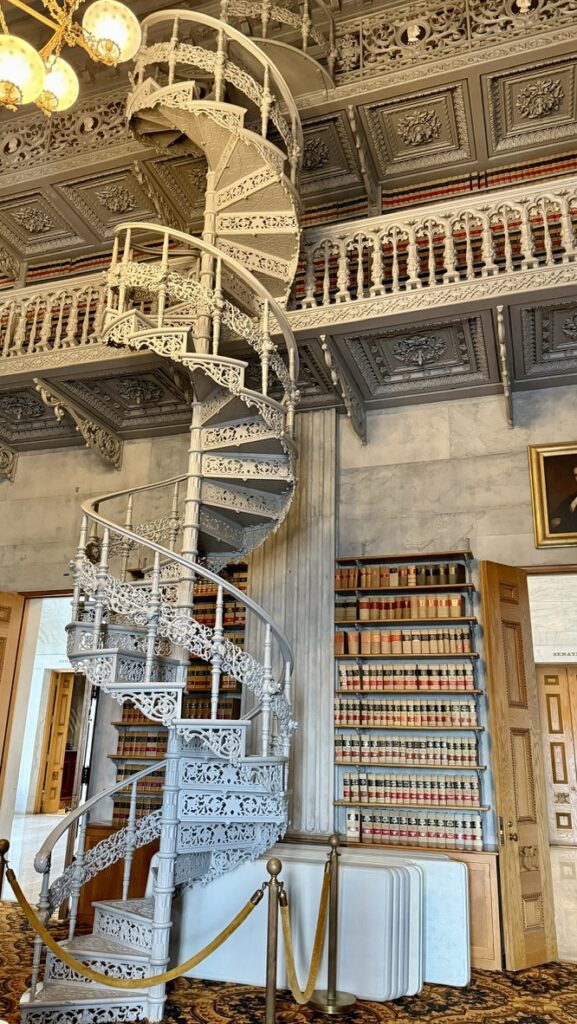
This intriguing room used to be the state library. About 250 tons of books were moved to another building across the street. This was the last room to be finished and by then Strickland was dead, so the new architect designed it in the Gothic revival style, very different from the rest of the building. It looks like something from Harry Potter! The Chandelier is original. Its design contains elements of the purple passionflower, which is the state wildflower and native to Tennessee.
Sequoyah Bust
Sequoyah was a Cherokee, which of course was interesting to me since my great-grandmother was a Cherokee. I love the story about him developing the Cherokee syllabary. Here’s Hannah telling us the story in a 3-minute video, if you’d like to hear more of the history. Or you can read the plaque below for brevity.
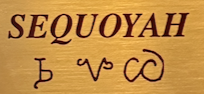
The plaque says, SEQUOYAH, Griffin Chiles, Sculptor, 1994, Bronze
Sequoyah, or George Gist, born in the late 1700s near the Cherokee town of Tuskegee in present-day Monroe County, invented the first form of written communication for his people. Comprised of 85 characters, each representing a syllable of the spoken language, Sequoyah’s syllabary was adopted in 1821 and widely used by 1823 among the people of the Cherokee Nation. Sequoyah died in August 1843 near San Fernando, Tamaulipas, Mexico, while seeking a band of Cherokee he thought had migrated to the Southwest.
Capitol Grounds
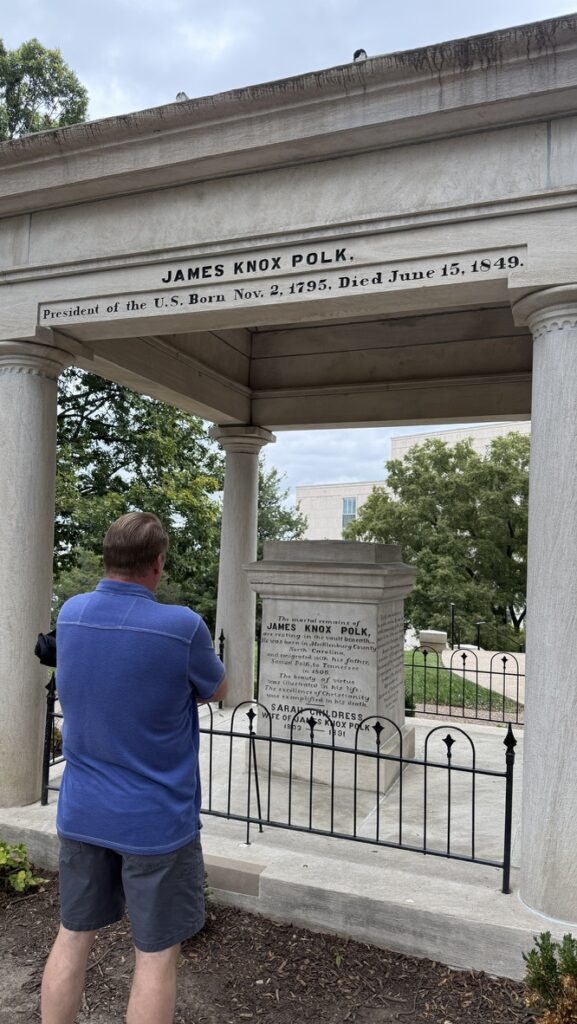
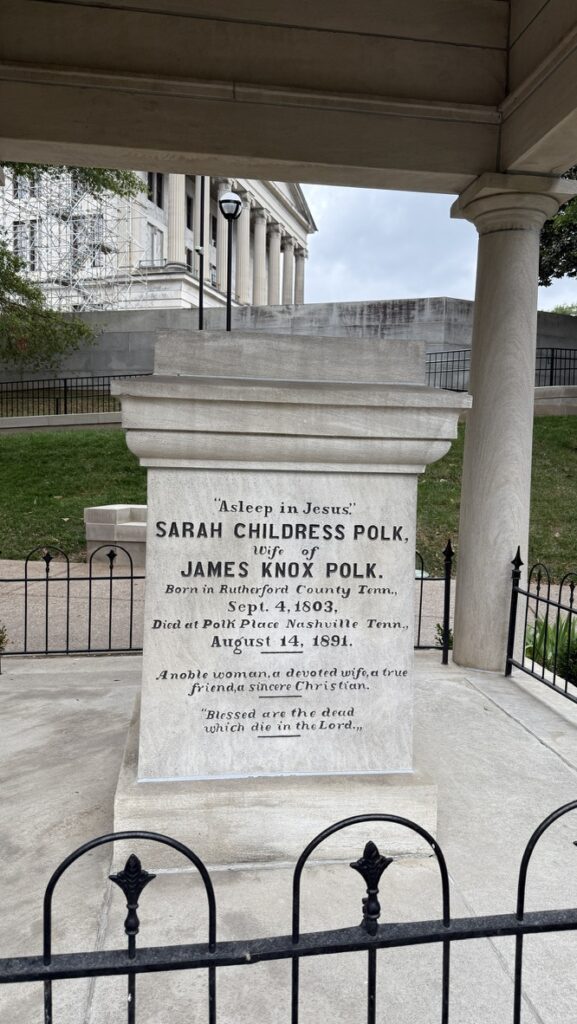
A walk around outside is pleasant on a day like today. There are several monuments, markers, and statues to see outside as well. An equestrian statue of Andrew Jackson, statues of Andrew Johnson and Sergeant York, and the tomb of President James K. Polk and his wife are just a few. Polk and his wife Sarah are buried on the property, underneath a beautiful monument. His body had to be moved several times after his death before its final resting place here. He moved to Nashville after he left office where he planned to live out his life. Sadly, they were battling a cholera outbreak in Tennessee, which he died of just three months later.
I love the inscriptions on Sarah’s grave, “Asleep in Jesus” and “Blessed are the dead which die in the Lord.” It’s so comforting to know when your loved ones die they are going into the arms of Jesus.
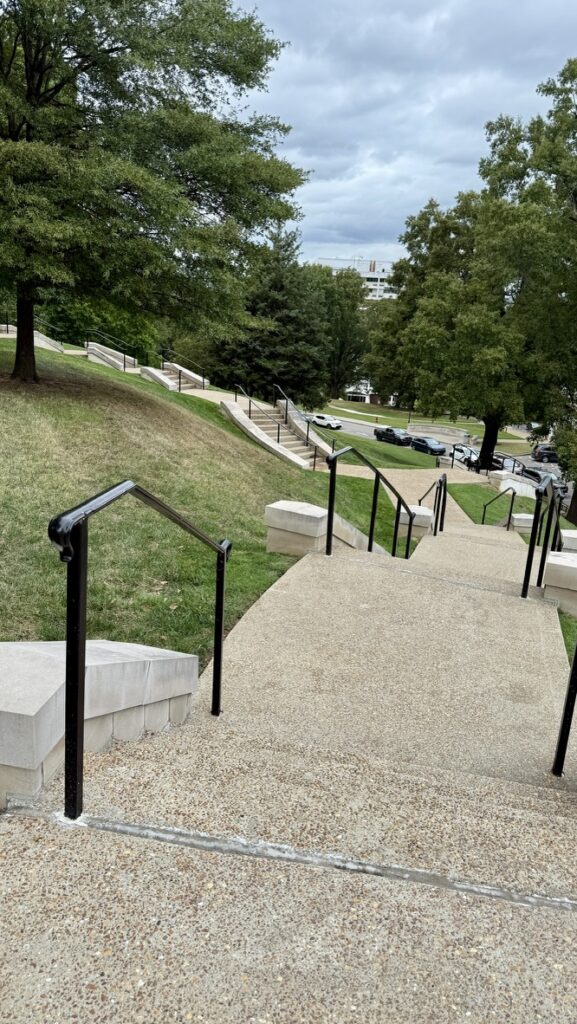
Heading back to the truck. There is a way to get to the Capitol without climbing all these stairs, as they have dug a tunnel for ADA access with elevators, but we didn’t know it sits on the highest hill in downtown Nashville when we started walking there from our parking spot. 🥴 The Tennessee State Capitol is built on Cedar Knob, a prominent elevation overlooking the Cumberland River. The site was selected in the 1840s to ensure a commanding view of the city. The first Catholic Church was originally built here and had to be demolished to make room for the Capitol (there’s a marker on the Capitol grounds where it stood). There is no private parking for the Tennessee State Capitol. During the week, visitors must park in paid lots or at street parking meters.
I hope you enjoyed this little tour of Tennessee’s State Capitol in Nashville. It would be great if you would leave a comment and let me know if there is something else (of less) you would like to know, as we have several more capitols to see before we complete our bucket list. Thanks for following my blog!
À la prochaine…hasta la próxima vez…until next time!
“I am the Lord, who heals you.” ~Exodus 15:26
My relationship with Jesus Christ motivates me to keep blogging. Though I have metastatic breast cancer*, my faith helps me survive, thrive, and feel alive while staying active. Without Him, I couldn’t achieve anything. With His help, well, my accomplishments speak for themselves on my blog. If you’re interested in learning about building a relationship with Jesus, feel free to comment below. I will never sell or share your email.
*Metastatic breast cancer is Stage IV cancer. Metastatic, or metastasis, means the cancer has spread beyond the original location (breast and immediate lymph nodes). In 2016 the doctors found significant metastasis to my bones, skull, liver, and lungs; then in 2018 to the brain. However, with chemo, immunotherapy, gamma knife, and of course my faith in the Lord, it is all undetectable at this point. I continue in treatment every three weeks via infusions, and receive multiple scans on a regular basis. If you or someone you know has metastatic breast cancer, I recommend these organizations for additional support:
Metavivor and Unite for Her (also for ovarian cancer)