

March 24, 2026. Richmond, Virginia. If you’re keeping track, yes—the date matches Delaware and Maryland; we managed to visit three state capitols in a single day! Talk about a whirlwind adventure. But let’s be honest: Richmond absolutely deserves a blog post all to itself.
In this blog you will see a newly installed and very cool diorama, a law-abiding contraption, an amazing Lego model, a real-live painter, extremely rare full-size sculptures of Thomas Jefferson and George Washington, a 16th century dial clock, the chambers, and more fun facts! Please let me know in a comment at the bottom if you read this blog, and tell me what you think of this State Capitol!

They tend to be even more meticulous with the Passport stamp when they know you are filming the process LOL.
Our tour guide? He was a storytelling superstar, spinning tales that kept us entertained and on our toes throughout the visit. So much for short capitol tours!
Mark was his name, and talking was his game! We arrived about 15 minutes before the tour began, enough time to view the diorama — one of the coolest features we have seen in any State Capitol building thus far. Our guide told us that is a new feature, just installed about 8 weeks ago!
Mark has been a docent here for a quarter of a century; he loves it! His knowledge surpassed any tour guide we have had thus far, and that’s saying a lot. One might say he was a bit theatrical at times, refusing to respond to any question with a simple answer; each query began another five to ten minutes of storytelling, gesticulating, eyebrow raising, and quirky smiling. Tim kept watching the clock as our two-hour parking pass was nearing expiration.
The Virginia State Capitol has undergone a remarkable transformation over the years, including extensive restoration, renovation, and even expansion. The heart of the building—the central section—was originally designed in 1785 by none other than Thomas Jefferson. Interestingly, Jefferson’s original plans included the outdoor grand staircase, but it was not included in the build at the time. During the modern renovation, not only were the iconic stairs finally added, but crews also excavated the hill beneath the entrance. Now, guests arrive via an impressive underground entryway (where we started our tour), and the space above has been reimagined as a beautiful, sprawling park.
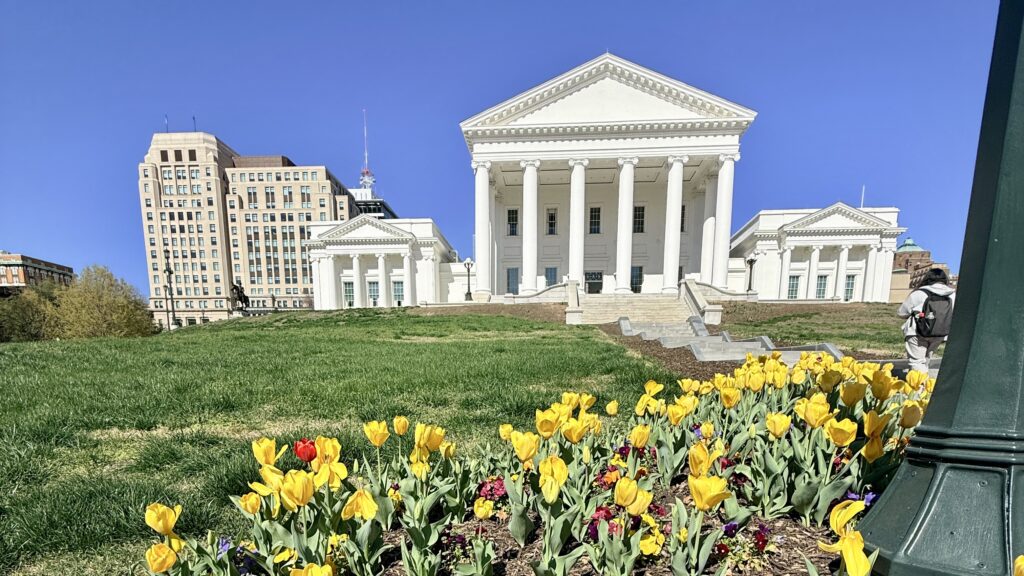
This area serves as the perfect spot for inaugurations and is also a favorite gathering place for locals to enjoy picnics on the lush grass and community celebrations around the sweeping staircase. The Capitol’s two legislative wings, home to the Senate and House, were later additions by architect Peebles, who earned the bid on the project because he was committed to honoring Jefferson’s original design, unlike other architects who wanted to leave their own stylistic marks.
The Diorama.
The tour begins at the diorama, which is underneath the Capitol as stated earlier. Pictures of Kevin Kline, Ben Kingsley, and Geena Davis were featured on the back wall due to their significant connection to the Capitol in their movies, along with George Washington, other famous politicians, prime ministers, the Queen, a bomb dog, and more. Different sections of the diorama light up, highlighting the history of the state, buildings on the Capitol complex, the four seasons, and much more. It was quite impressive!

The Contraption.
Click this link for a very fun demonstration on how an idea is formed and eventually turned into law. It’s a cool metaphor, sitting across the room from the diorama. You can see this cool Rube Goldberg-style contraption at the beginning of the tour, yet another reason to go to Virginia!
Fun Facts!
Several interesting features were noted by our docent as he lead us through the building. After the diorama he showed us this 24-square foot model, built to scale (1:48) by an architectural student from the University of Virginia named Benjamin Edlavitch. It is completely made out of Legos: 50,000 to be exact! It took him about six months to complete, and he only used pieces that were available for retail purchases. If you would like to take a stab at it, you could build one of these too!


The inside of an old elevator shaft was uncovered during the renovation. If you ever wanted to know something about the government, you would ask the elevator operator. The elevator had to be manually operated, making him privy to many political discussions on both sides of the political continuum, listening intently while going up and down from one level to another. The elevator moved so slowly, people could walk up the stairs and continue their discussions with those on the inside.
Thomas Jefferson Bronze Statue.
The original architect, who also decided to build the State Capitol on the Shockoe Hilltop. Our guide had a lot to say aboutThomas Jefferson’s bronze statue, of which I can’t remember much. I do recall Jefferson said architecture was his delight; he had a love for design. He was serving as the State Minister to France, in Paris, when he designed the building. While he was there, he was thrilled to discover graph paper! He is holding one of his drawings of the building in his hands.
I remember the thrill of drawing on graph paper as a fifth grader, and my teacher telling me I could be an architect. What would my life be like today if I had listened to her?!
After this we made our way up the winding staircase to the (former) main entrance.

George Washington Marble Statue.
The remarkable life-size statue of George Washington was sculpted by Jean-Antoine Houdon from Carrara marble—the very same exquisite stone that Michelangelo chose for his masterpieces. The lifelike detail is truly striking; his face is rendered so realistically that it almost feels like his eyes are following you across the room. His contemporaries confirmed it looks just like him. There’s even a special touch with subtle light behind the eyes (don’t ask me how Houdon did it!), making it seem as if Washington is gazing right through you if you could step in for a closer look. Maybe his nickname should be “Houdini.”
The sculptor thoughtfully showcased both the military and civilian sides of George Washington’s life in this statue. You’ll notice his sword resting at his hip, while his left hand is placed atop a fasces—a bundle of rods that represents authority in ancient Rome. Yet, he’s also carrying a simple walking cane in his right hand, and standing beside a plow, highlighting his role as a citizen and farmer in addition to his military achievements.


I love the detail of this sculpture, from all angles!
Fun Fact
The Statue of George Washington is the only statue to be sculpted “from life,” e.g. while George was sitting for it. Thomas Jefferson planned for it to be in that exact location, as we saw on his original drawings. He even hired the sculptor in advance. Apparently, the sculptor placed a plaster cast on George’s face and left it there while Washington breathed through two straws until the plaster was set. The sculptor wanted to ensure he had a proper mold for the face to make it as realistic as possible. The Smithsonian asked if they could borrow this sculpture for an exhibit one time, and the State Capitol said, “um, no!” (paraphrased by Mark, our tour guide).
Rotunda and Dome.
The heart of the Capitol features the Rotunda, a spacious two-story area topped with a dome that spans about 30 feet across. Natural light pours in from the skylights above, creating a bright and airy atmosphere. Interestingly, the dome was built under the slope of the gable roof, so you can’t view it from outside the building.
The Capitol’s dome was completed in 1794, yet Thomas Jefferson’s earliest descriptions of the central area never mention a dome. He referred to it as the “conference room.” It’s unclear if Jefferson later decided to include the dome or if it was an addition made by Samuel Dobie, the builder who oversaw the project. To this day, the origins of the dome remain a bit of a mystery. However, it was quite evident he intended for George to be placed here, as the central focal point.

Old House Chambers
This grand chamber witnessed some of Virginia’s most pivotal moments. From 1788 to 1904, it served as the meeting place for the House of Delegates, and over the years it hosted conventions that shaped both the U.S. Constitution and four constitutions for the Commonwealth. In April 1861, Virginia voted here to secede from the Union, and Robert E. Lee accepted command of Virginia’s forces in this very room. By the late 1860s, the chamber welcomed Virginia’s first elected African American Delegates—marking a new chapter in the state’s history.

THE MACE OF THE HOUSE OF DELEGATES
A ceremonial object symbolizing power and authority, this modern sterling silver mace with 24-karat-gold finish was made in England in 1938 and presented to the Virginia House of Delegates in 1974. When the House is in session, the Sergeant at Arms carries the mace to the House Chamber each day where it is displayed in front of the Speaker’s podium. Today the mace remains a symbol of the important political and legal traditions shared by the Commonwealth of Virginia and Great Britain.


We Met a Professional Portrait Painter!

The man in this picture is a professional portrait painter from Philadelphia, and he was in our tour group. He has been working for the past six months on the politician seen in the portrait here, and he came back today to correct a few blemishes. This is the second portrait he was commissioned to paint in this State’s Capitol. We were quite amazed at his handiwork. Awestruck, really. The oil painting looked like a photograph, even up close!
The Old Senate
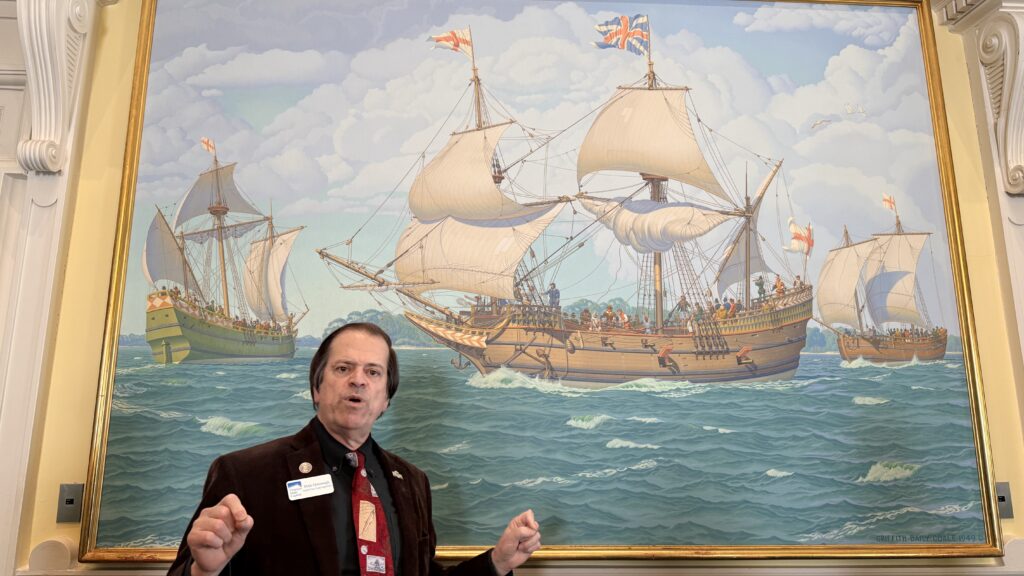
The former Senate chamber is now used for occasional committee meetings; it contains paintings depicting two of the most important events in the history of the Commonwealth and of the nation. I felt honored to meet the painter behind a portrait. Since he was in our tour group, our docent had a lot to say about much of the artwork throughout the building.
This painting, completed in 1949 by Griffith Bailey Coale, represents the establishment of the first permanent English settlement in America. It showcases three ships, the Susan Constant, the Godspeed, and the Discovery, bringing the first settlers to Virginia in May 1607.
The Jefferson Room.
This room contains a large full-length portrait of Thomas Jefferson painted by George Catlin, who copied an original portrait by Thomas Sully now on display at West Point.
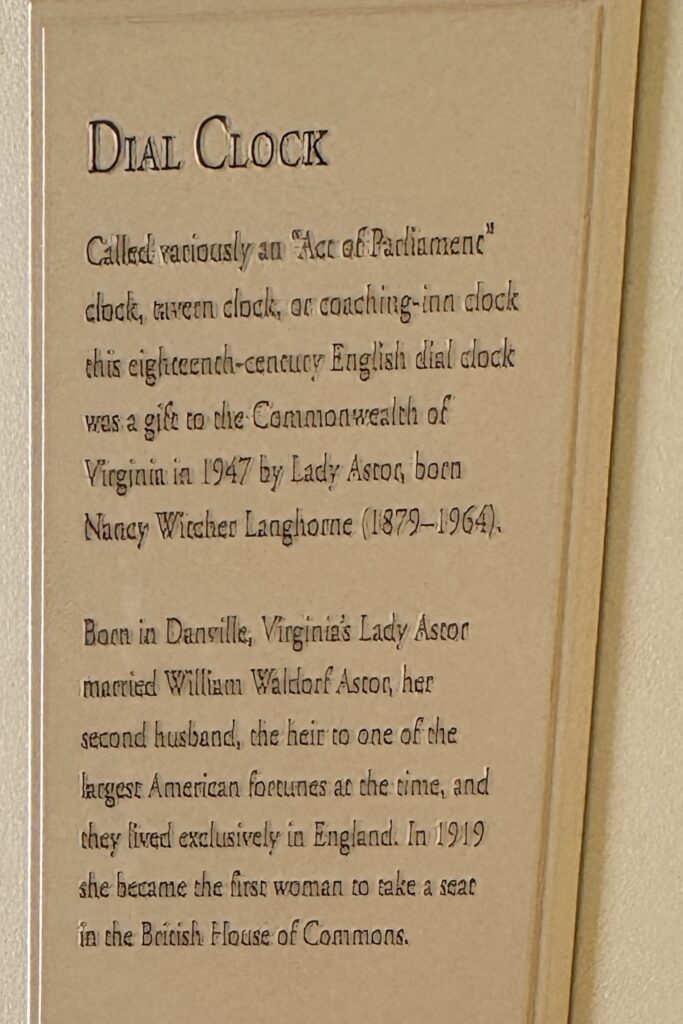
Mark also had much to say about this famous, antique dial clock. It is a 300-year-old English dial clock that must be re-cranked by hand every eight days but still keeps perfect time. The clock is one of the key historical items in the Capitol, which was designed by Thomas Jefferson and stands as a major landmark of Virginia architecture.
Mark is in charge of winding it up, which he does at the same time and day every week. I knew he was wound up for a reason! The plaque tells us more.

Senate and House Chambers.
The current Senate and House Chambers were locked, but the guide did have a key to let us in. He didn’t have a lot to say about those, and it seemed more like an afterthought than a main event of the tour, due to the rich and lengthy history found elsewhere.


Conclusion.
I’ll close with an interesting bit of history I found online: “Winston Churchill, Margaret Thatcher (both honorary citizens of Virginia), and President Dwight D. Eisenhower have addressed Joint Sessions of the Virginia General Assembly in the House of Delegates Chamber. In May 2007, Her Majesty Queen Elizabeth II of Great Britain addressed the Virginia General Assembly in the House Chamber.”
Tim said this capitol is probably in the top five of the ones we have seen so far. I would have to agree. With the underground tunnel addition, the stories by the best docent to date, and the grounds, we give it two-thumbs up.
I hope you enjoyed this little tour of Virginia’s State Capitol in Richmond. It would be great if you would leave a comment and let me know if there is something else (or less) you would like to know, as we have several more capitols to see before we complete our bucket list. Thanks for following my blog!
À la prochaine…hasta la próxima vez…until next time!
“I am the Lord, who heals you.” ~Exodus 15:26
My relationship with Jesus Christ motivates me to keep blogging. Though I have metastatic breast cancer*, my faith helps me survive, thrive, and feel alive while staying active. Without Him, I couldn’t achieve anything. With His help, well, my accomplishments speak for themselves on my blog. If you’re interested in learning about building a relationship with Jesus, feel free to comment below. I will never sell or share your email.
*Metastatic breast cancer is Stage IV cancer. Metastatic, or metastasis, means the cancer has spread beyond the original location (breast and immediate lymph nodes). In 2016 the doctors found significant metastasis to my bones, skull, liver, and lungs; then in 2018 to the brain. However, with chemo, immunotherapy, gamma knife, and of course my faith in the Lord, it is all undetectable at this point. I continue in treatment every three weeks via infusions, and receive multiple scans on a regular basis. If you or someone you know has metastatic breast cancer, I recommend these organizations for additional support:
Metavivor and Unite for Her (also for ovarian cancer)
