State Capitol 24: Pennsylvania

the metastatic breast cancer journey banner

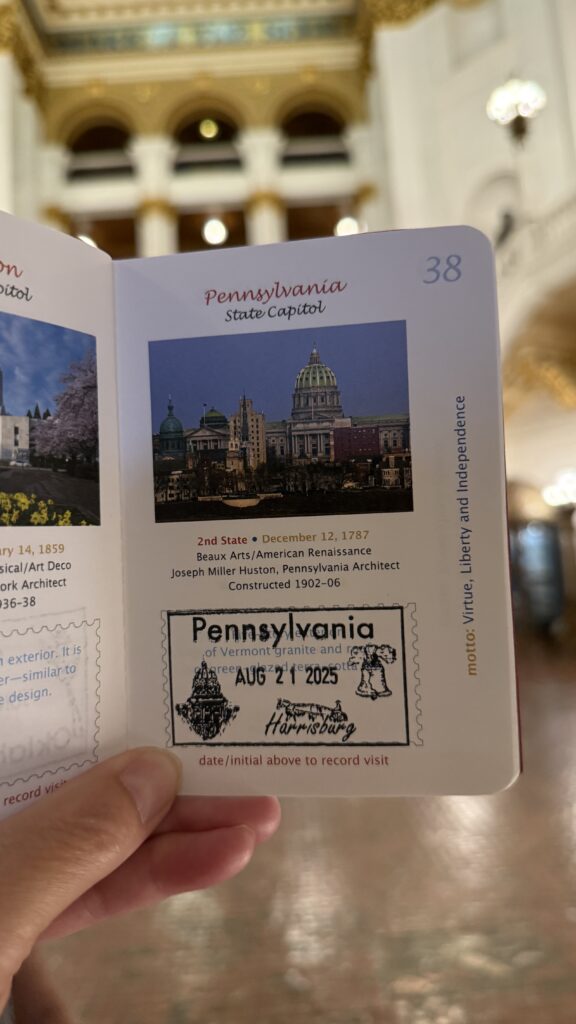
August 21, 2025. Harrisburg Pennsylvania.
Welcome to the Pennsylvania State Capitol!

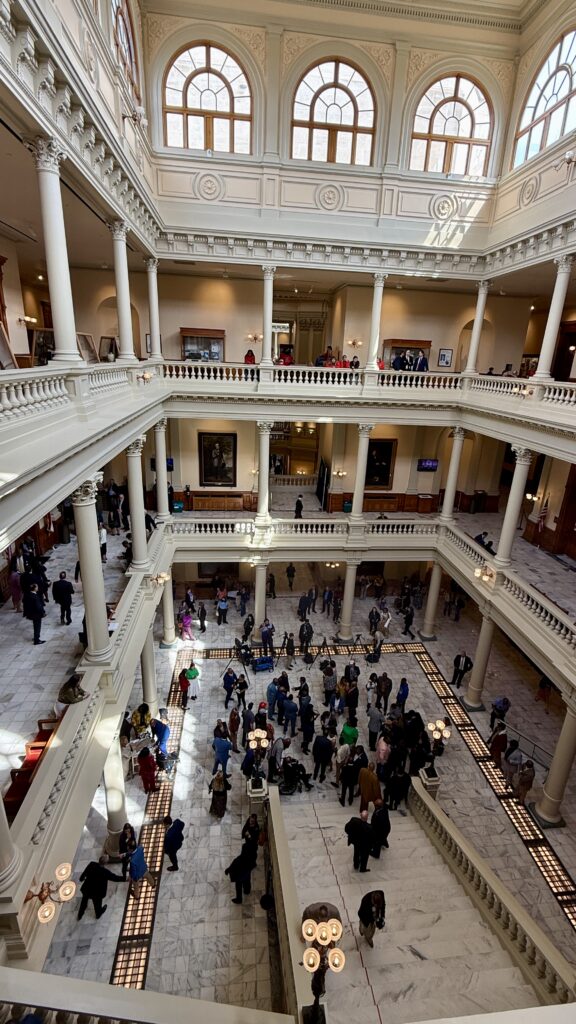
Nestled in the heart of Harrisburg, the Pennsylvania State Capitol is more than just a seat of government — it’s a magnificent piece of American history and architecture, designated as a National Historic Landmark in 2006. With over 600 rooms in the building, we will visit just a few. Join me as your tour guide for a memorable walk through this iconic building, where every corner reveals a story!

And, don’t forget to get your Passport stamped when you visit! #bucketlist

The Grand Entrance

As you approach the Capitol, the first thing you’ll notice is the stunning dome. *Fun fact: The dome was inspired by St. Peter’s Basilica in Rome and rises 272 feet above the ground! In fact, it’s so impressive that President Theodore Roosevelt called it “the handsomest building” he’d ever seen when he dedicated it in 1906. The five-story exterior consists of Vermont granite and the roof is covered in green-glazed terra-cotta tile.
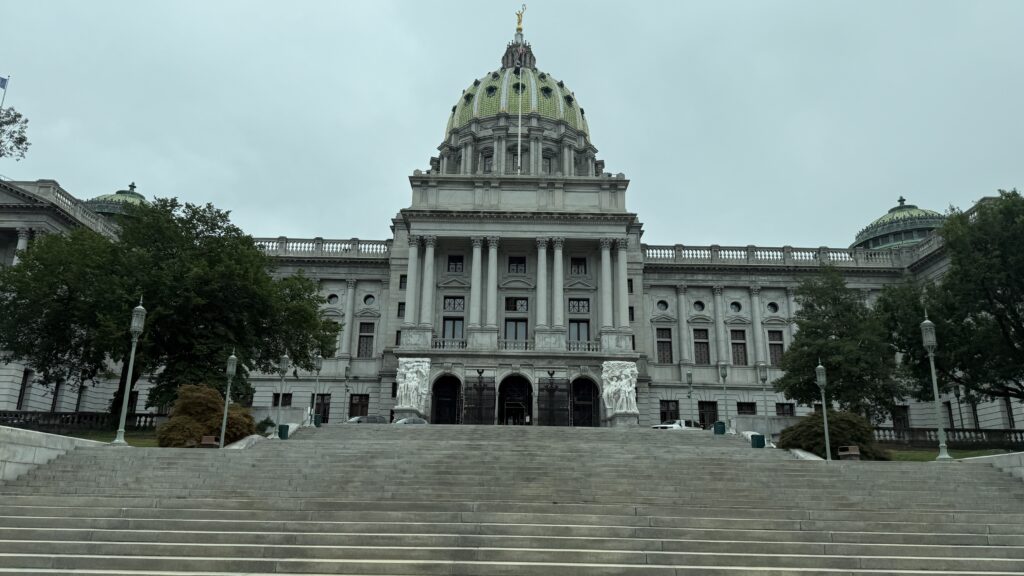
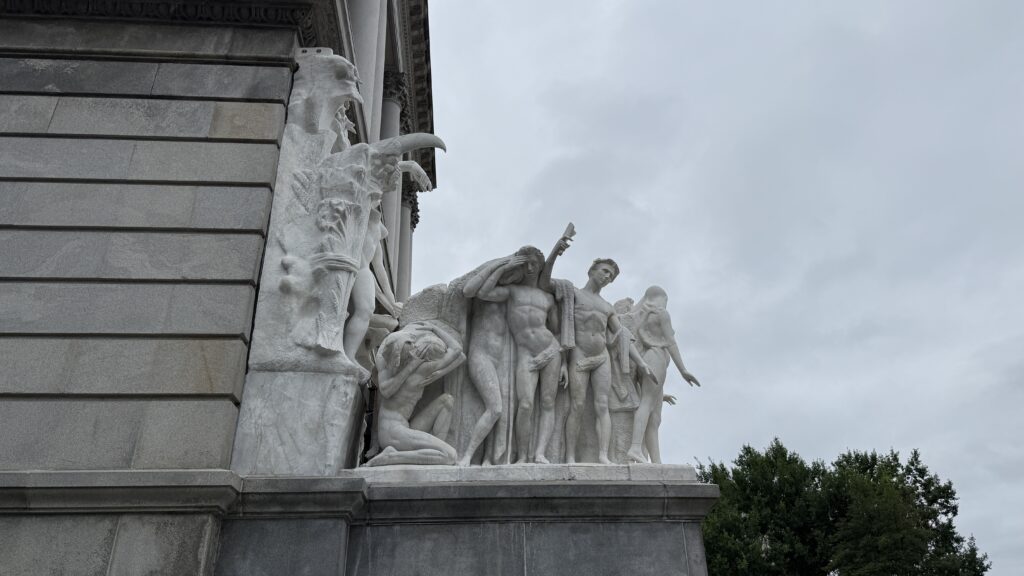
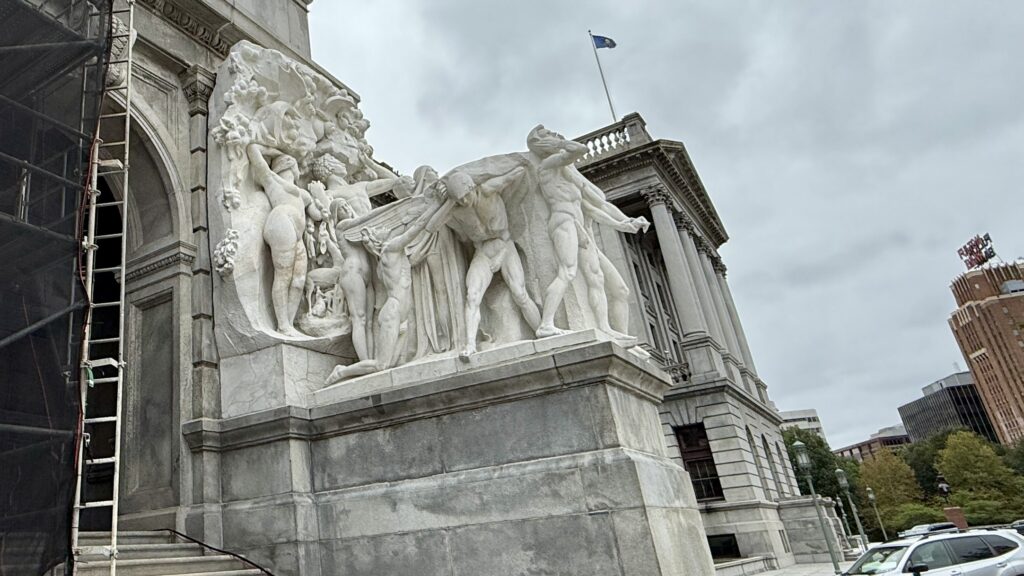
The sculptures that frame the main doors of the Capitol represent humanity advancing through work and brotherhood (left) and lives of degradation and spiritual burdens (right). They restored the statues to their original state during the Capitol preservation project after severe deterioration over the years. Created by Pennsylvania artist George Grey Barnard (1863-1938).
Bronze Doors.

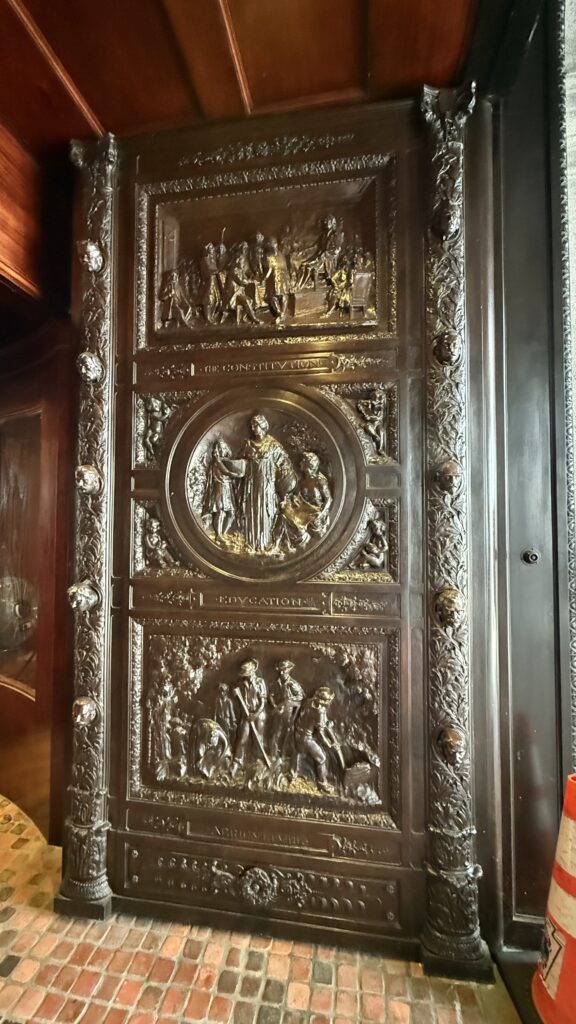
Now that’s a door! Each 17-foot door at the Capitol’s main entrance weighs a full ton, but can swing open at the touch of a hand. Modeled after a pair of gilded bronze doors by Italian Renaissance sculptor Lorenzo Ghiberti, they feature portrait heads of individuals responsible for the Capitol’s construction.

Pennsylvania was the 2nd State to join the union, on December 12, 1787. The building represents the Beaux Arts/American Renaissance style designed by Joseph Miller Huston, Pennsylvania Architect, who had a vision for the building as a “Palace of Art.” It took four years to build, constructed 1902-1906 at a cost of $13 million. (This was not the first State Capitol building.)
The Rotunda

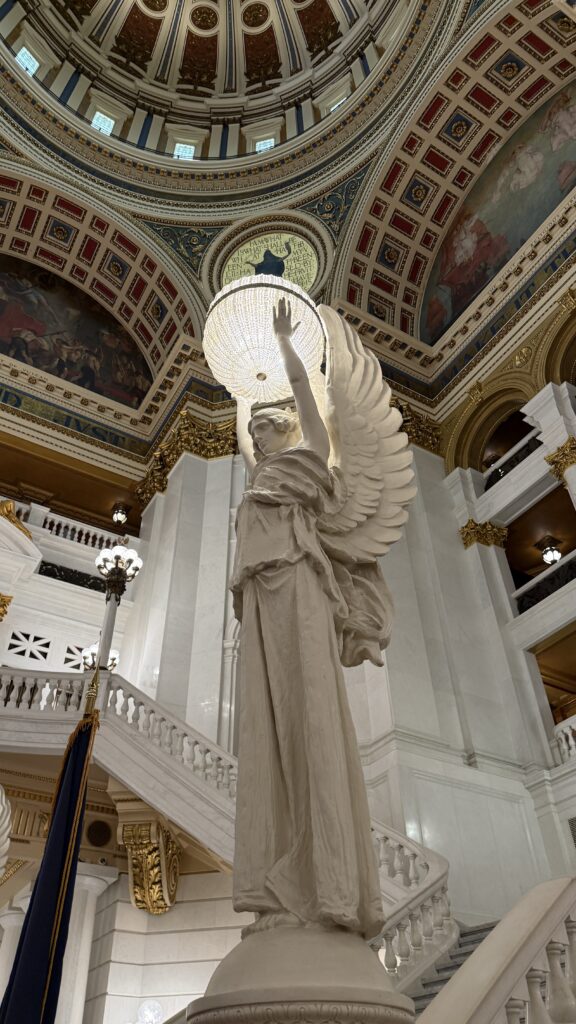
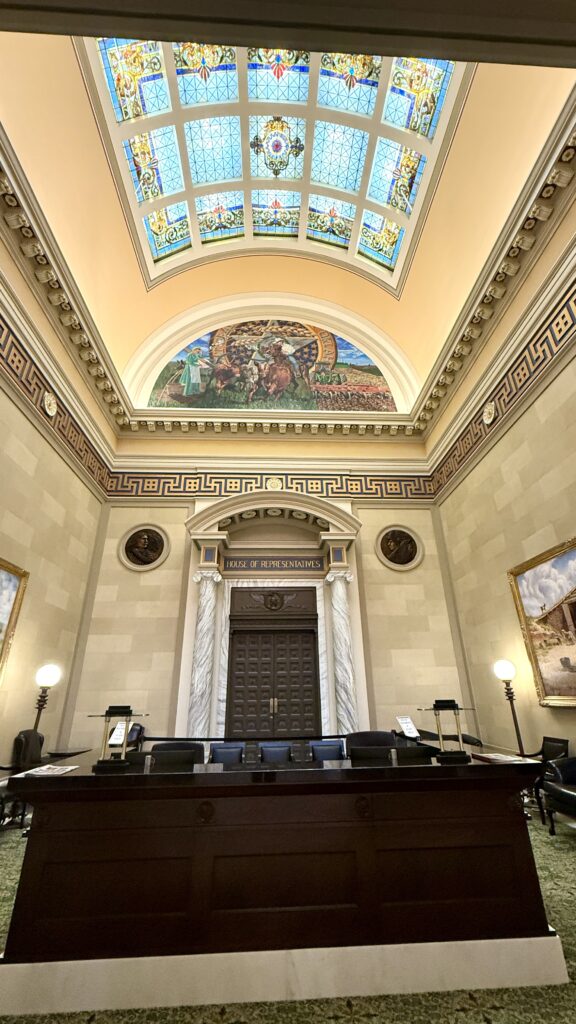
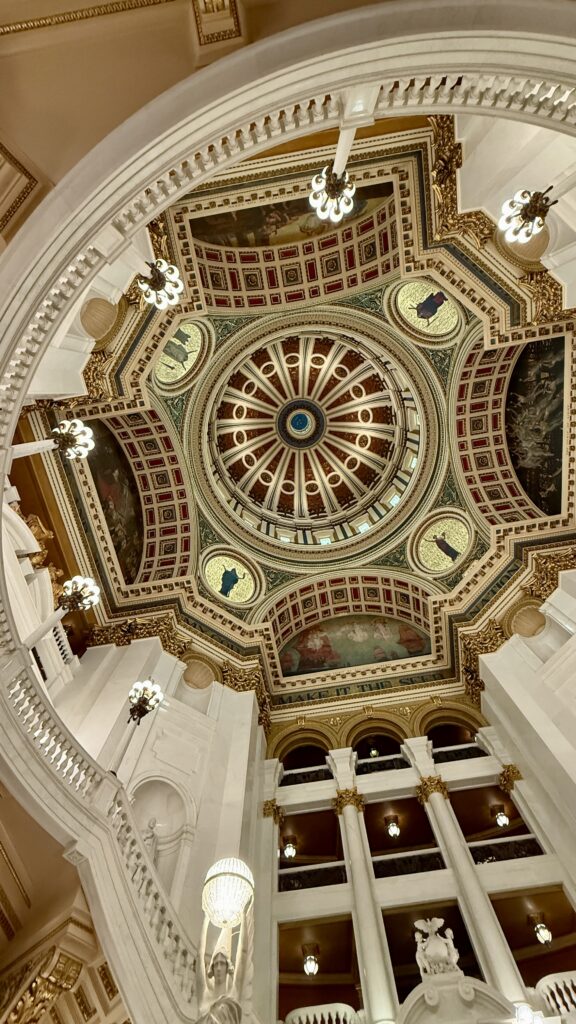
Step inside, and you’ll find yourself in the breathtaking Rotunda. Look up: the central dome is adorned with vibrant murals celebrating the state and Pennsylvania’s history. Thanks to the Gilded Age, the 24-karat gold leafing seen on the rotunda can be found throughout the Capitol, making this one of the most stunning state buildings in the country.

The marble columns surrounding the rotunda come from four countries—Italy, France, Algeria, and Greece—showcasing Pennsylvania’s connection to the world.

Moravian Tiles

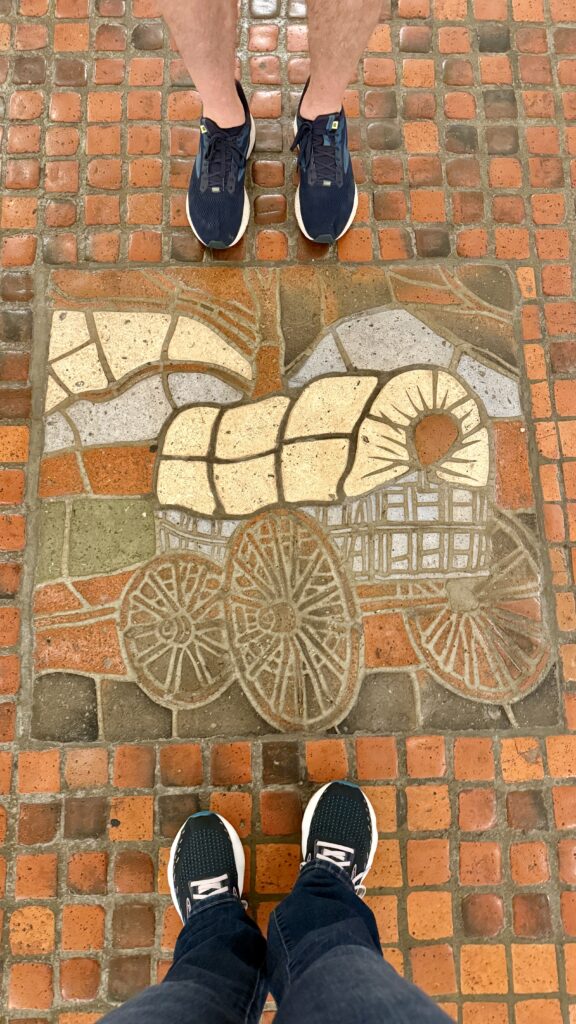
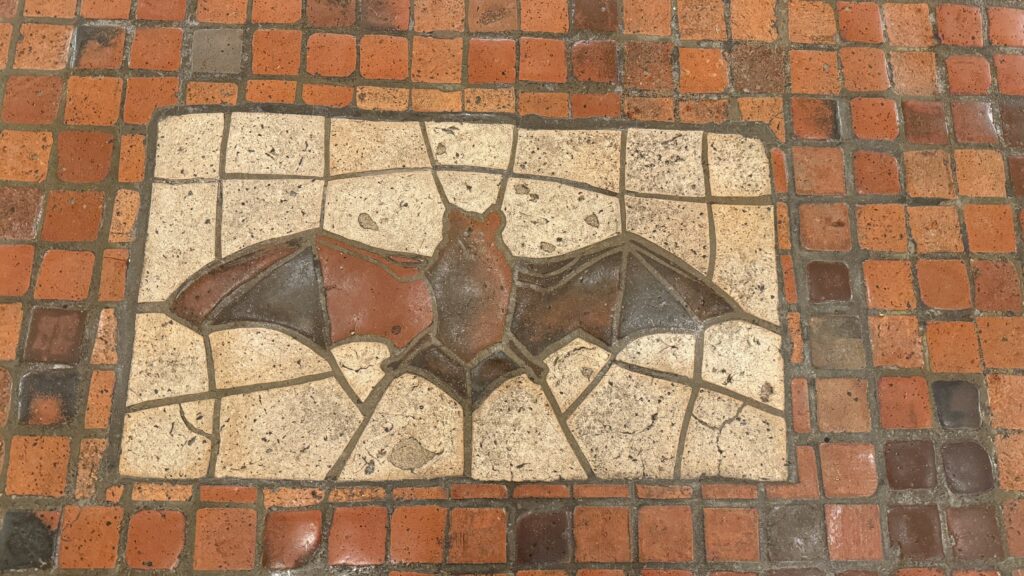
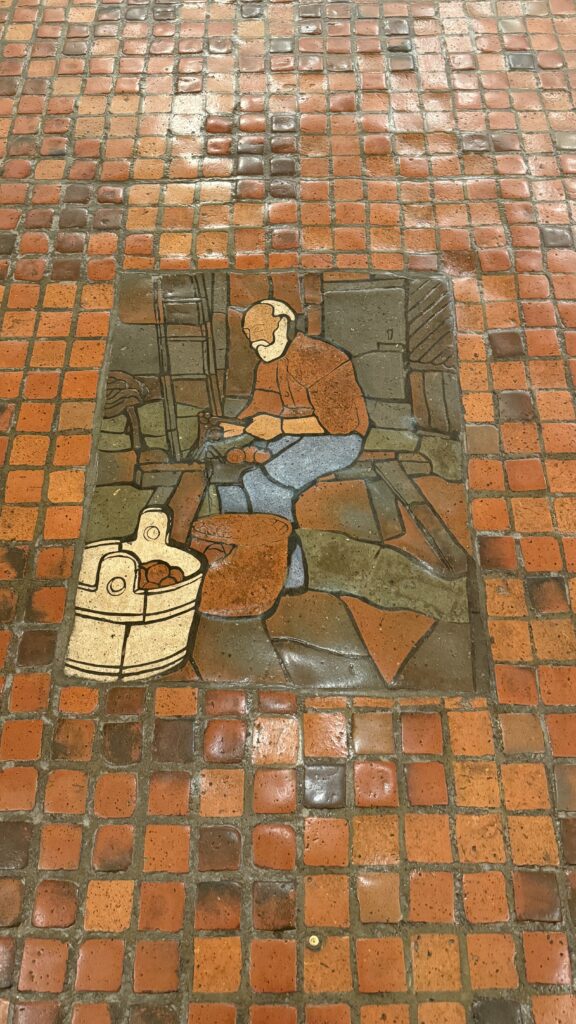
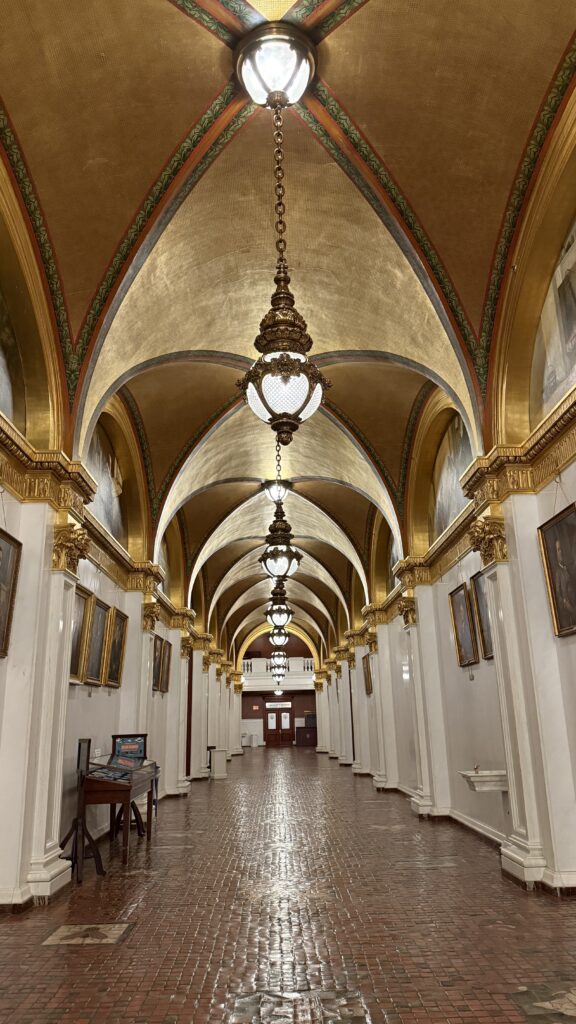
Don’t forget to look down at your feet from time to time as you stroll through history from one end of the first floor to the other. Colorful Moravian tiles cover the entire first floor, as well as its adjoining corridors. This floor has over 400,000 pieces of Moravian tile, with close to 400 tile mosaics illustrating the state’s history, animals, industries, and modes of transportation. They are thought to be some of the finest examples of Pennsylvania German folk art.
The Grand Staircase

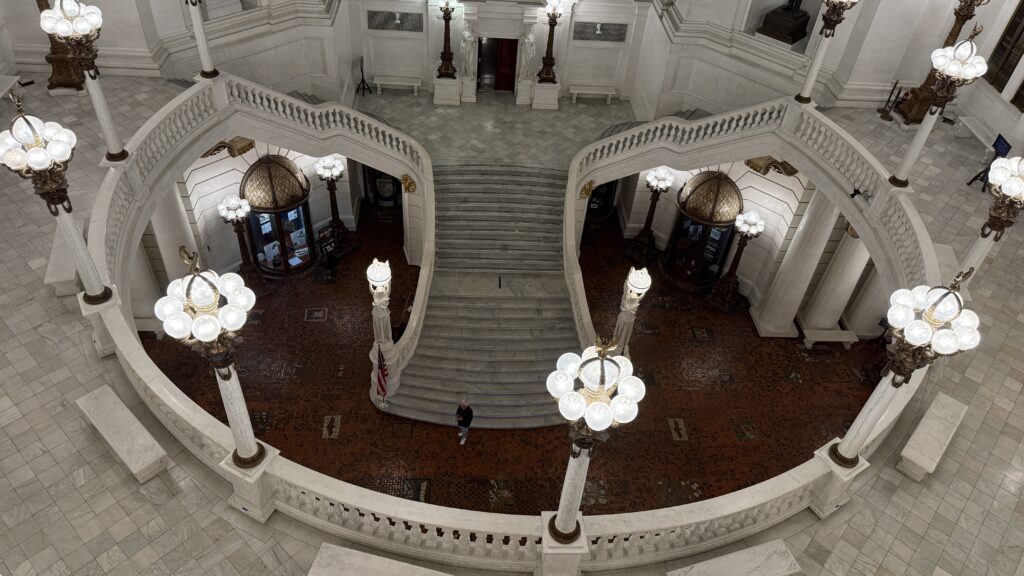
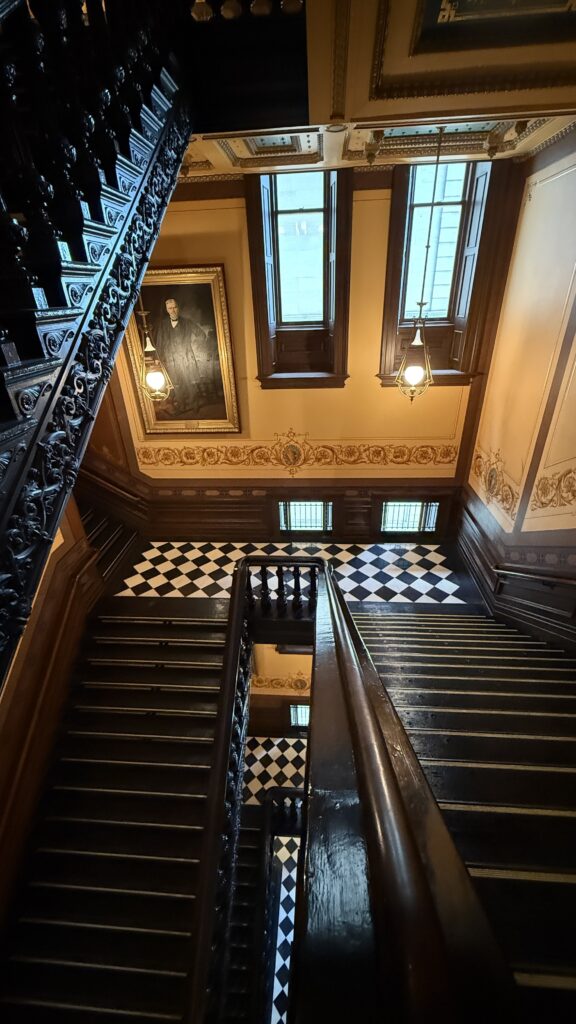
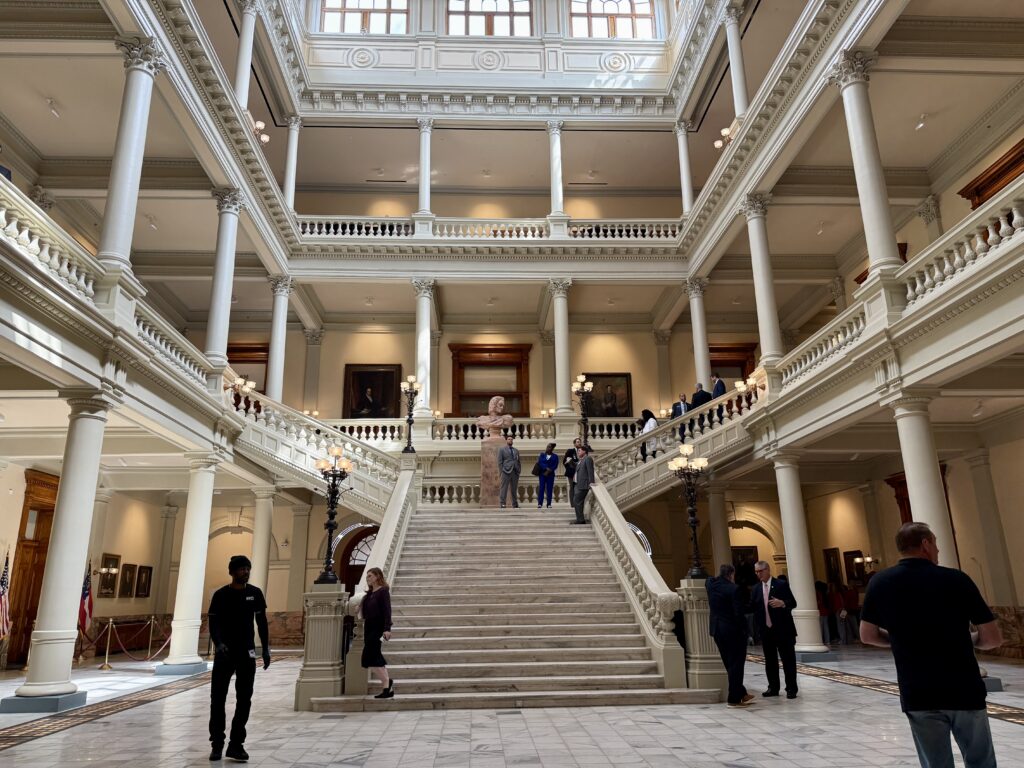
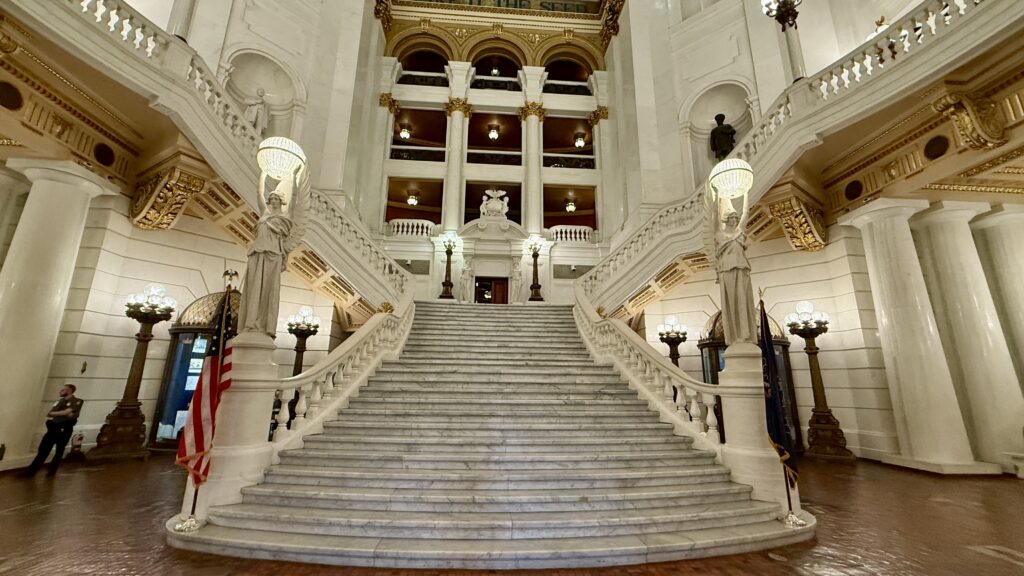
Architect Huston borrowed the Capitol Rotunda’s features from the Paris Opera House, including the Grand Staircase and three-tiered gallery. The Capitol Rotunda serves as a popular public forum, providing a magnificent and symbolic setting for many types of gathers, from rallies and bill-signings to news conferences. About 25 weddings per year are also performed here, with use of the building being absolutely free! (The bride and groom must provide chairs, tables and other essentials for the ceremony.) A former Miss Pennsylvania was married here!

The Senate Chamber

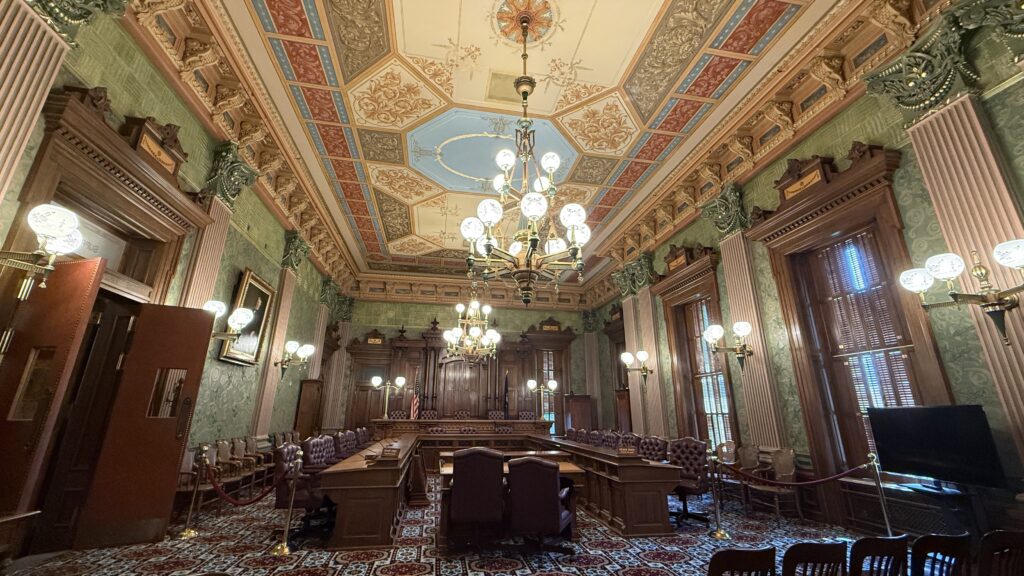
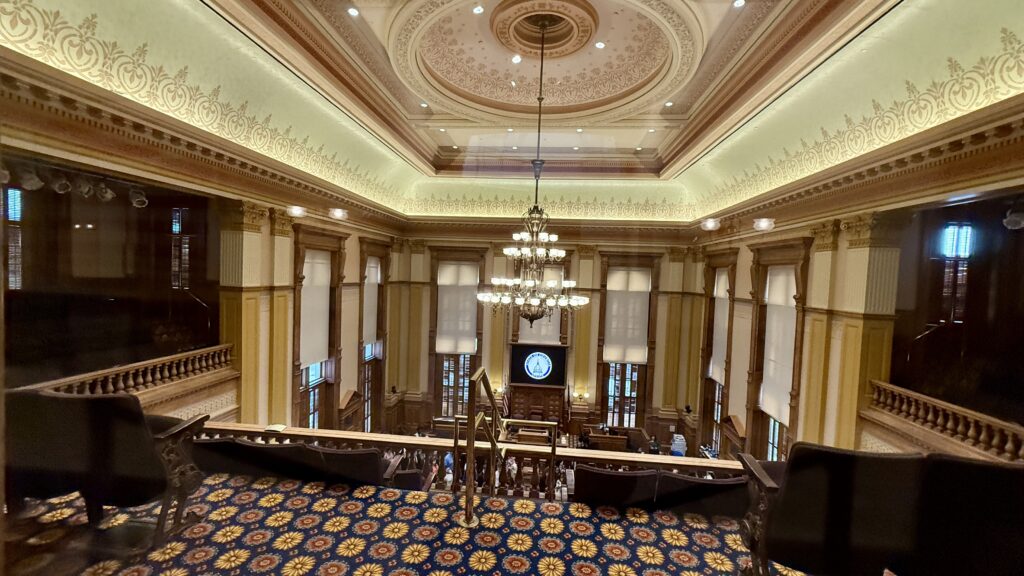
After you walk up the grand staircase, you will be on the second floor where the Senate Chamber is located on the north side of the Capitol. Pennsylvania has 50 state Senators who serve a four-year term (no limits), representing approximately 246,000 people each. Pennsylvania’s Lieutenant Governor services as the President, where they vote on legislation and resolution. Each Senator is assigned a desk, and they vote on amendments and bills the old-fashioned way with a verbal “aye” or “nay,” rather than using electronic tally boards as seen in the House of Representatives and other Senate Chambers.

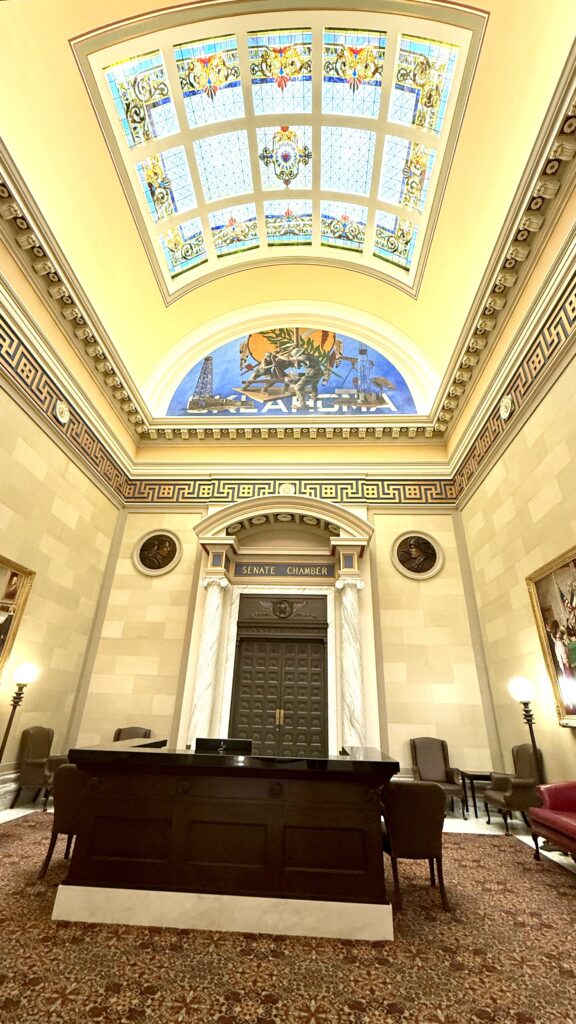
The Senate chamber is equally lavish, with its bronze chandeliers and plush red carpets. Pay special attention to the murals here; they depict Pennsylvania’s history, including William Penn’s treaty with the Native Americans. Adding to the grandeur, the desks in the chamber are made from mahogany imported from Belize, dating back to the 1906 opening of the Capitol. The green marble that lines the Chamber’s walls is rare Connemara, imported from Ireland. And the four massive, gold-finished iron and glass floor lamps weigh two tons each.
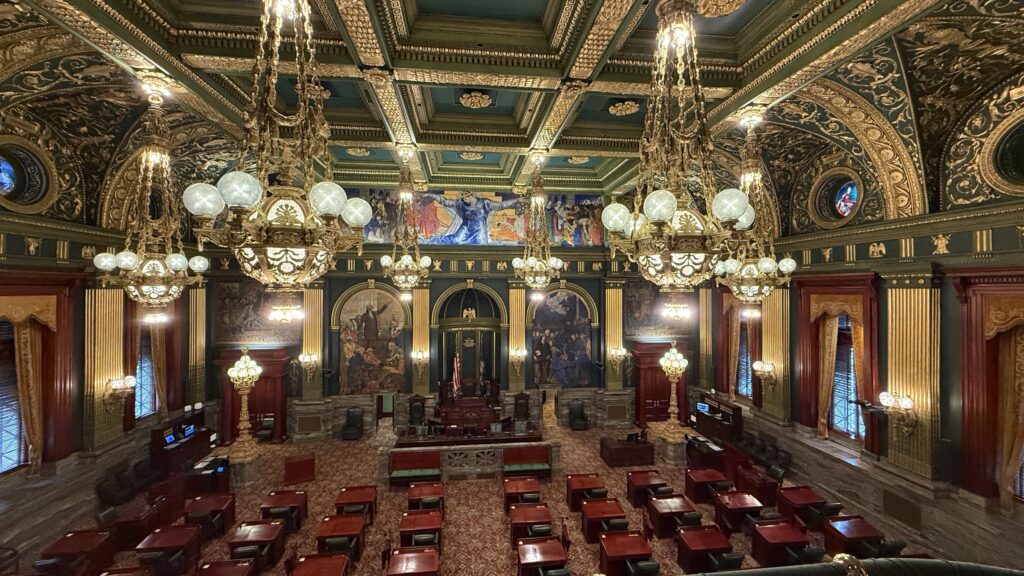
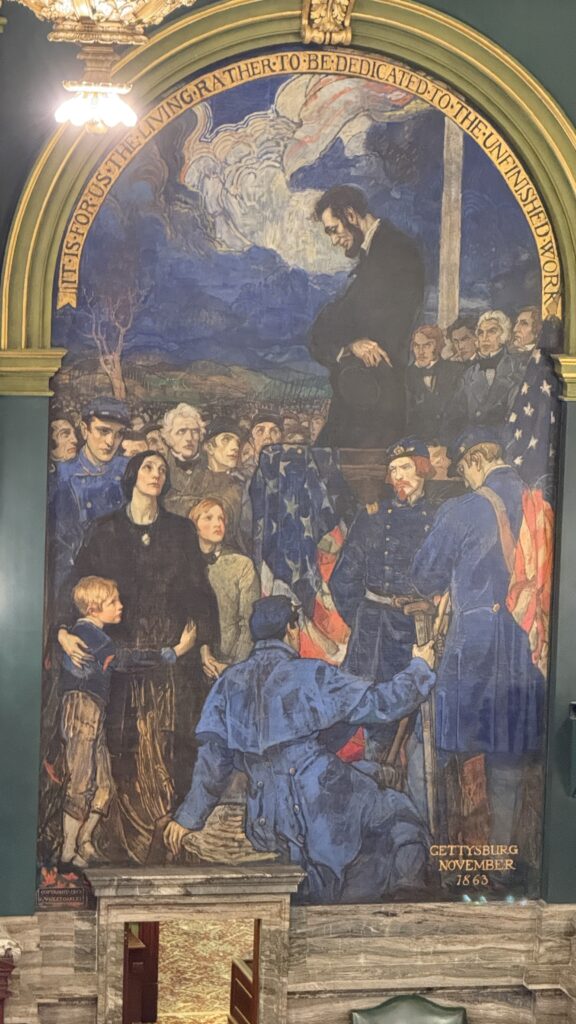
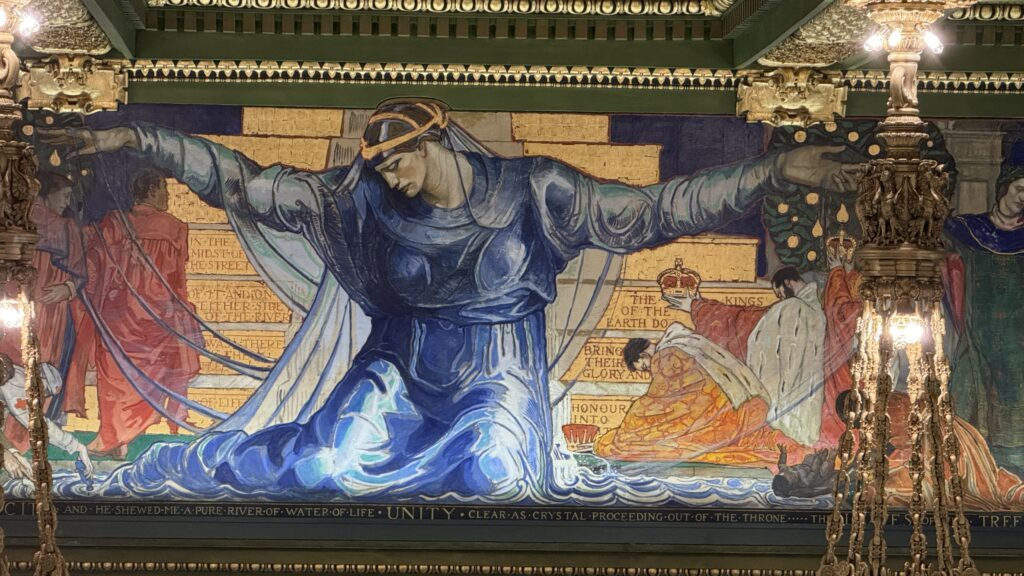
The restoration project in 1994 was able to maintain the original design by Architect Joseph Huston and painter Violet Oakley.
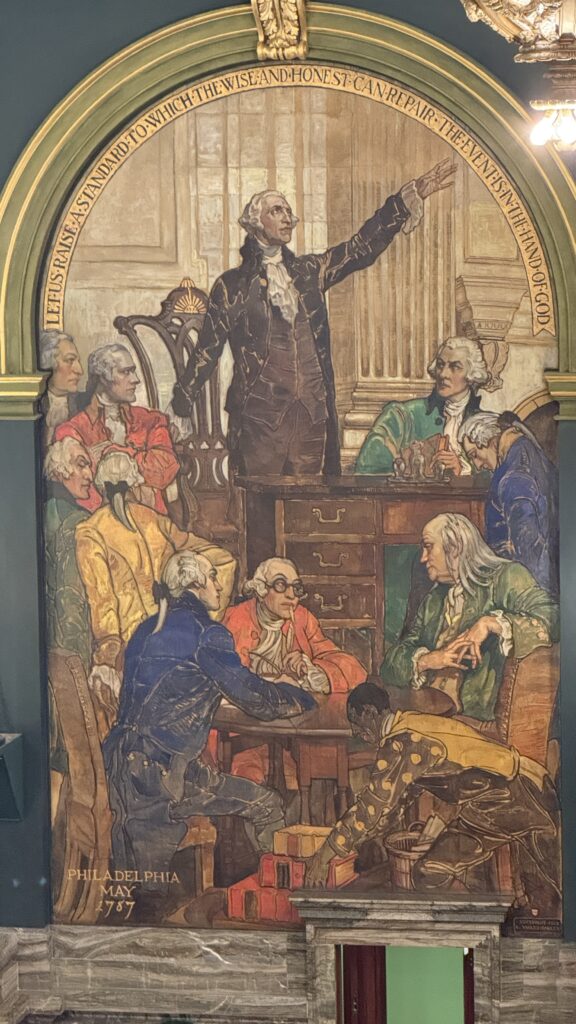
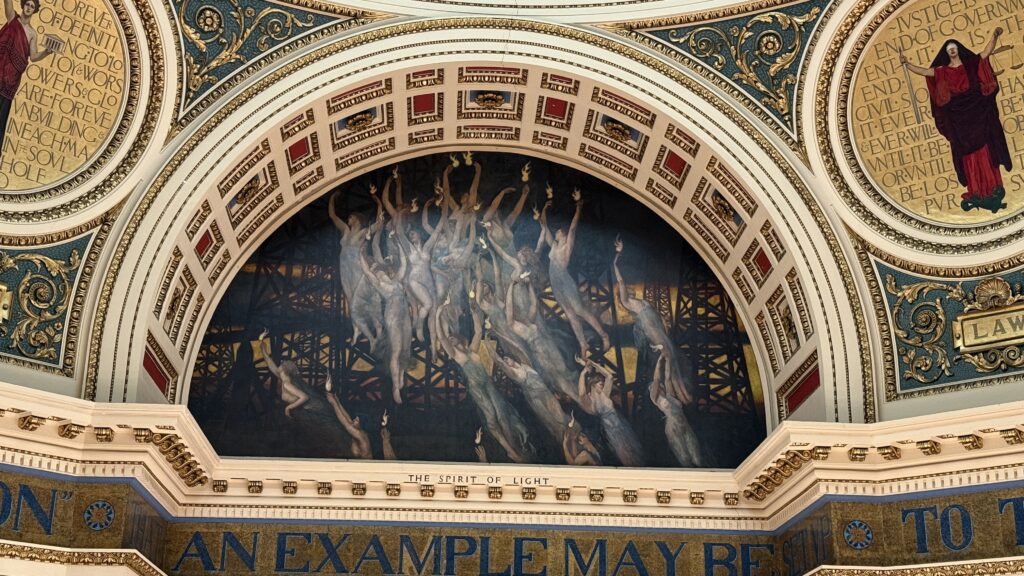
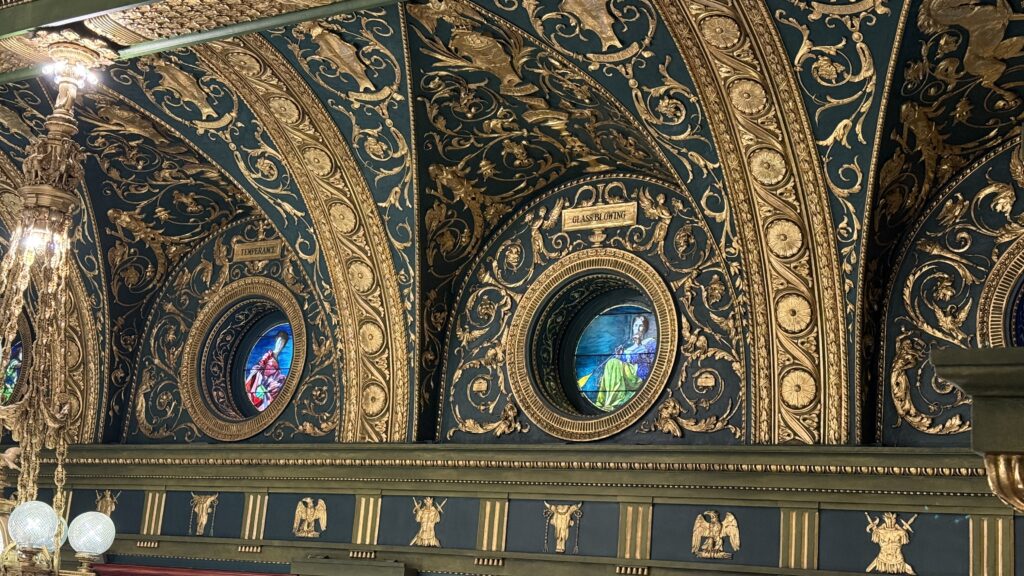
The 24 stained glass windows in the Senate (10) and House (14), are framed in 24-karat gold leave embellishments.

The House of Representatives Chamber

Walking into the House chamber, you’ll spot the dazzling stained-glass windows previously noted, and murals created by artist Edwin Austin Abbey. Here’s a fun fact: Abbey never actually saw the completed murals in person—he passed away before they were installed! His painting The Apotheosis of Pennsylvania on the wall directly behind the Speaker of the House is the largest mural in the Capitol, standing 35 feet square. It includes prominent legislators, explorers, pioneers and others standing at the feet of a figure representing the “Genius of State.” All 29 figures are listed in the full-color Pennsylvania Capitol tour guide (which you can obtain for free at the visitor’s desk), with a statement about their role.

The ceiling is a circular mural entitled The Hours, representing passage of time in the form of 24 maidens revolving in an endless circle around the moon, sun, and stars.
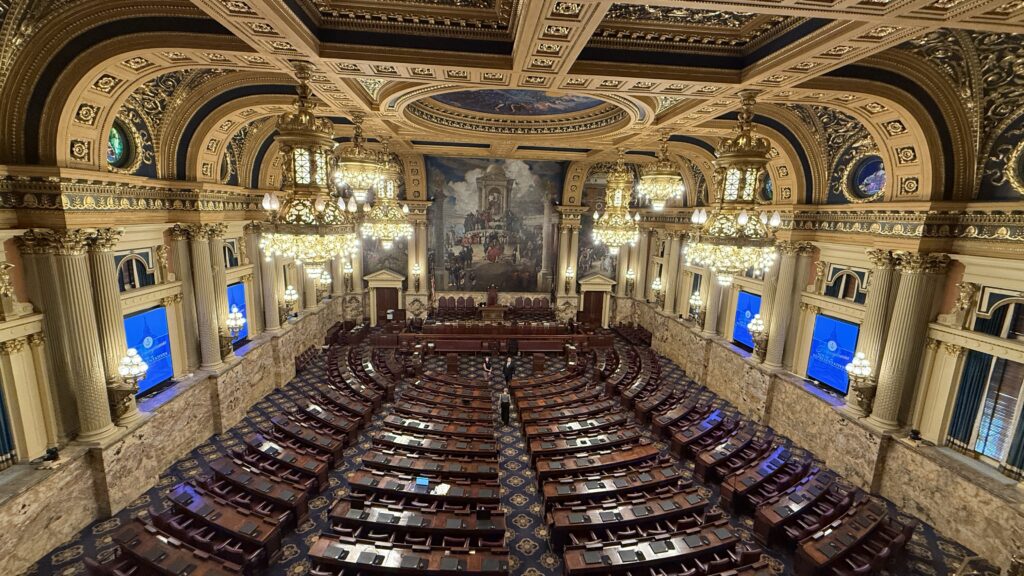
Some major players on the mural include William Penn, founder of Pennsylvania; Speaker of the Assembly Benjamin Franklin, who also signed the Declaration of Independence and Constitutions of PA and the USA; and Daniel Boone, legendary “Pathfinder” of the Cumberland Gap and noted outdoorsman.

The Supreme Court Chamber

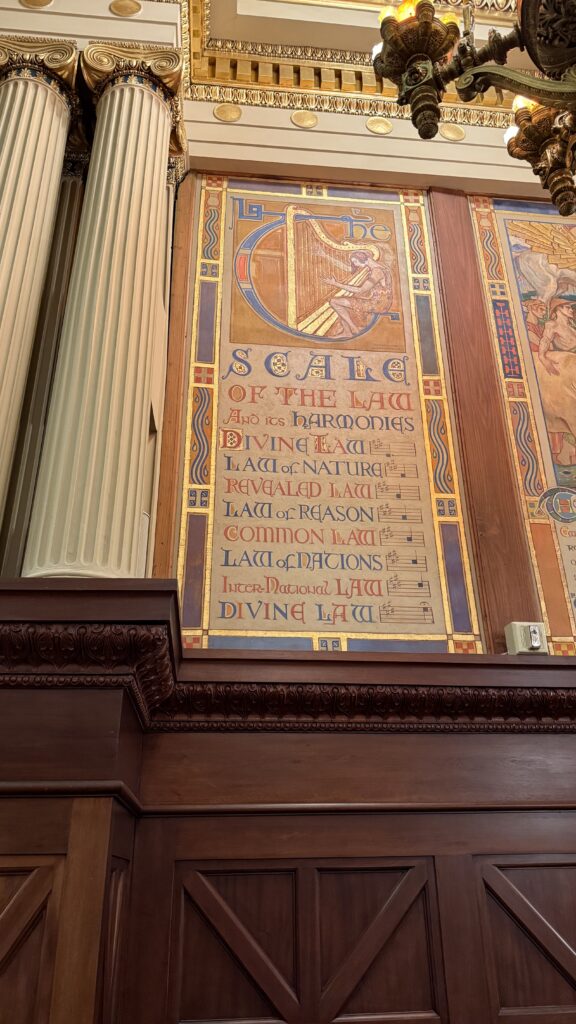
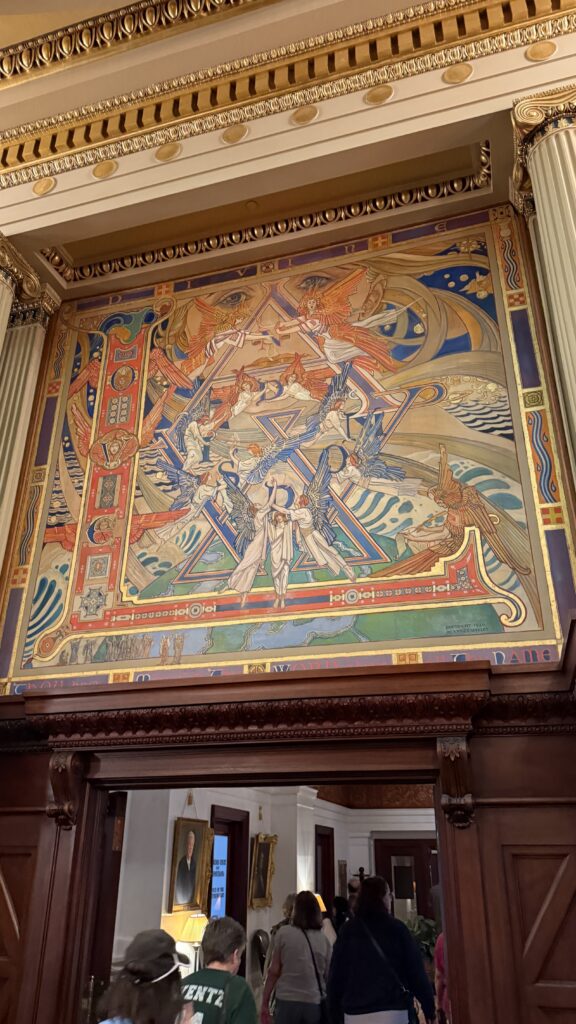
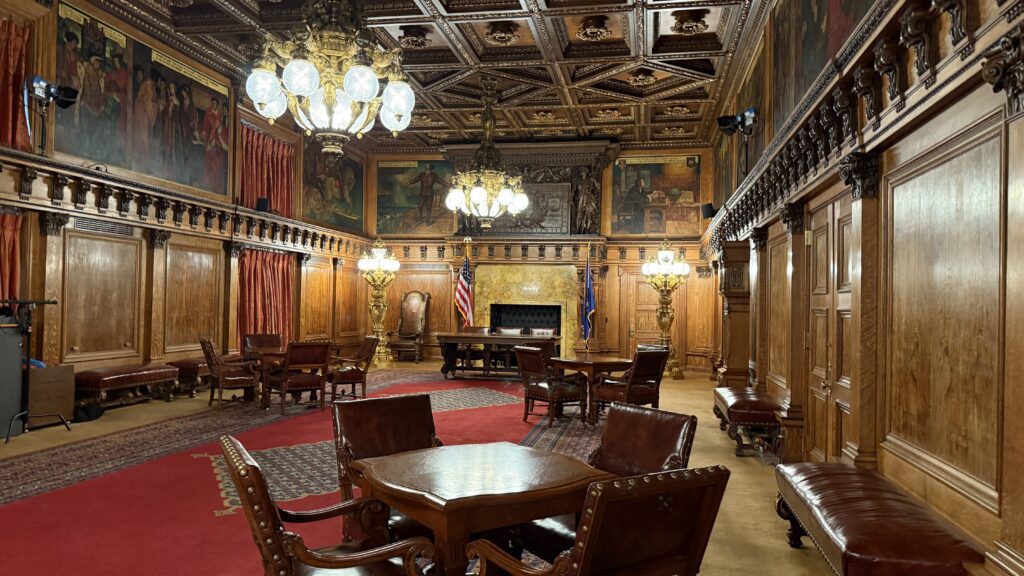
Did you know the Pennsylvania Supreme Court is the oldest appellate court in the United States? The chamber is designed to resemble a courtroom from the French Renaissance, complete with their own stain-glass dome (designed and executed by Pennsylvania native Alfred Godwin) and ornate mahogany woodwork, wainscoting and furnishings. The Chamber houses 16 intricate paintings by Violet Oakley, a grouping she called The Opening of the Book of Law. The painting, Divine Law – The Keynote hangs above the center door. Oakley used an intricate combination of images and letters spelling out the words Love, Law and Wisdom.
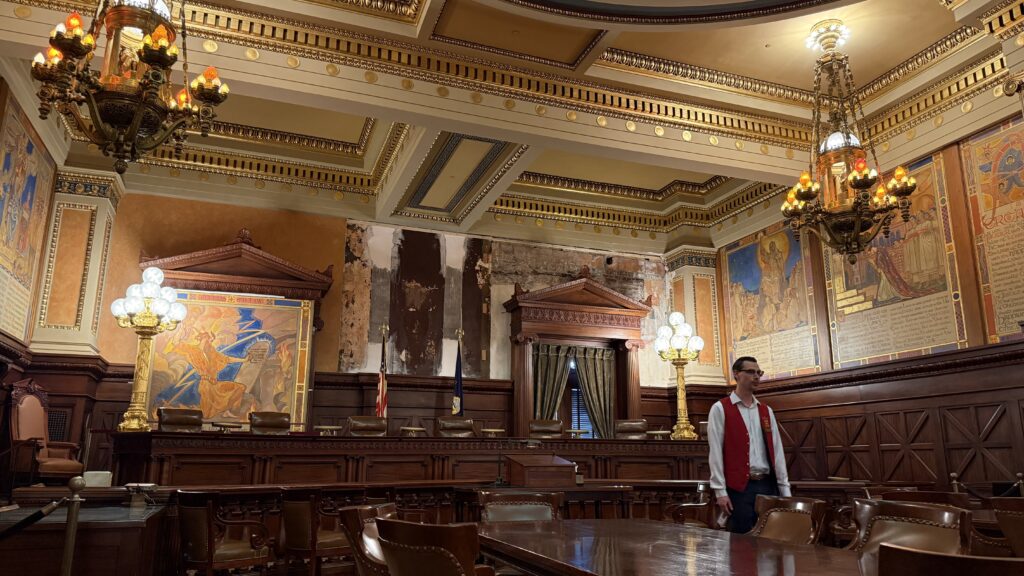
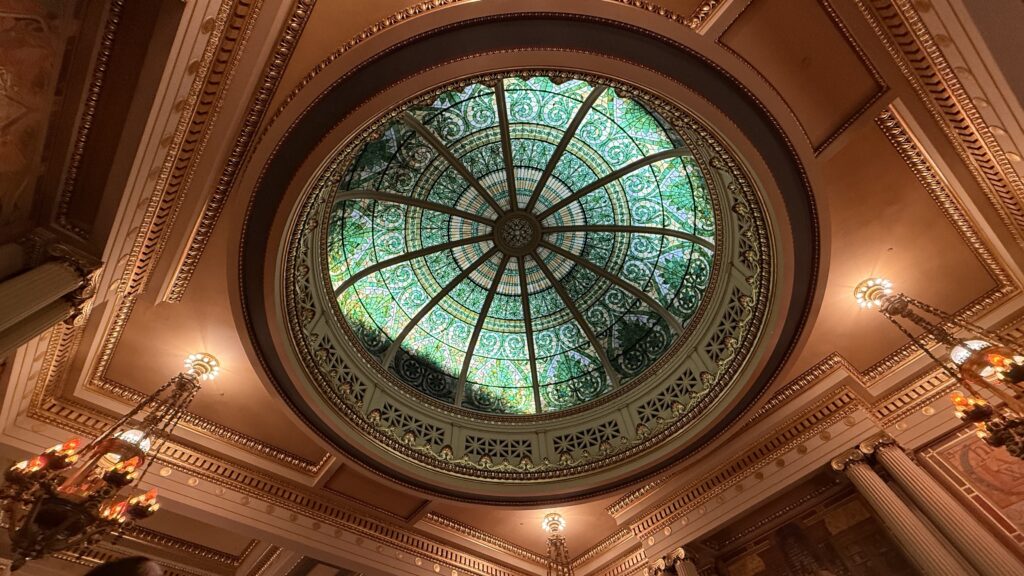
Our tour guide describes the painting, woodwork, and other interesting facts.
Supreme Court Dome with green stain-glassed windows reminiscent of the outer dome.
Governor’s Reception Room: It is open to the public. The grandfather clock on the right wall is over 100 years old.
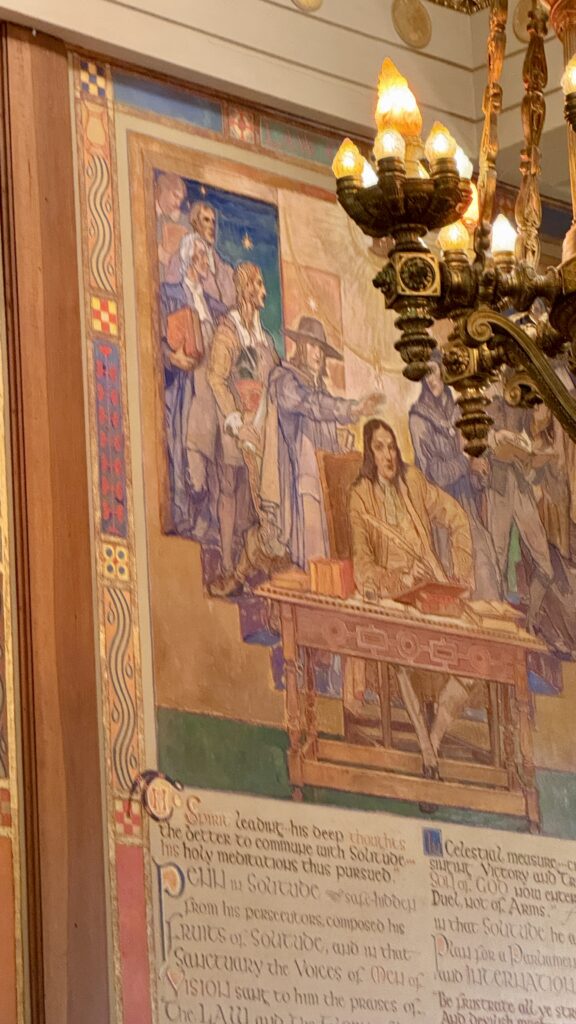
Governor’s Reception Room is used for news conferences, receptions and bill-signings. The paintings by Violet Oakley depict the history of religious liberty in England and the rise of the Quaker religion, as she was part of the Quaker community.

A Few More Unique Details and Fun Facts

  • Secret Tunnels: Beneath the Capitol complex, there is a network of underground tunnels connecting various government buildings, originally built for moving records and protecting officials during emergencies. These tunnels allow politicians and staff to move between buildings without braving Pennsylvania’s unpredictable weather.
  • Hidden Mouse: A whimsical secret hides in the ornate tile floor of the main rotunda—a tiny tile mouse! Placed there by the craftsmen as a playful signature, it’s a favorite scavenger hunt for visitors and school children.
  • Enormous Art Collection: The State Capitol features more than 400 murals, sculptures, and stained glass windows. Its interior is a museum-quality display of Pennsylvania history and artistry, making it one of the most decorated legislative buildings in the United States. The Capitol houses one of the largest collections of Pennsylvania Impressionist art in the country.
  • Guided Tours: One of the few state capitols that holds tours during the week as well as weekends and most holidays. For more information, visit their website here.
  • Talented Artists:
    • 1) The stained-glass works were created by William B. Van Ingen, a former student of the famous glass artist Louis C. Tiffany.
    • 2) In 1908–09, Edwin Austin Abbey began an ambitious program of murals and other artworks for the newly completed Pennsylvania State Capitol. These included allegorical medallion murals for the dome of the Rotunda, four large lunette murals beneath the dome, and multiple works for the House and Senate Chambers. For the Senate chamber he finished only one painting, Von Steuben Training the American Soldiers at Valley Forge, after which he was diagnosed with cancer and subsequently died in 1911.
    • 3) Violet Oakley (the first American woman to receive a public mural commission) was originally commissioned in 1902 only for the murals in the Governor’s Grand Reception Room, which she titled The Founding of the State of Liberty Spiritual. In the reception room murals, Oakley depicts the story of William Penn and the founding of Pennsylvania. She conducted extensive research on the subject, even traveling to England! After Edwin Abbey’ death, Oakley was offered the job of creating the remaining murals for the Senate and Supreme Court Chambers. She agreed as long as she could paint in her own style. It was a 16-year project. She painted a series of 43 total murals for the Governors Grand Reception Room, the Senate and the Supreme Court.
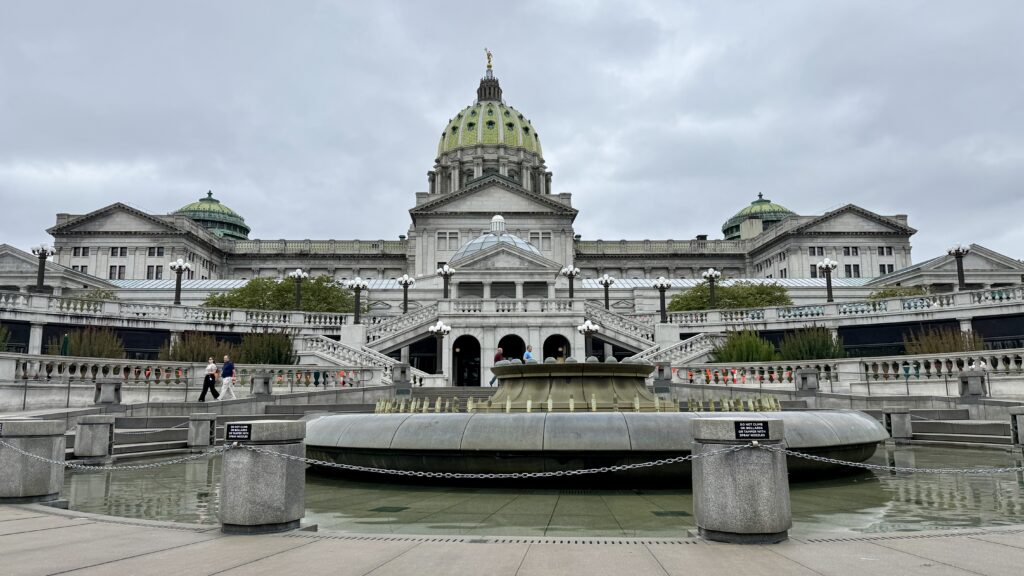
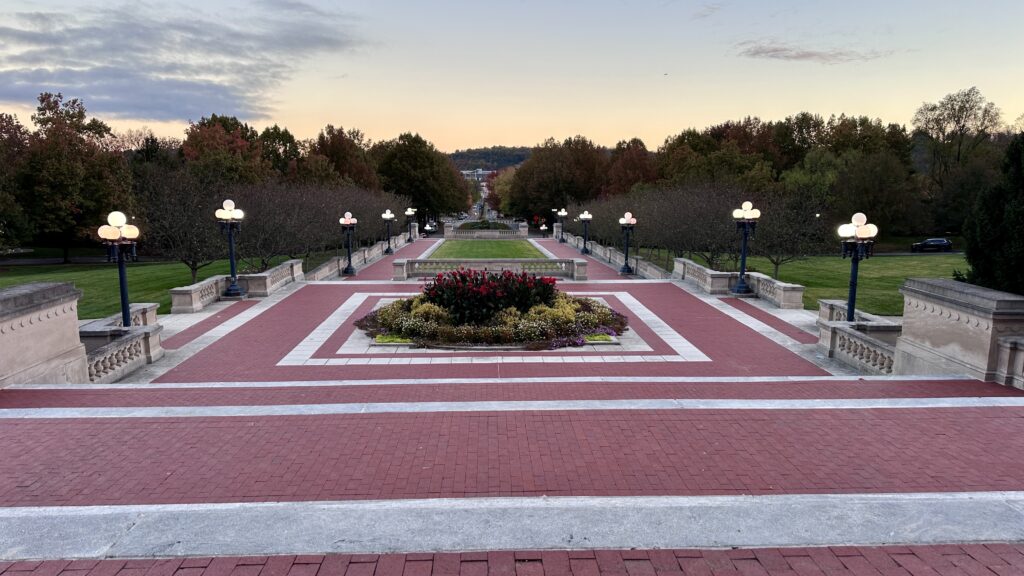
The back side of the building is just as beautiful with its series of staircases leading up from a courtyard fountain.

Wrap-Up

The Pennsylvania State Capitol isn’t just a building—it’s a living museum, a testament to craftsmanship, history, and the Pennsylvania jewel. Whether you’re marveling at the marble, tracing the murals, or standing beneath the magnificent dome, there’s always a new story to discover.

Thanks for joining me on this tour! I hope you enjoyed these fun facts and feel inspired to visit in person for an even deeper dive into the heart of Pennsylvania.


À la prochaine…hasta la próxima vez…until next time!


“I am the Lord, who heals you.” ~Exodus 15:26

My relationship with Jesus Christ motivates me to keep blogging. Though I have metastatic breast cancer*, my faith helps me survive, thrive, and feel alive while staying active. Without Him, I couldn’t achieve anything. With His help, well, my accomplishments speak for themselves on my blog. If you’re interested in learning about building a relationship with Jesus, feel free to comment below. I will never sell or share your email.

*Metastatic breast cancer is Stage IV cancer. Metastatic, or metastasis, means the cancer has spread beyond the original location (breast and immediate lymph nodes). In 2016 the doctors found significant metastasis to my bones, skull, liver, and lungs; then in 2018 to the brain. However, with chemo, immunotherapy, gamma knife, and of course my faith in the Lord, it is all undetectable at this point. I continue in treatment every three weeks via infusions, and receive multiple scans on a regular basis. If you or someone you know has metastatic breast cancer, I recommend these organizations for additional support: 
Metavivor and Unite for Her (also for ovarian cancer)

*Many thanks to the Pennsylvania Capitol Preservation Committee for providing the historical information in their State Capitol Tour Guide, as well as good ol’ Wikipedia.
State Capitol 23: Michigan

the metastatic breast cancer journey banner

July 31, 2025. Lansing Michigan.

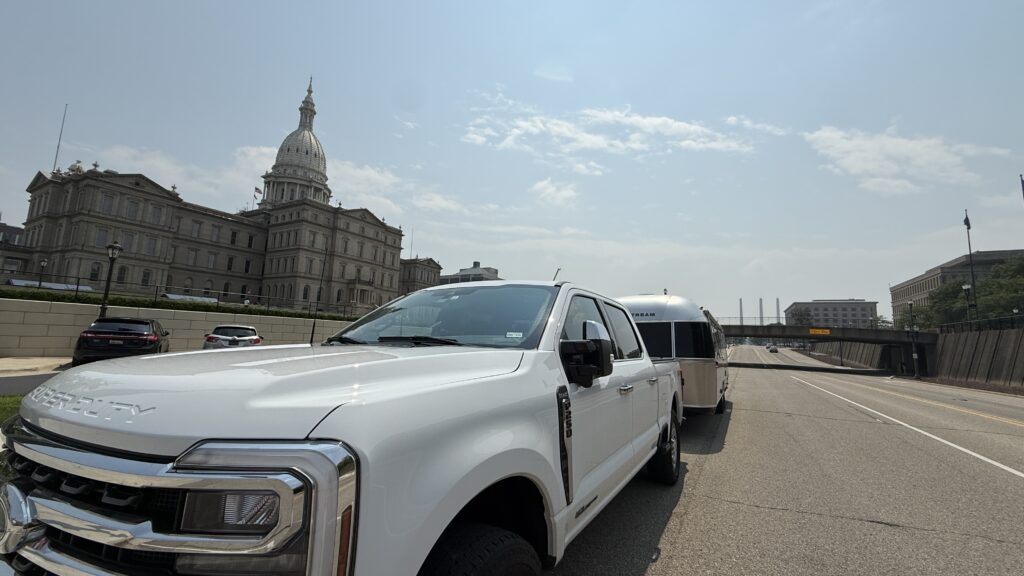
This is not your typical capitol tour. We were unable to connect with a guided tour (timing was off and we were pulling the Airstream), so Tim served as our tour guide. Again. 😂

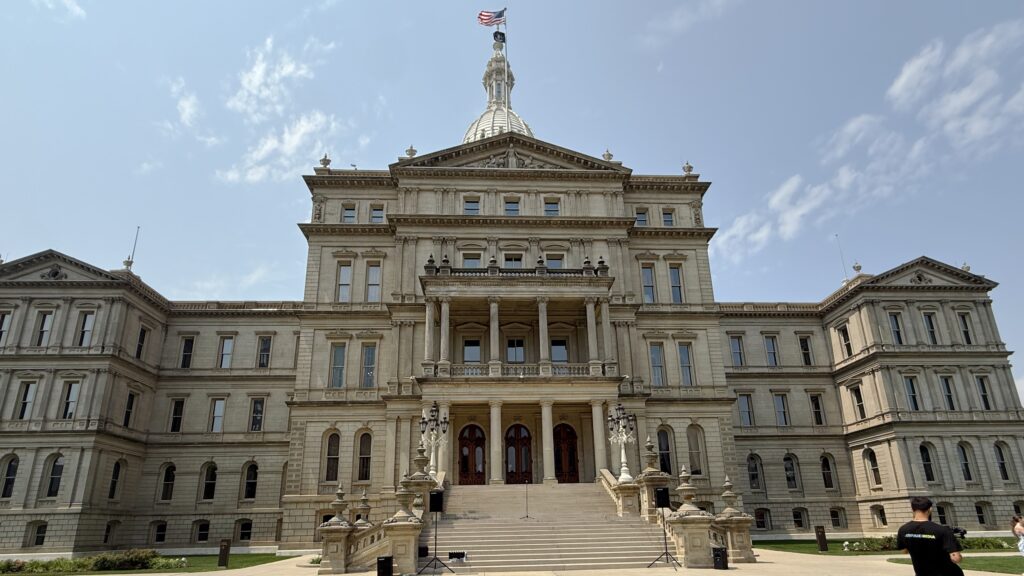
This building does have some interesting history, as well as beauty. Listen to the videos as Tim shares some of the highlights from the Full Color Michigan State Capitol Tour Guide.

Driving by, looking for a place to park.
On our way from Grand Rapids to Detroit.

For the History Buffs

The Michigan State Capitol recently opened its new welcome center, Heritage Hall. The facility serves as a multi-purpose space featuring an Atrium for luncheons and ceremonies, a Stateroom for meetings and events, and an Exhibit Ramp with museum displays for visitors and tour groups. Included in the exhibit cases are over 200 artifacts, documents, and photographs that show the chronological history of Michigan’s Capitol.

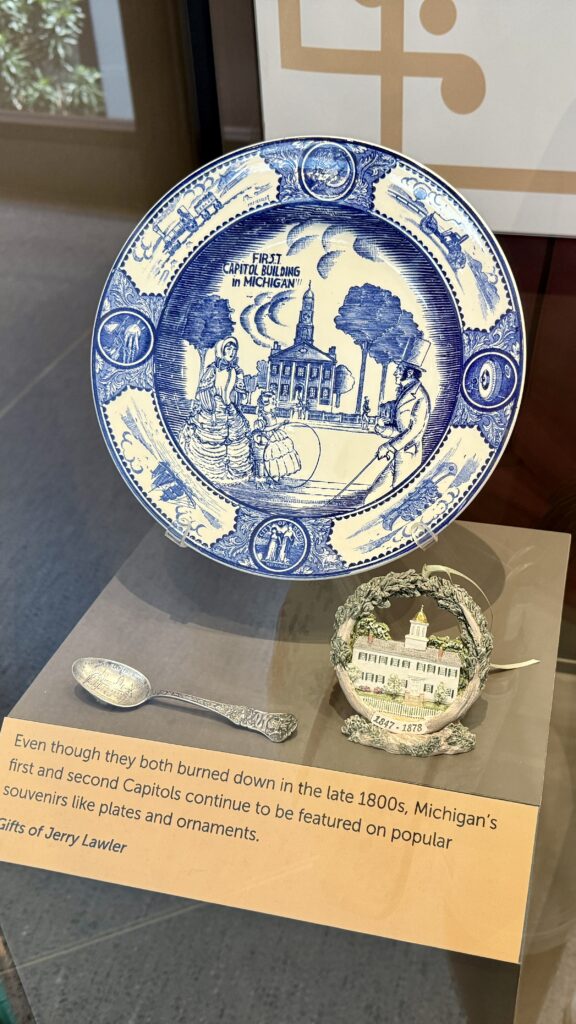
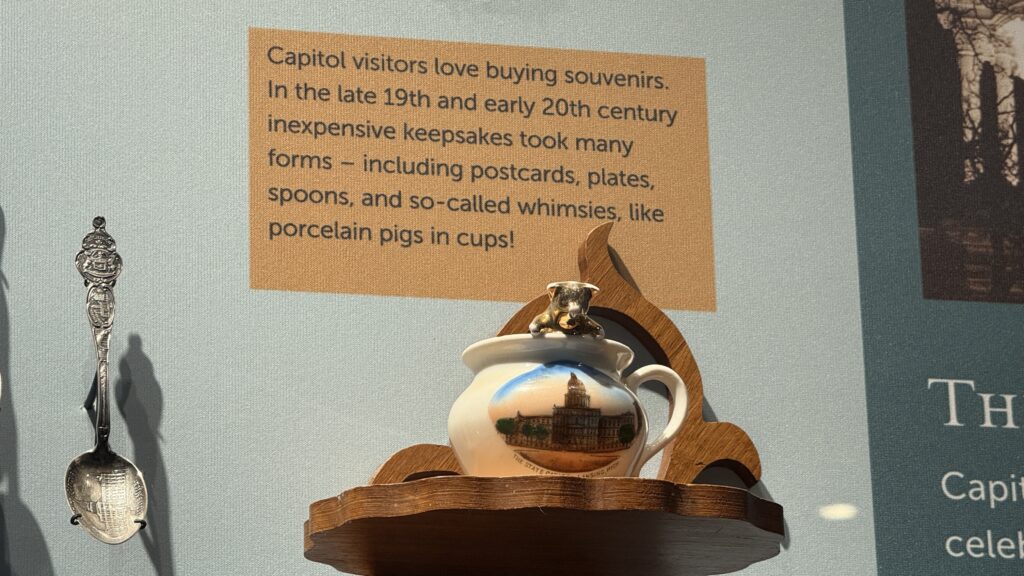
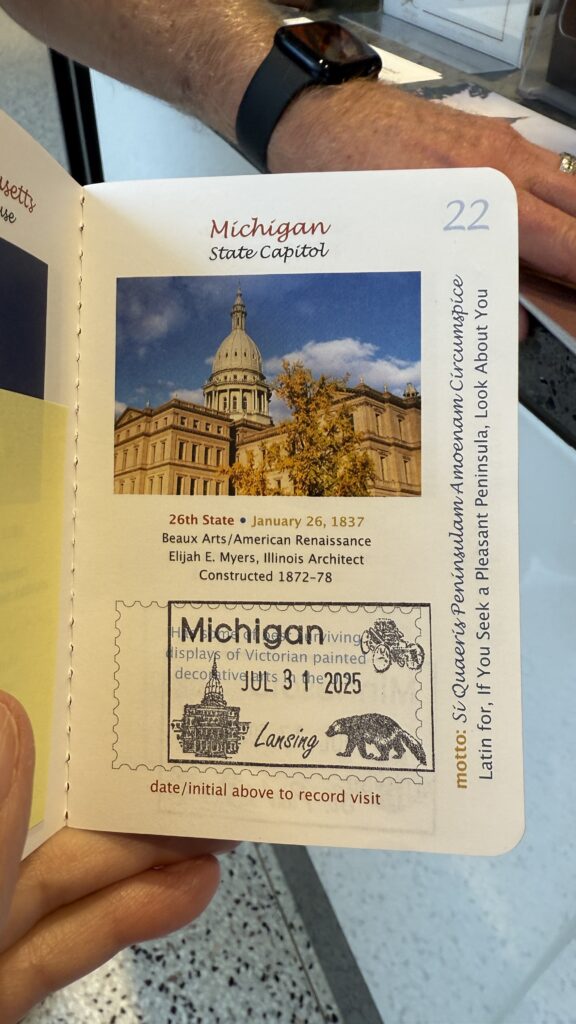
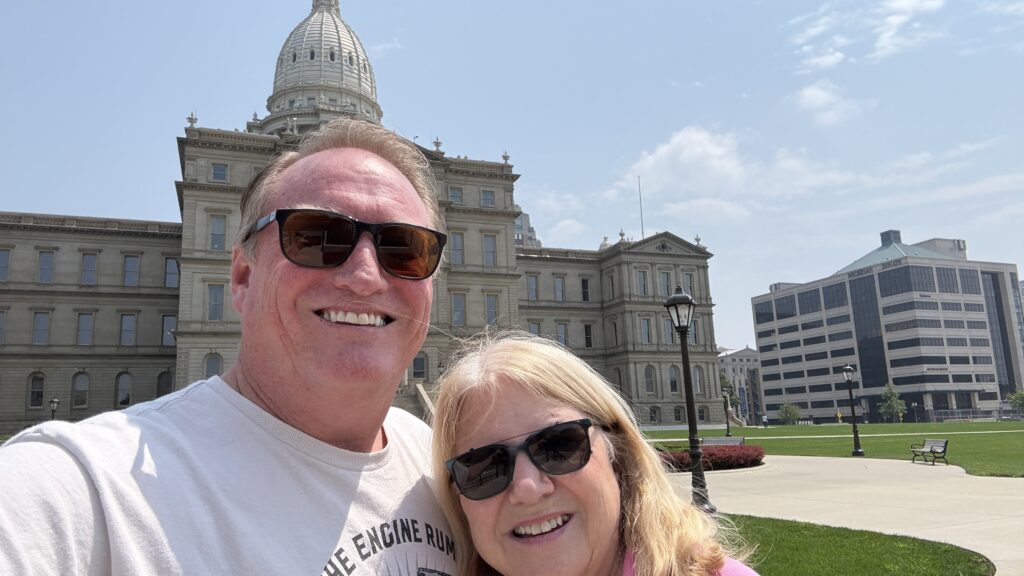
This is the third capitol building since Michigan declared herself a state in 1835 and was subsequently admitted to the Union as the 26th state in 1837. The first two Capitol buildings were destroyed by fire, but they are still displayed on souvenir plates and ornaments.

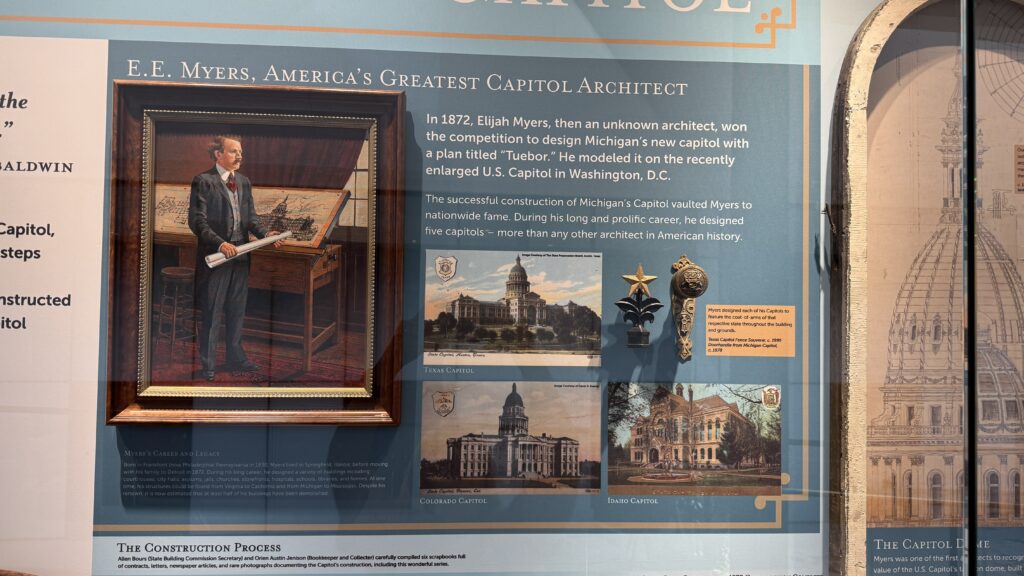
The current Capitol was designed in Beaux Arts/American Renaissance style by Eljah E. Myers, Illinois Architect, constructed 1872-78. He was relatively unknown at the time, but won the bid with his plan titled “Tuebor,” meaning “I will defend.” This would be his first capitol, but certainly not his last. The successful construction of Michigan’s Capitol vaulted Myers to nationwide fame. During his long and prolific career, he designed five capitols – more than any other architect in American history. He modeled this structure on the recently enlarged U.S. Capitol in Washington, D.C. The final cost of the Capitol totaled $1,427,738.78, which was about $200,000 over budget but a modest cost for capitols of that day. (According to one inflation calculator, $1,427,739 of 1878 dollars would be worth: $57,109,551.20 in 2025.)

Although the millions of bricks that make up its walls and ceilings were locally made in Lansing, the stone facade came from Ohio, the cast iron for the dome and floor beams from Pennsylvania, and the marble and limestone floors from Vermont. 

Tim tells us about the walls.
And he shares some interesting facts about the chandeliers.

How the Government Works

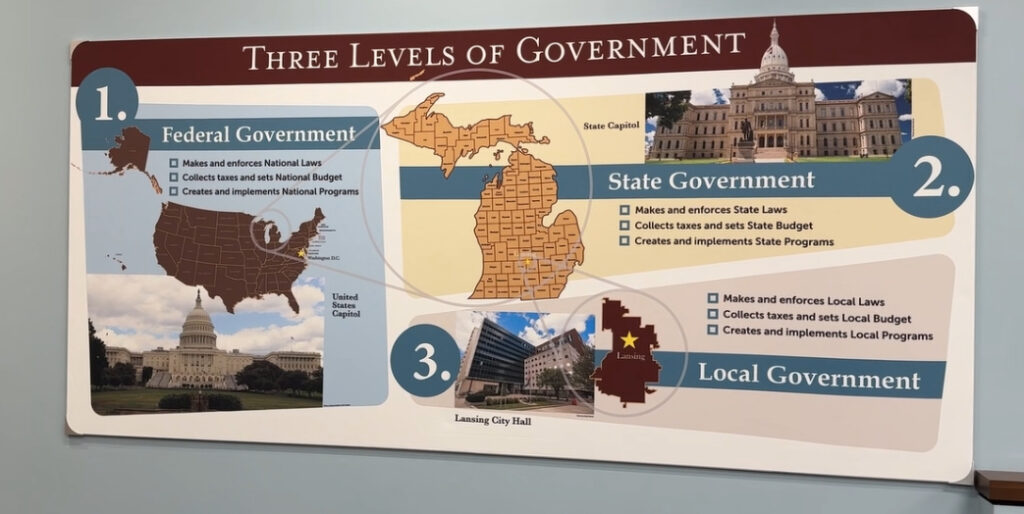
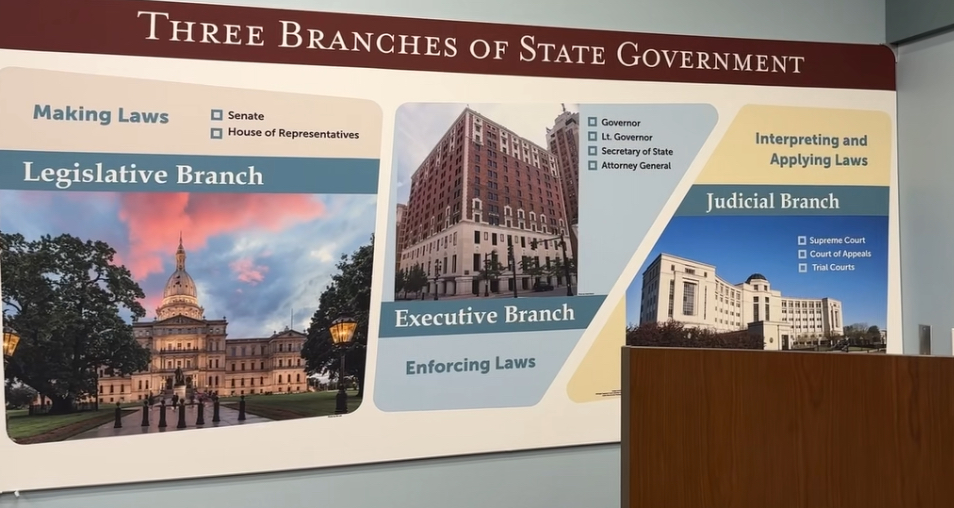
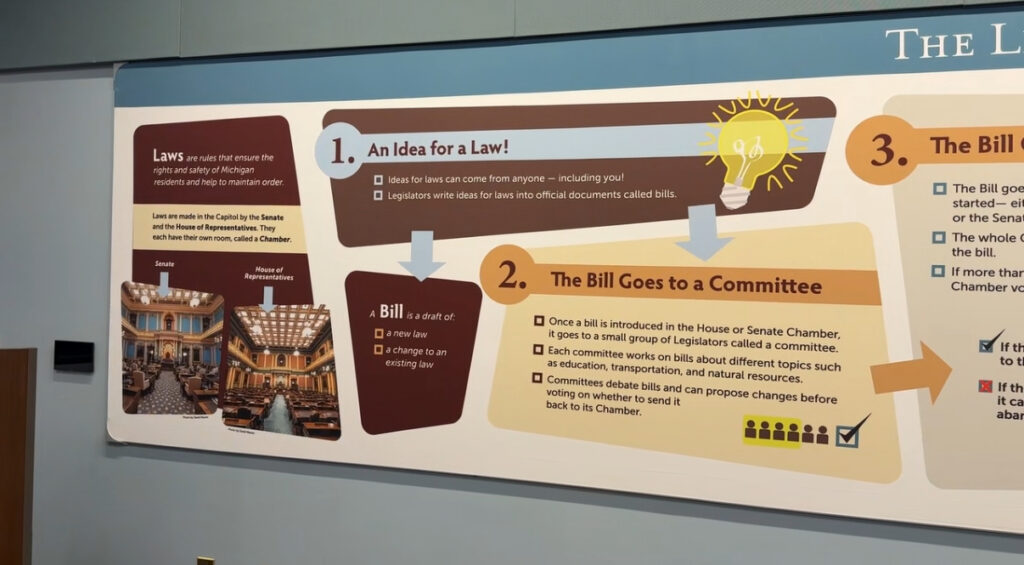
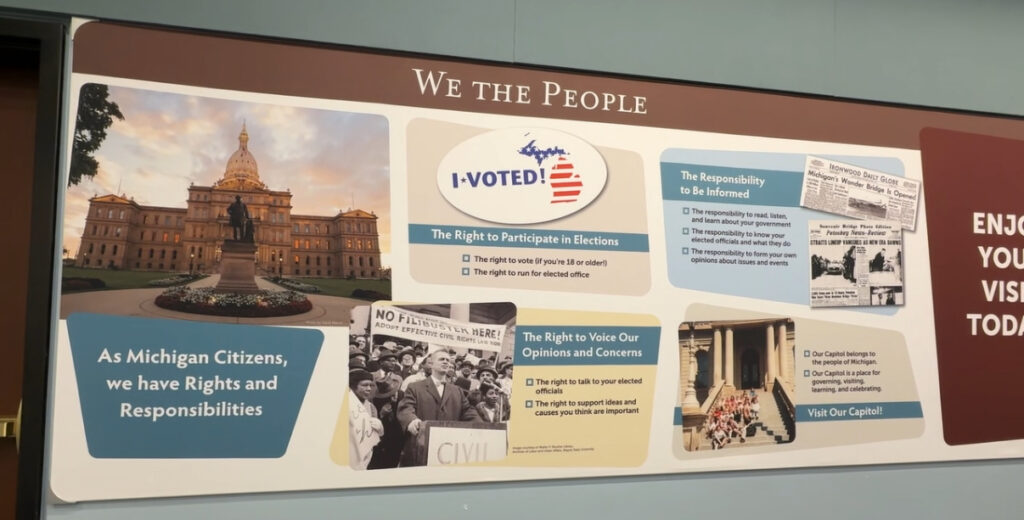
Michigan has an entire room set up to educate its citizens on civics, including the Levels of Government, Branches of State Government, and Legislative process. (I should have paid better attention in high school.) This is probably the best visual I have seen describing our governmental functions. Not all states do it exactly the same way (e.g. some have fewer Senators or more Representatives; Nebraska is unicameral), but this is an excellent visual to best understand the overall process. So often people get confused about why our states do not intervene in some matters, or why the federal government doesn’t touch others, etc. Maybe this visual can help someone who reads this blog.

Three Levels of Government.
Three Branches of State Government.
The Legislative Process.
The Legislative Process continued.
Executive Branch.
Don’t forget to vote!

Preserving the Colors

The following information was found on the plaque in front of a worker who was preserving a flag behind a glass enclosure. It’s a tedious process!

“Battle flags played an important role in Civil War combat, serving as a rallying point amid the confusion of battle. Soldiers performed incredible acts of bravery to protect their tattered, bullet-ridden flags.

“During the Civil War Centennial (1961-1965), the State of Michigan had the flags stabilized by stitching them between layers of polyester netting on a sewing machine. While state of the art at the time, this method put thousands of tiny holes in the flags and the abrasive net is beginning to damage the original fibers.

“To preserve the flags for future generations, this netting must be removed by cutting each individual zig-zag stitch. Next, the flag can be gently vacuumed to remove dust and other loose particles. Finally, the flag can be conserved with more modern techniques.”

On to the Tour

The tour starts here (after Heritage Hall).
NOT the Rotunda. It’s actually the floor below the Rotunda. You can see people walking on the glass floor above. In the next video Tim describes the Block Glass and Dome.
THIS is the Rotunda. Also notice the Hall of Flags that surround the Rotunda.

THE CHAMBERS

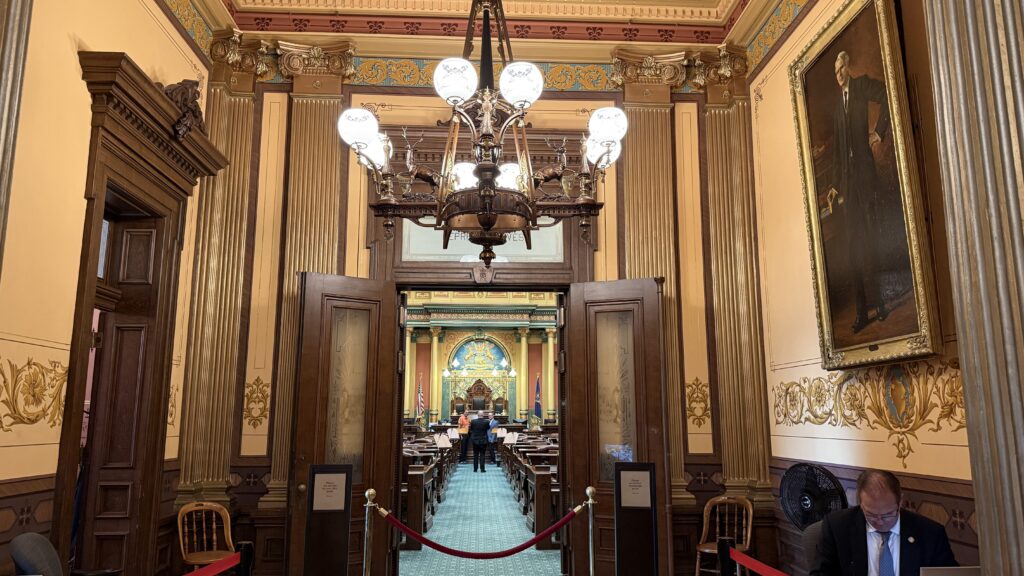
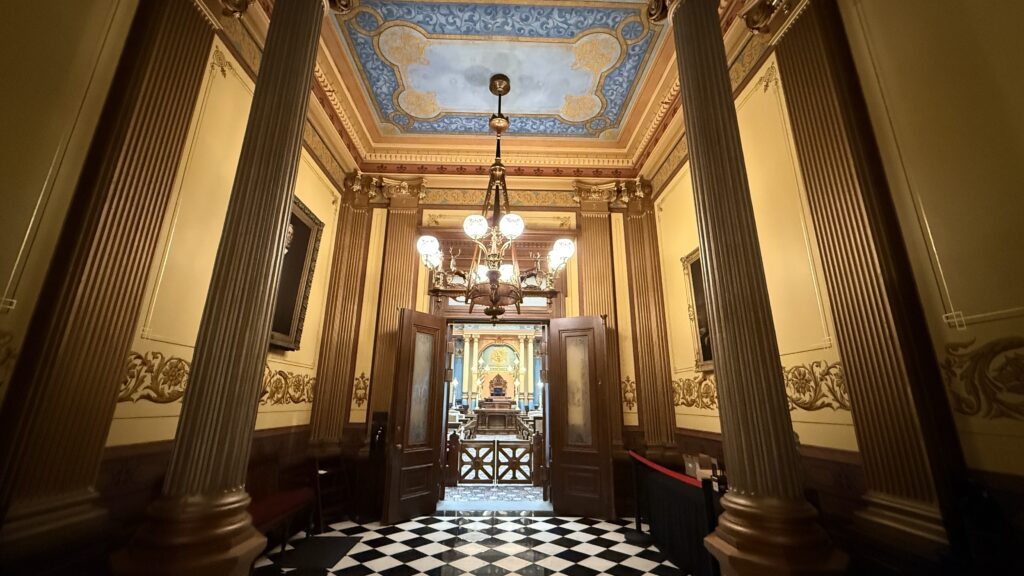
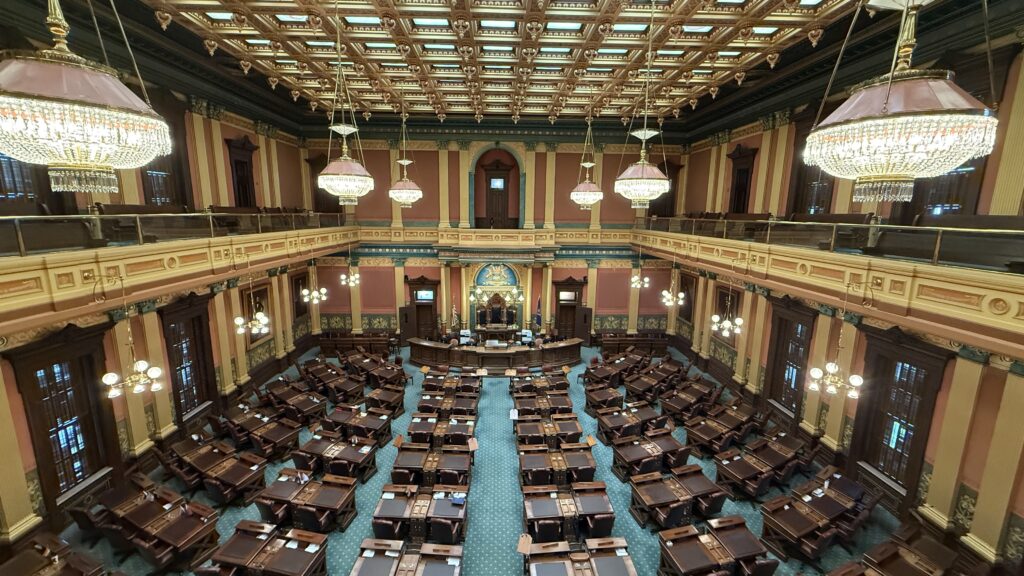
Now that you know how the legislative process works, no tour would be complete without a peak inside the chambers. Legislatures were in the rooms when we went through Lansing, so we were not permitted to go inside the House on the main floor. However, if you go up one floor and step into the Gallery, you can get a bird’s eye view of the entire room.

The Michigan State Capitol has a foyer leading to each Chamber, designed to compliment one another. We haven’t seen this type of entry in other State Houses thus far.

House of Representatives.
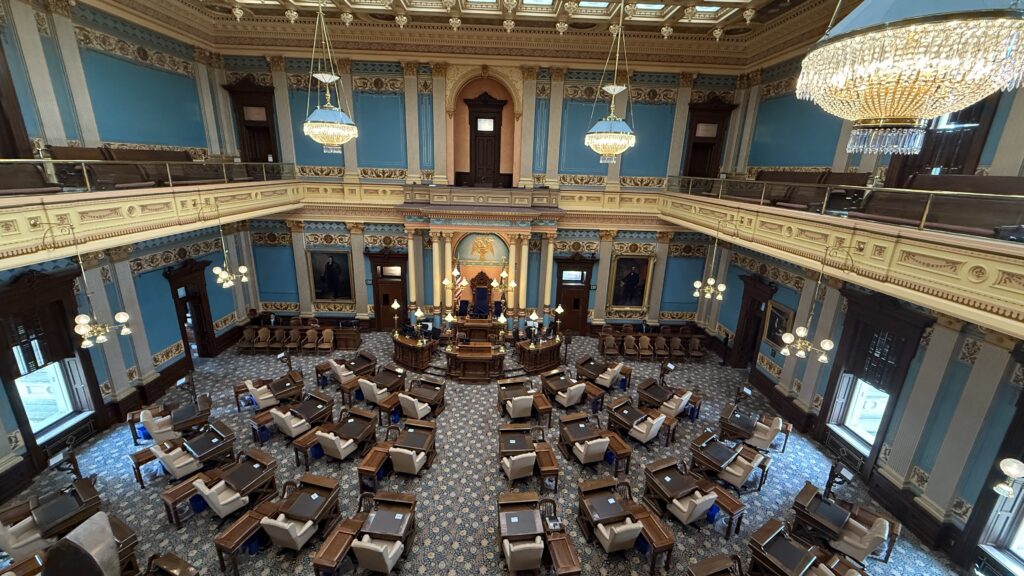
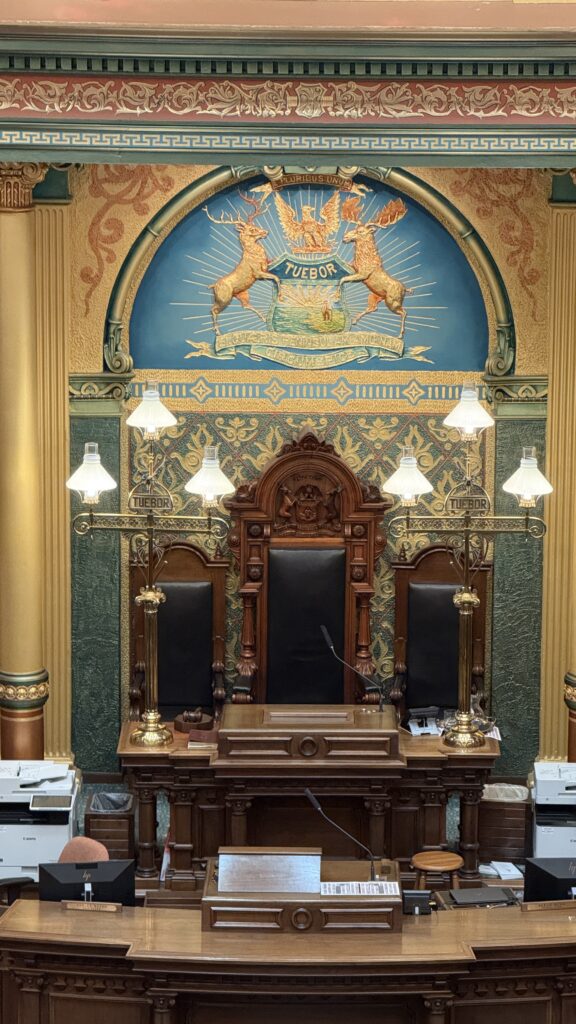
Senate Chambers.

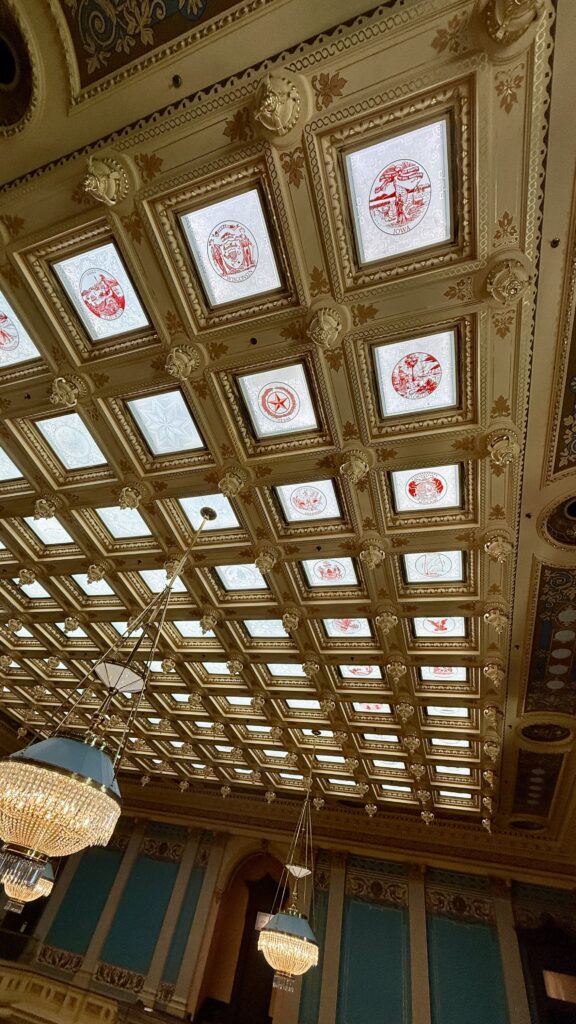
Senate Chamber ceiling contains ninety pieces of glass to make up the skylights overhead. The skylights were originally installed to bring more natural light into the room. The original tiles started creating safety concerns and the mid-20th century era had also come to an end. Builders took out the hand-etched glass tiles and (unfortunately) threw them in a dumpster. During restoration (years later) they were able to bring the ceilings back to its original design, but instead of including 38 states as were present when Michigan entered the Union, all 50 states seals were included.

Old Supreme Court Chamber, currently serving as the Senate Appropriations Committee Room.

A FEW FUN FACTS

  • Although it has been Michigan’s capital since 1847 (it was in Detroit before that), Lansing was not actually incorporated as a city until 1859.
  • Some of the best surviving displays of Victorian painted decorative arts in the U.S. are found here.
  • The Capitol has led the state in technological advancement, from the lighting of the dome in 1905 to show off the power of the new electric light bulb, to installation of the nation’s largest state capitol geothermal system in 2019.
  • The glass and crystal chandeliers in the Senate Chambers are the original ones installed in 1878. They were converted from gas to electric, and now have 42 lightbulbs each, which have to be changed by dropping the chandeliers 40 feet to the floor and disassembling the unites.

SO-LONG LANSING

Hopefully you enjoyed this tour of Michigan State Capitol and learned a few things about our government as well. On the way out of town, I asked Tim to tell his what he thought of this Capitol, and here was his reply. He later said he liked the walls, and the design of the building as part of his reasoning for ranking it so high. What did you think?


À la prochaine…hasta la próxima vez…until next time!


“I am the Lord, who heals you.” ~Exodus 15:26

My relationship with Jesus Christ motivates me to keep blogging. Though I have metastatic breast cancer*, my faith helps me survive, thrive, and feel alive while staying active. Without Him, I couldn’t achieve anything. With His help, well, my accomplishments speak for themselves on my blog. If you’re interested in learning about building a relationship with Jesus, feel free to comment below. I will never sell or share your email.

*Metastatic breast cancer is Stage IV cancer. Metastatic, or metastasis, means the cancer has spread beyond the original location (breast and immediate lymph nodes). In 2016 the doctors found significant metastasis to my bones, skull, liver, and lungs; then in 2018 to the brain. However, with chemo, immunotherapy, gamma knife, and of course my faith in the Lord, it is all undetectable at this point. I continue in treatment every three weeks via infusions, and receive multiple scans on a regular basis. If you or someone you know has metastatic breast cancer, I recommend these organizations for additional support: 
Metavivor and Unite for Her (also for ovarian cancer)

State Capitol 22: South Dakota

the metastatic breast cancer journey banner

June 23, 2025. Pierre, South Dakota.

While the city was named after a colonial Frenchman who built Fort Pierre across the Missouri River, and it is spelled the French way, the city is pronounced “PEER.” The city itself is worth a visit, as the Missouri River flows through and around the area making for some beautiful scenery. It may not have some of the amenities of a large city, but our campground was in a beautiful location and there are a lot of parks and walkways along the river (picture at the end). The population of Pierre is less than 15,000 (South Dakota only has a million people total).

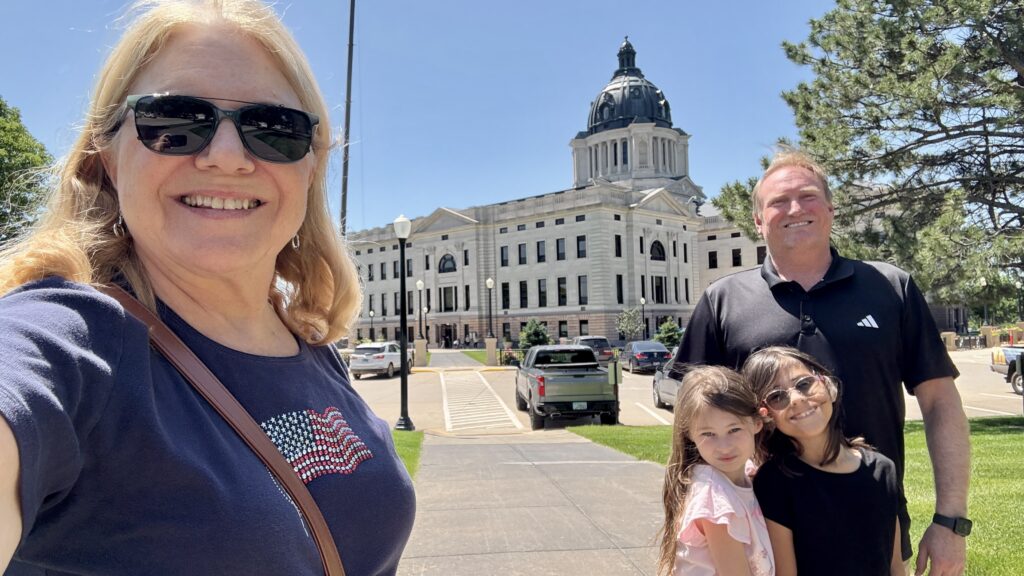
We had our two oldest granddaughters with us during this visit, as we were on a summer road trip to the Badlands. The Capitol didn’t have any volunteers this week, so we did the self-guided tour. Every State Capitol we visit has some unique features worth mentioning, like the one in the caption below. No wonder some people like living here!

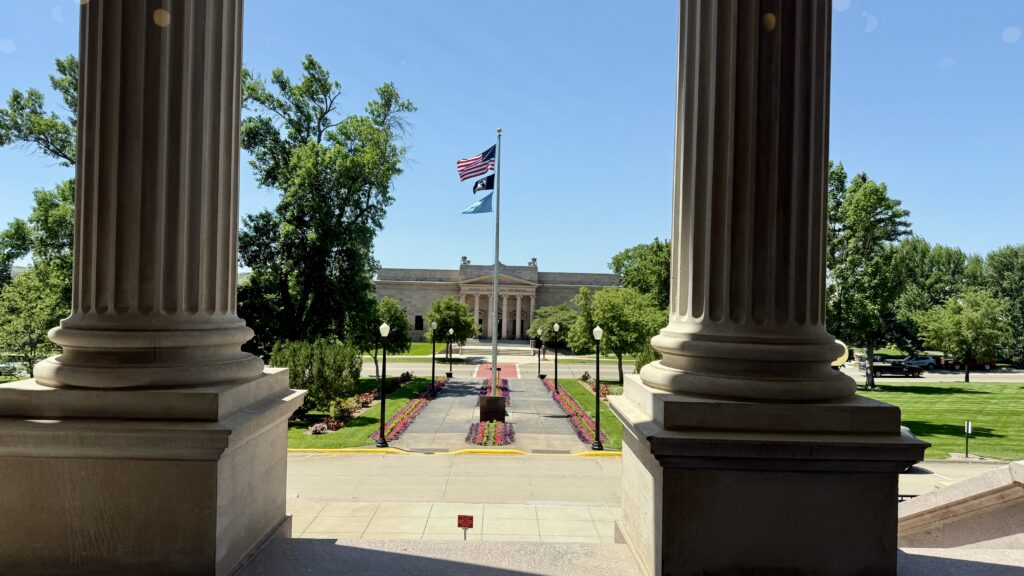
South Dakota has the only capitol building with a black dome. It is made with copper, which patinas over time. Unlike other locations where copper turns green, this dome turned black because the air quality is so high, e.g. no pollution! The girls got a science lesson today. 🤩

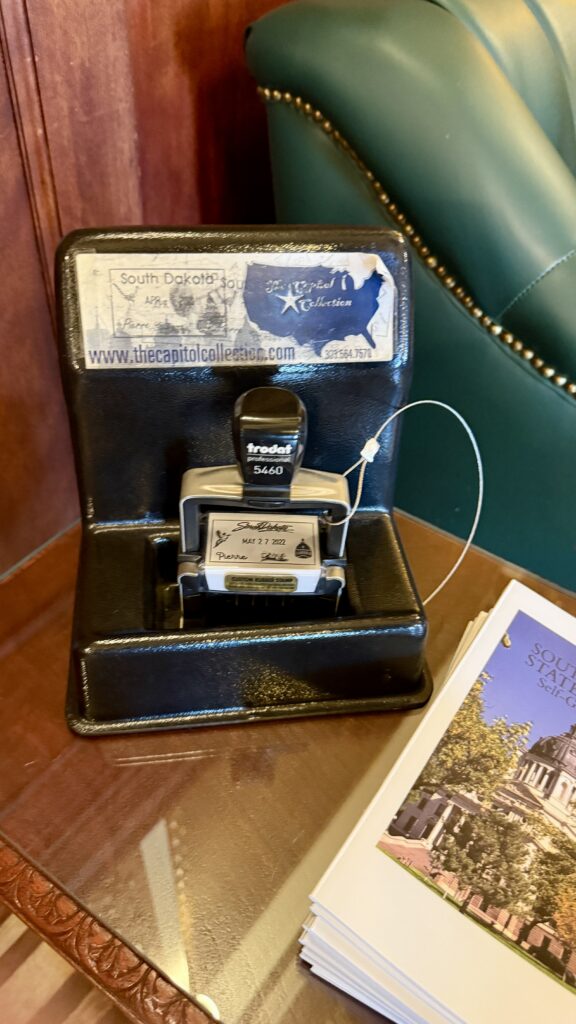
This is the first Capitol thus far that allowed us to stamp our own book. They tend to be pretty protective of those stamps! Yet, South Dakota had two different places where you could stamp your own. The picture on the right is in the governor’s office. The girls kept stamping the back of their guide books every chance they got.

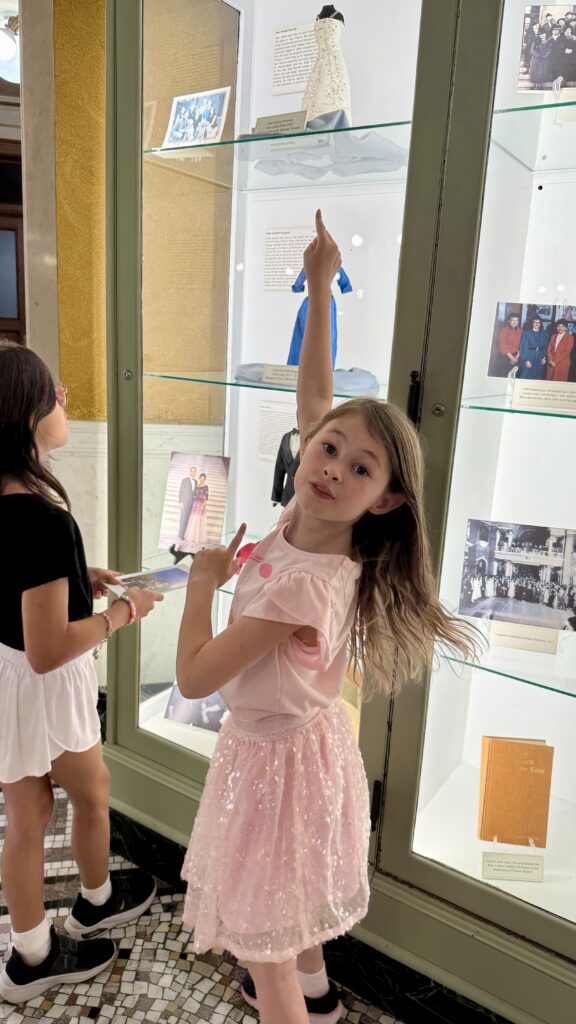
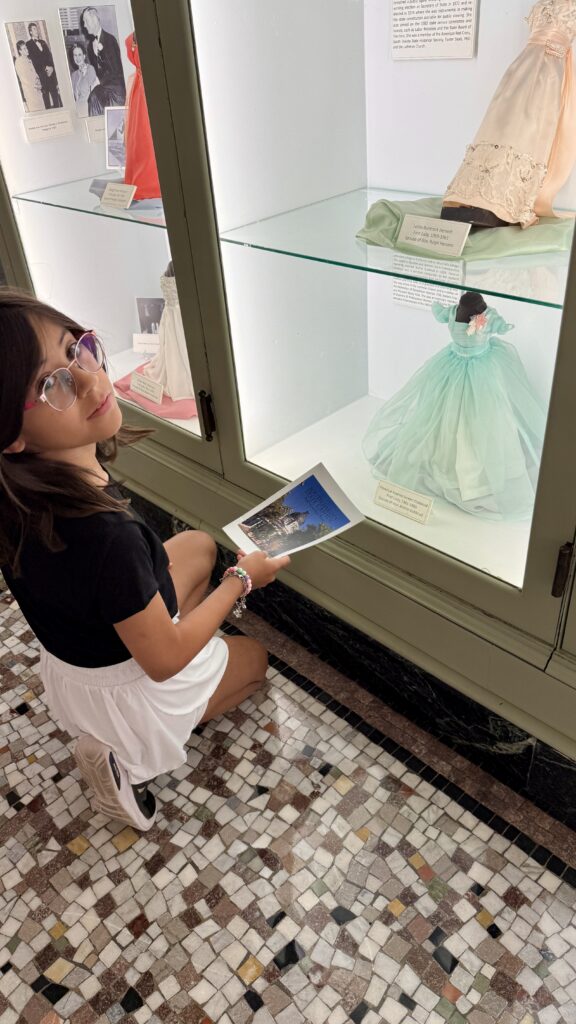
Something special the girls spotted was the display of the first lady dresses. (And now there is a first gentleman’s tuxedo, as their current governor is a woman.) This special display is always my favorite as well. Paige liked the slim dress while Alison picked a dress that looks like a quinceañera gown. We talked about that in the truck later. She said she had not heard of this before, but since her mother is Mexican we assume she will have a quinceañera celebration when she turns 15.

Inside the rotunda Yoda (his name for grandpa 🤦‍♀️) continues the tour.

Rotunda means “under the dome.” I think they were more interested in hearing their voices echo in the rotunda than listening to Yoda playing docent 😂. Sound on.
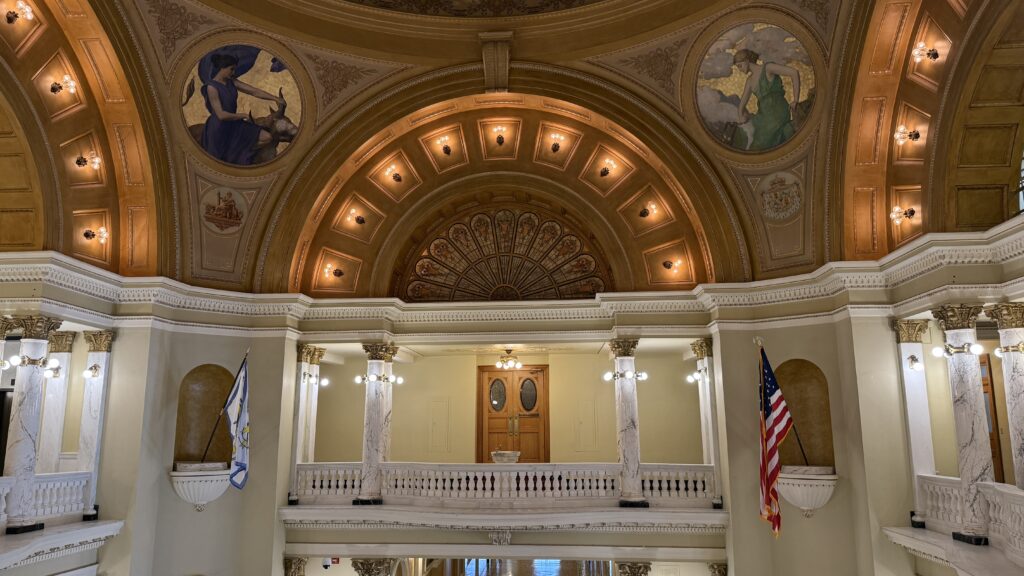
From the Rotunda floor to the top center black circle of the dome is 96 feet. It’s another 65 feet above the stained glass to the exterior ball. Not as tall as some others we’ve seen, but pretty impressive!

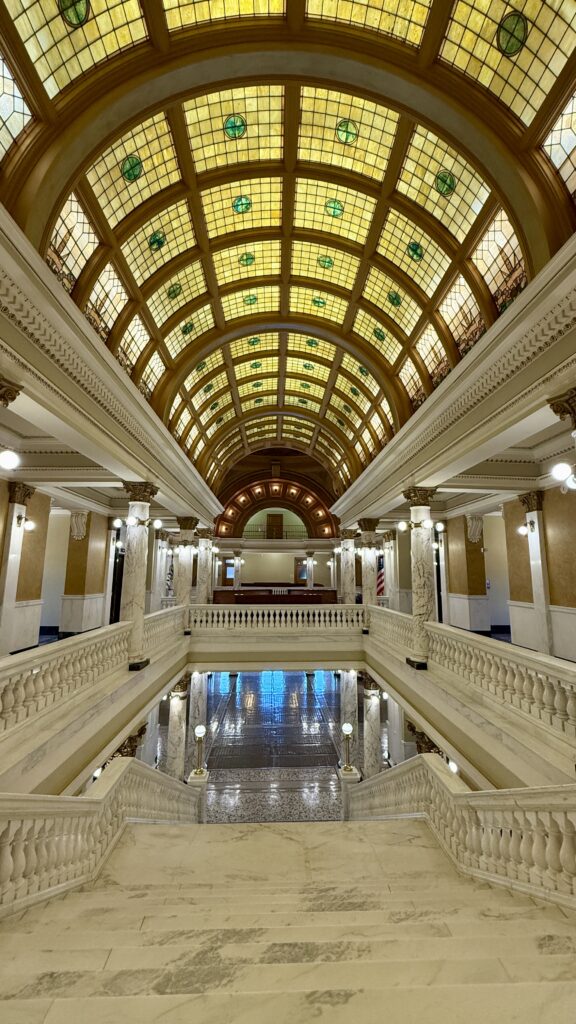
House and Senate. During the construction of the building in 1910, the House and Senate were each given the same amount of money with which to furnish and decorate their respective chambers. Because the Senate has fewer members, they were able to afford more lush wall treatments and furnishings, including marble wainscotting and cherry wood accents. To match wood tones between the two areas, thanks to the superior craftsmanship of the carpenters, the Senate doors are cherry on the interior and oak on the exterior.

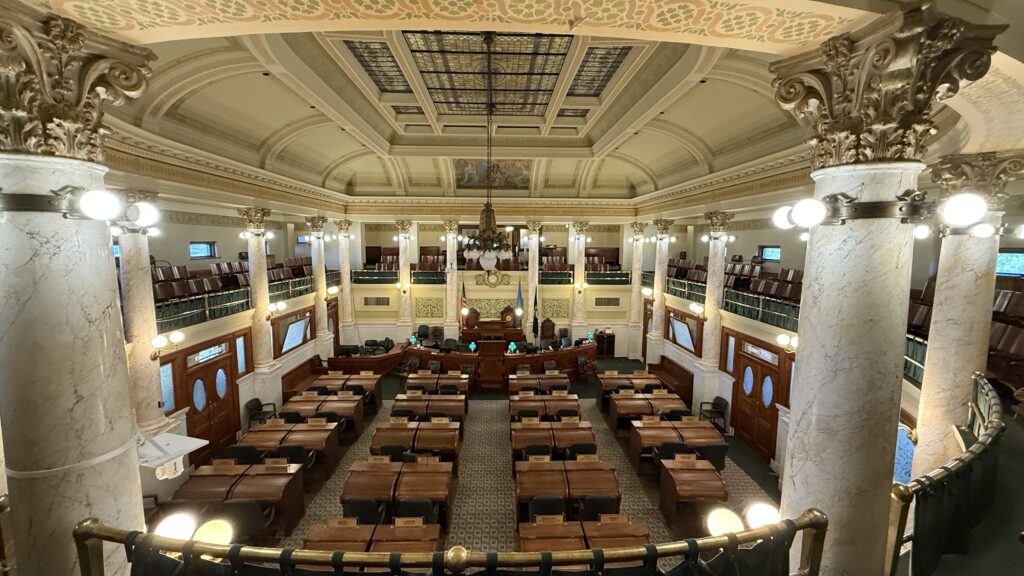
Senate Chambers, decorate in cool green tones, scagliola columns, Vermont White Cloud marble, cherry wood, and African mahogany. After an extensive search for the original 1910 light fixtures came up empty, solid brass replicas were cast and used in restoration. Each of the chandeliers weighs 750 pounds. Also of interest, the largest painting in the building, The Louisiana Purchase, is located here. If you look closely you can see it above the President’s Chair.
Tim briefly describes the purpose of the Senate 😂. Sound on.
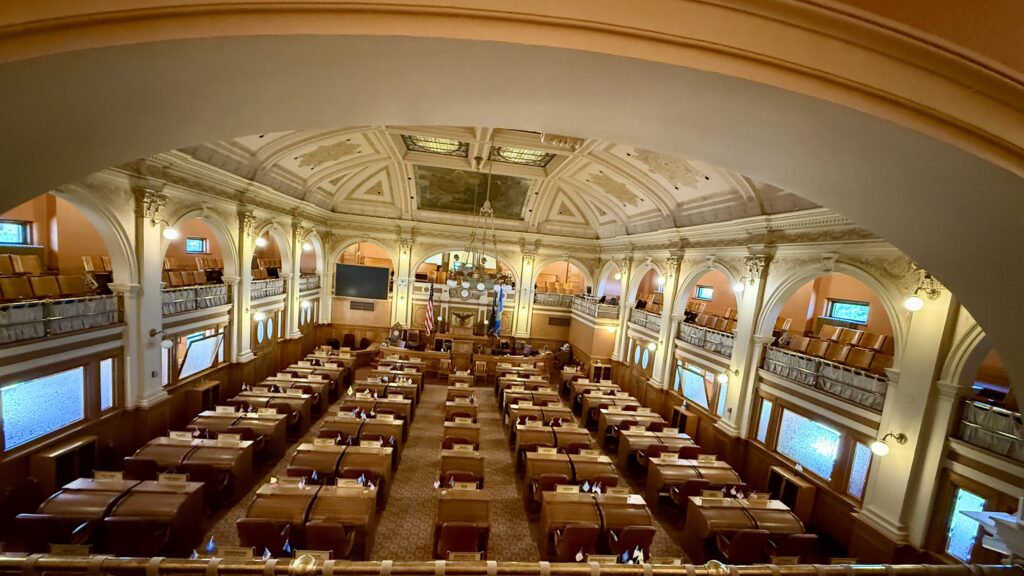
House of Representatives. The House Chamber is decorated in warm earth-tone colors, decorative plaster and solid oak wood accents. Chandeliers are not original or duplicates; they were removed from the original Federal Court Room in Pierre, also built in 1910, and installed in the Capitol. The House chamber is accented with decorative stenciling and backlit Victorian leaded stained-glass ceiling.
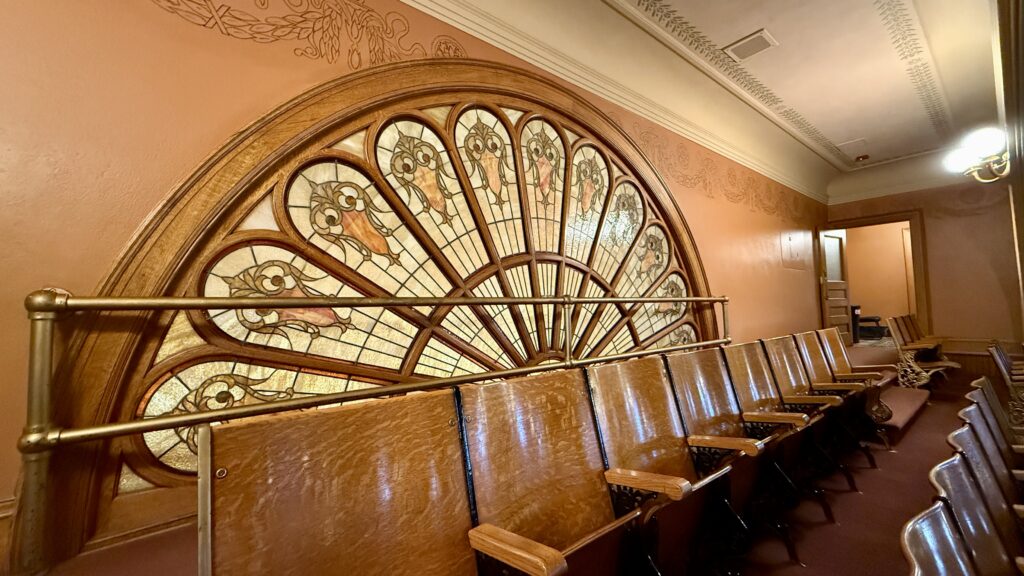
This stained glass fan is in the back of the House gallery, and can be seen from the Senate across the observation railing.

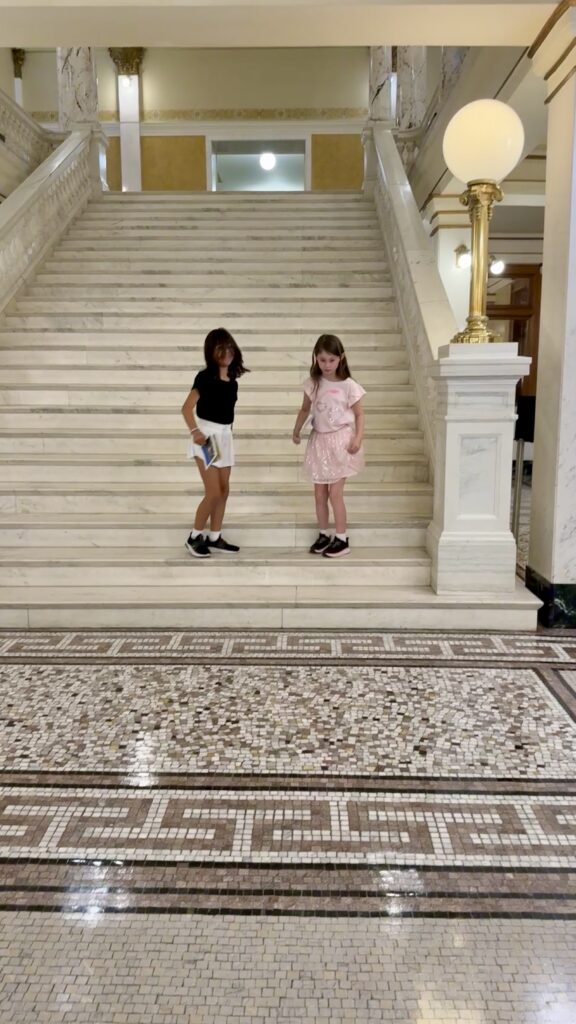
What is it with kids and stairs? They loved jumping from the second step, as we were preparing to leave the building.

Per legend, 66 blue signature stones – each representing a capitol Italian terrazzo artist – are laid in flooring. We didn’t see even one of them, or maybe we saw them but didn’t realize they were special.

Credit goes to the guide book for the wonderful information about the Capitol included in this blog.

Great day at the State Capitol of South Dakota!


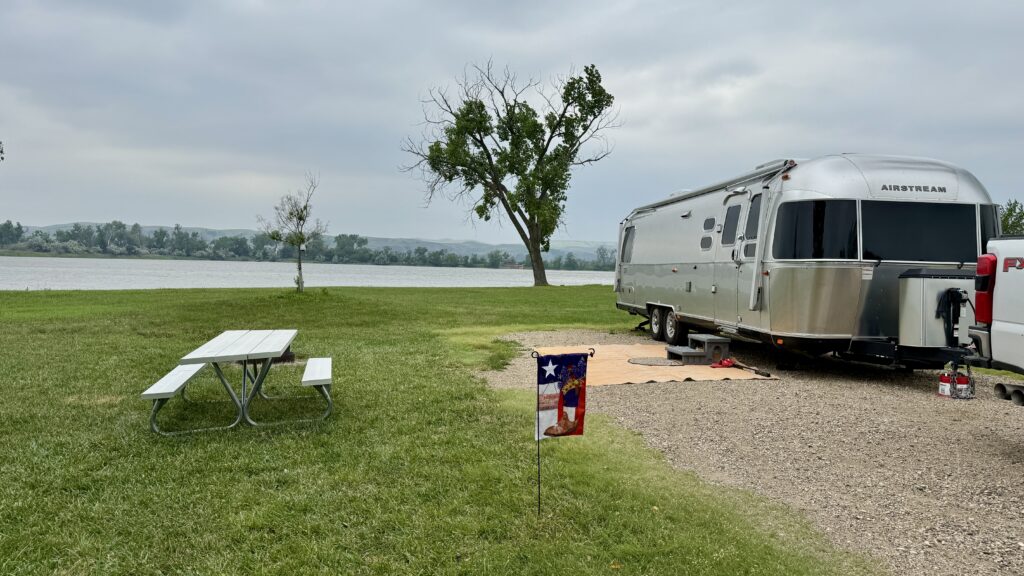
We camped for two nights at the Farm Island Recreation Area. It’s so quiet and peaceful there! We had a beautiful spot on the river, with a small sandy beach the girls enjoyed as well.

À la prochaine…hasta la próxima vez…until next time!

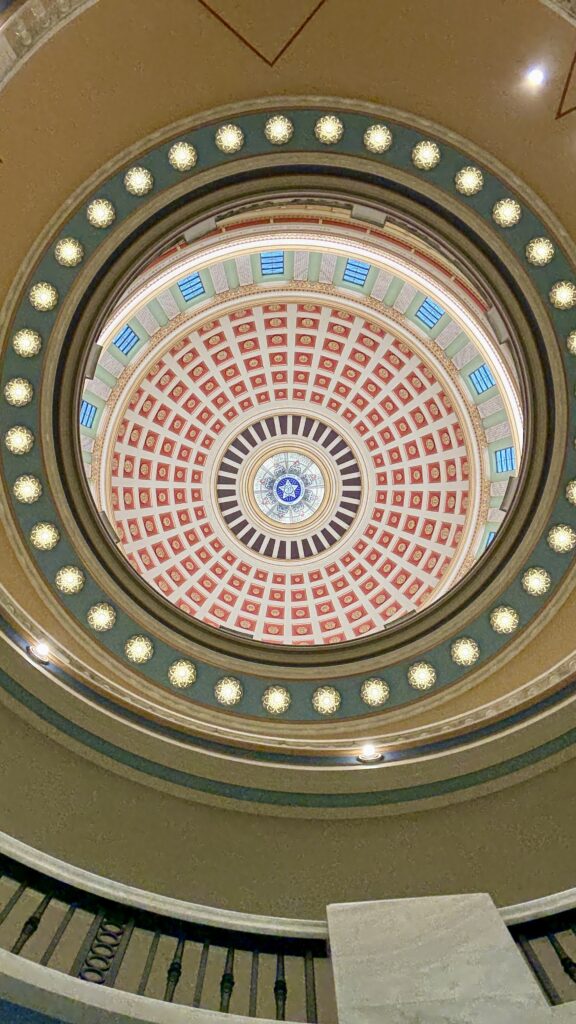
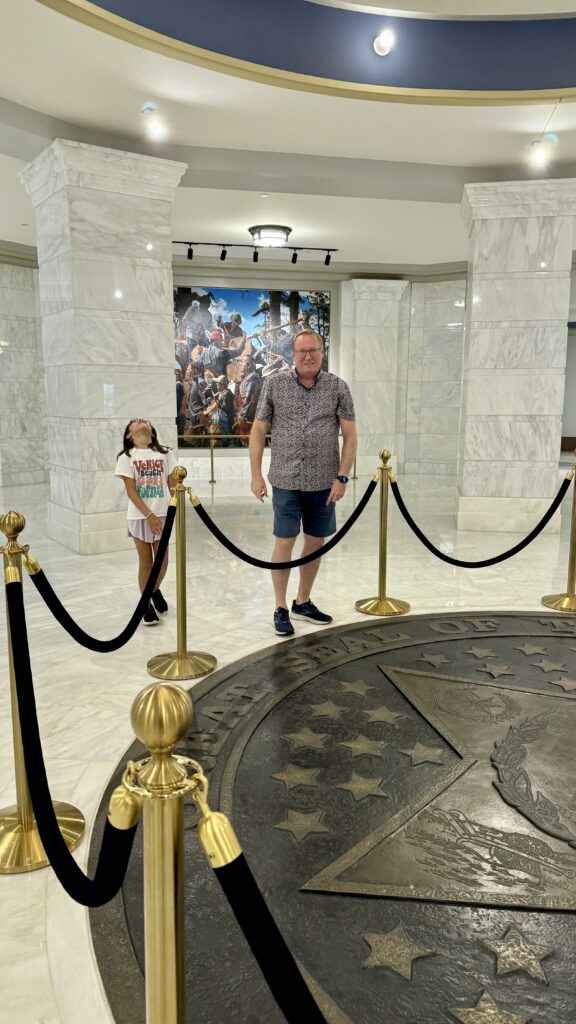
State Capitol 21: Oklahoma

the metastatic breast cancer journey banner

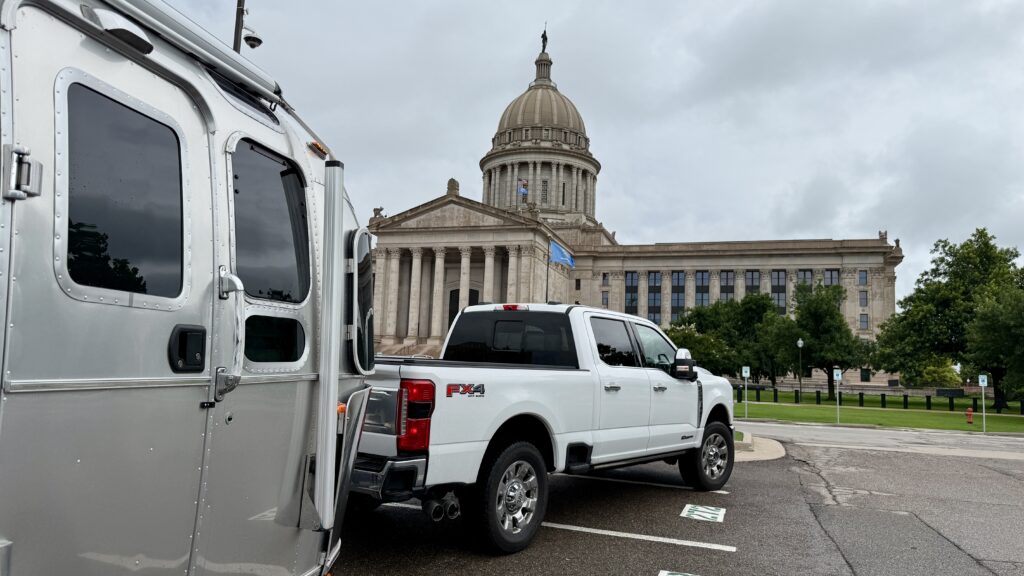
Sunday, June 15, 2025. Oklahoma City, Oklahoma.

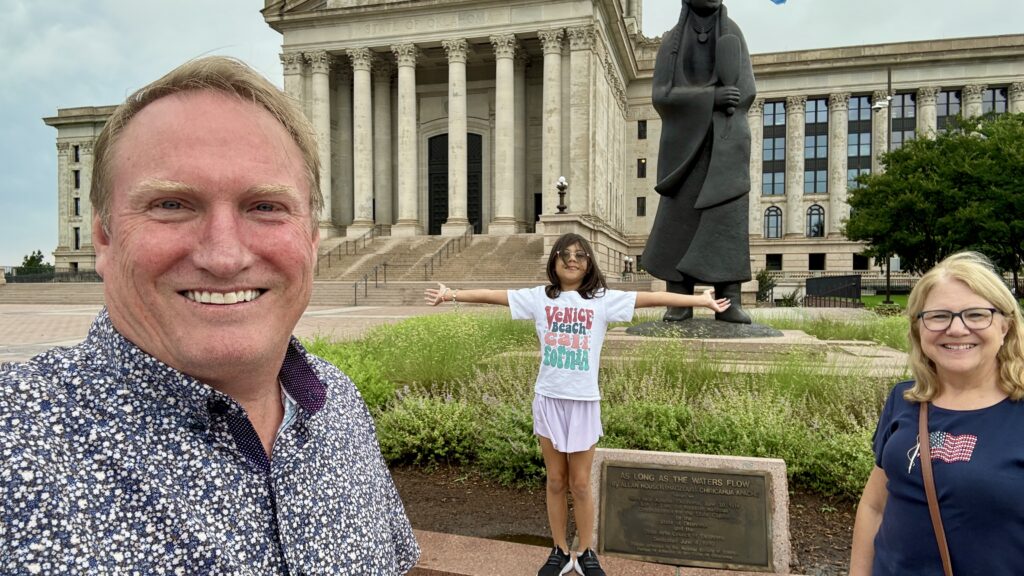
Tim lived in Oklahoma more than a decade growing up, but he never got to go to the state capitol. They did a renovation project in the early 2000s, so it may have been much different then anyway. We were able to take Alison to this capitol building, and show her the first one she has ever seen. She now knows about Oklahoma and Texas state capitols, as well as the states we have driven through! There is no better education than traveling.

It was pouring the rain for the whole two hours we took to get to the state capitol. You can still see some of the clouds in these photos. Then the skies cleared, and we had a beautiful day. The temperatures dropped so we pulled out light jackets after this.

We are traveling on this adventure with our first grandchild, Alison. She was surprisingly interested in the Capitol!

Going to the Capitol on a Sunday has its benefits as well as disadvantages. At least they are open on the weekend! That was a bonus. We appreciated that, because we were traveling through and the state capitol was right on our drive path. The perfect place to stop and stretch our legs. Know that if you visit this capitol, the entrance on weekdays is on the opposite side of the building from the weekend entrance. I was glad I had read that in advance, as it gave me a heads up on where to park and enter.

We arrived to a nearly empty parking lot, which made pulling the Airstream easier to park than many other places we have visited.

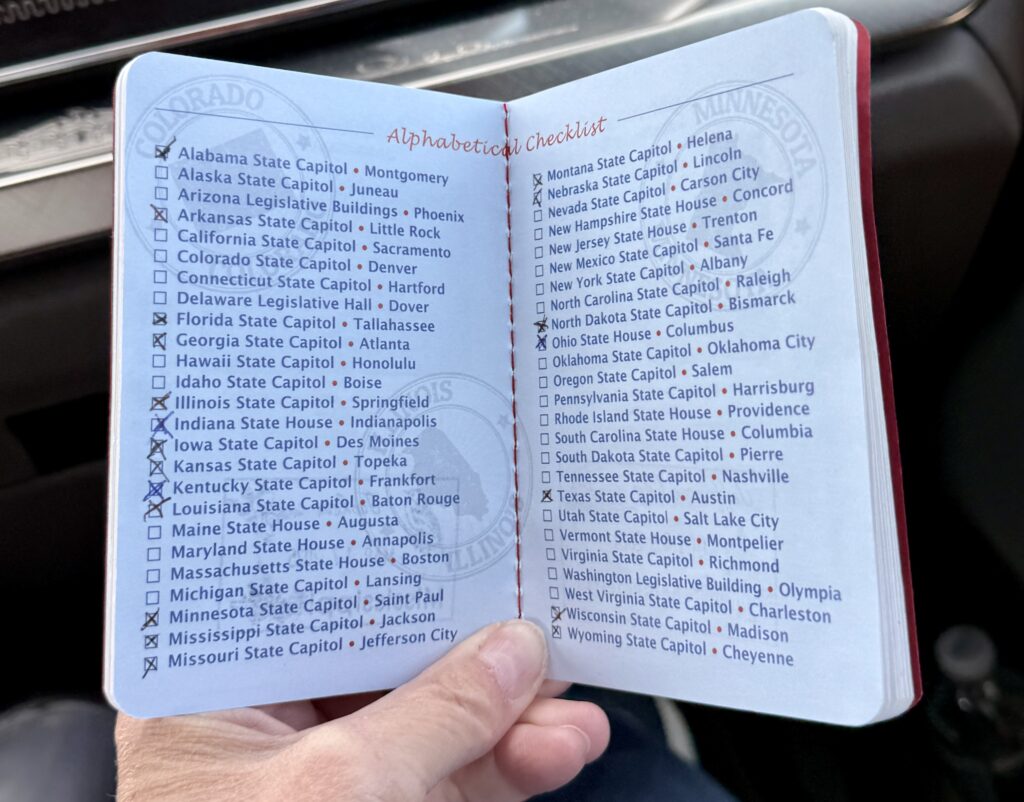
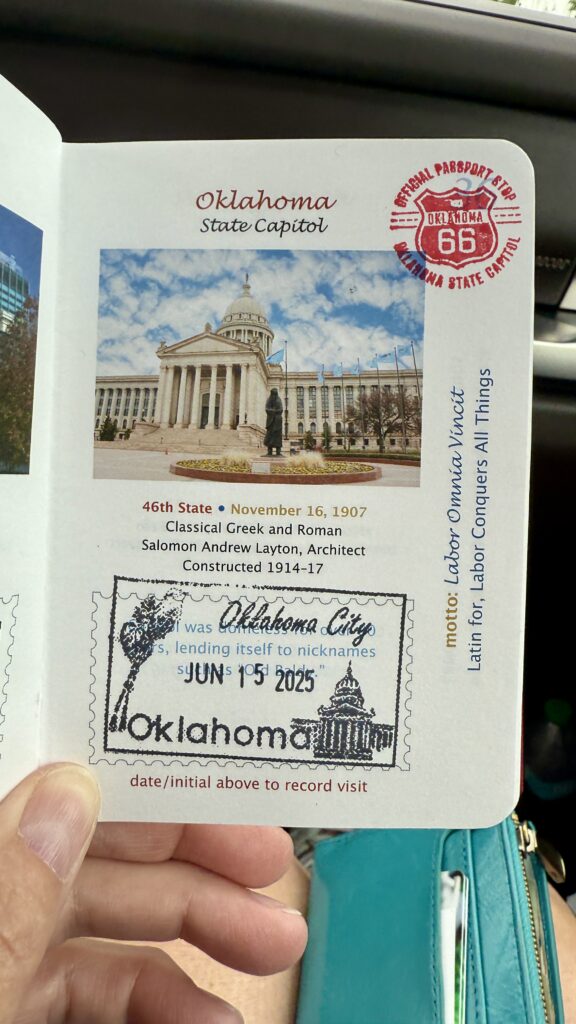
When we got inside, I was reminded they do not have docents working on Sundays. So, we did a self-guided tour based on the link given to us by the security guard at the entrance. (Yes, you have to go through security. Leave your guns at home.) She stamped our capitol passport, twice actually.

This capitol is on Route 66, so they have a stamp for the capitol as well as Route 66. That was a fun little discovery!

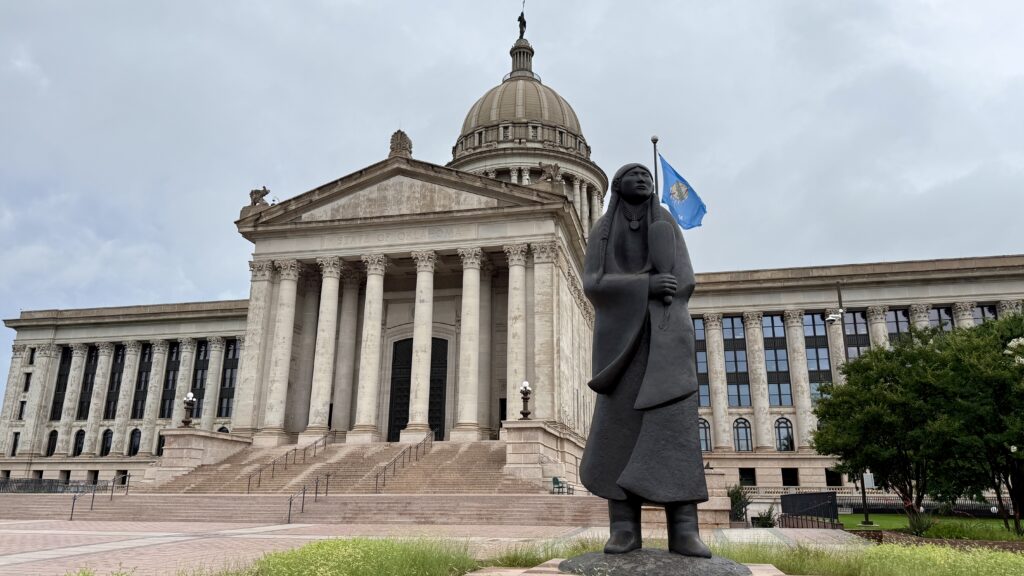
Not so small, a nine-foot tall bronze statue stands in the hallway right after we passed through security. He is a replica of the 22-foot statue called “The Guardian,” which was placed on top of the dome in 2002 when they completed the renovation and built the dome. Click on the link above to read more. He’s quite impressive, and stands for a lot.

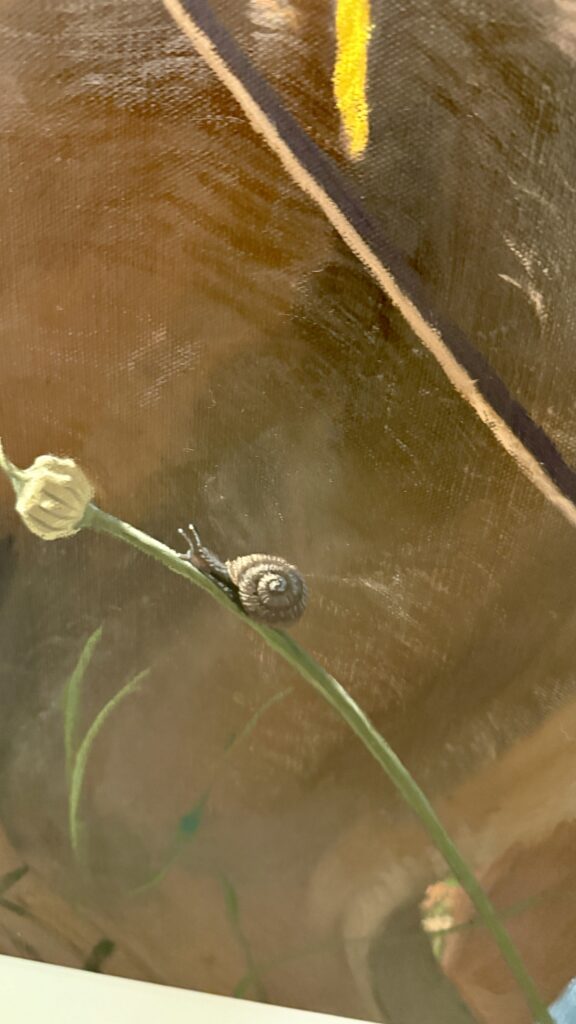
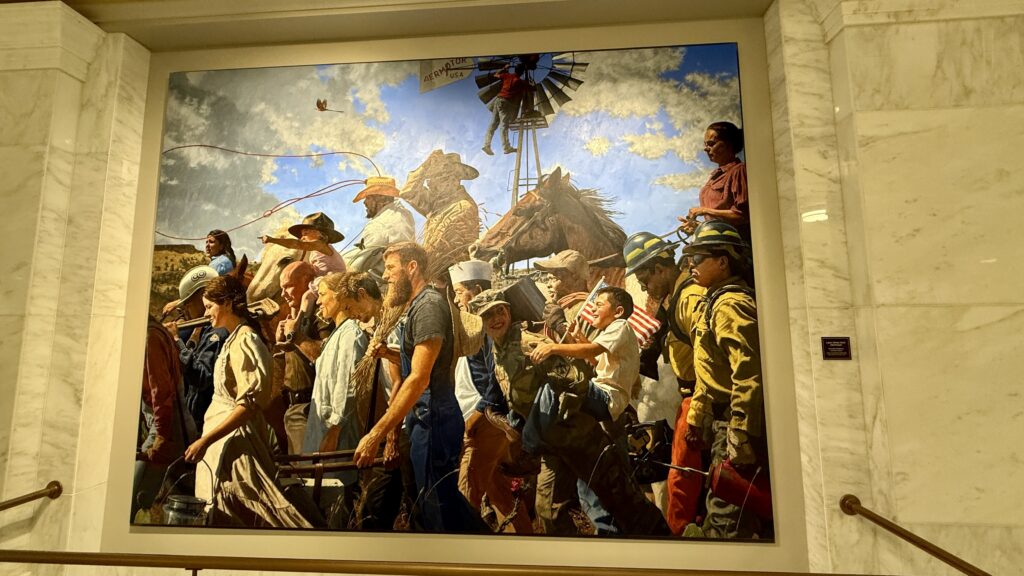
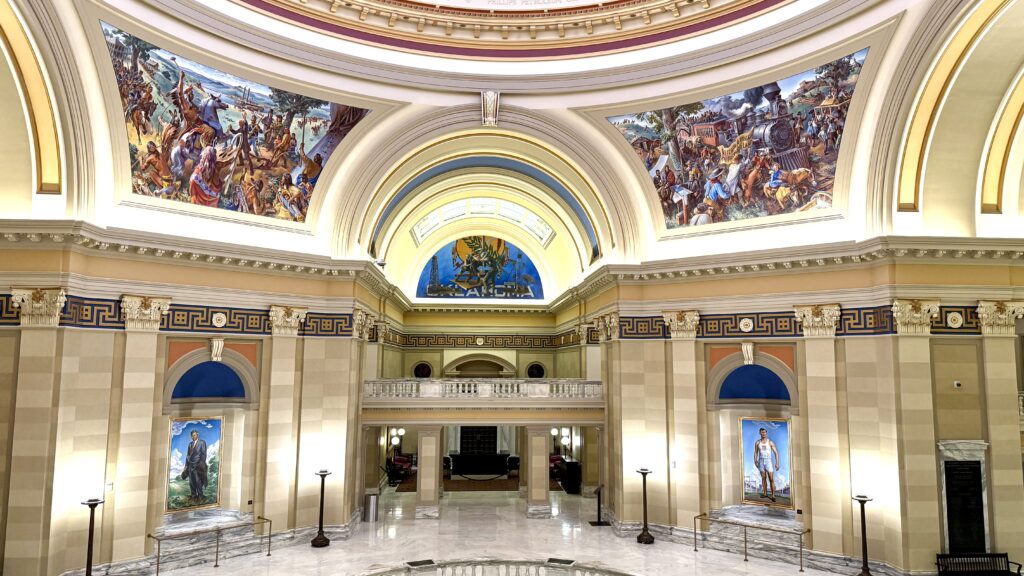
There is a lot of artwork in this building. On the main floor there are things to look for in the paintings that represent various aspects of Oklahoma, like a bee, a strawberry, red bud trees, a scissor tail flycatcher, and a swallowtail butterfly. We never did find that bee or that strawberry!

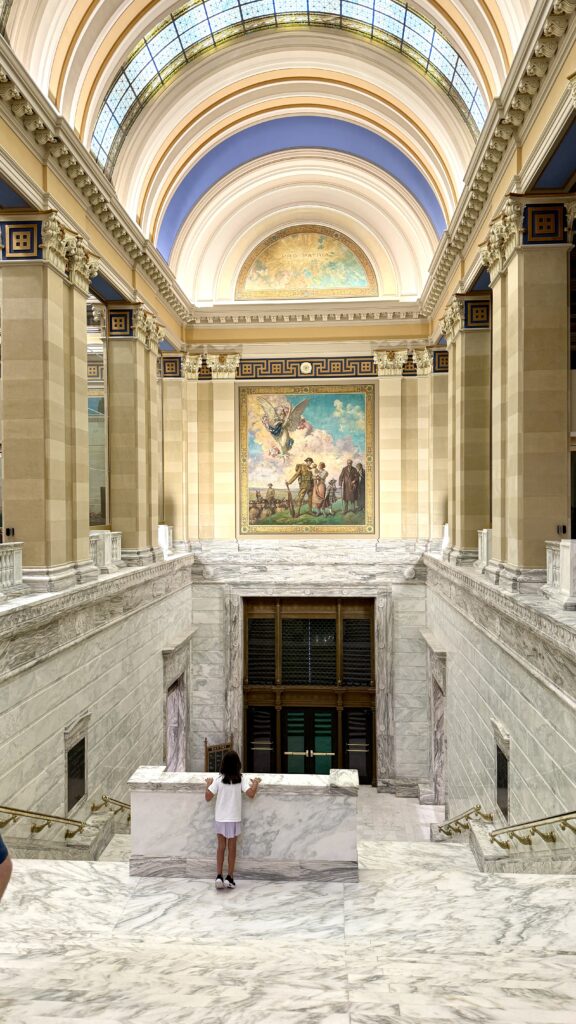
The disappointing part of coming on a Sunday was a locked door greeting us at both the House and Senate Chambers. You can’t get in without a docent. They have some beautiful foyers, but we will need to come back another time on a weekday so we can see the chambers.

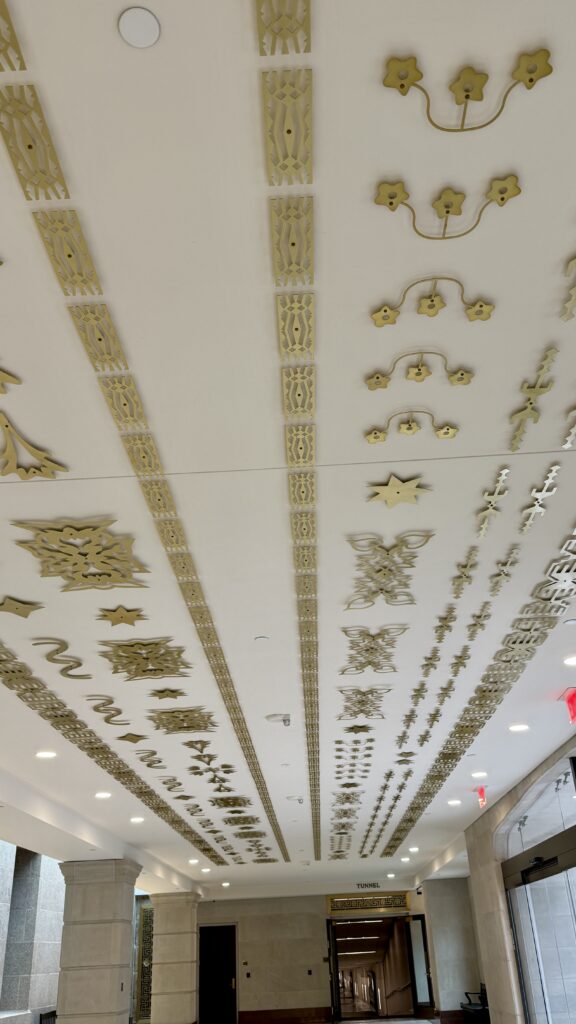
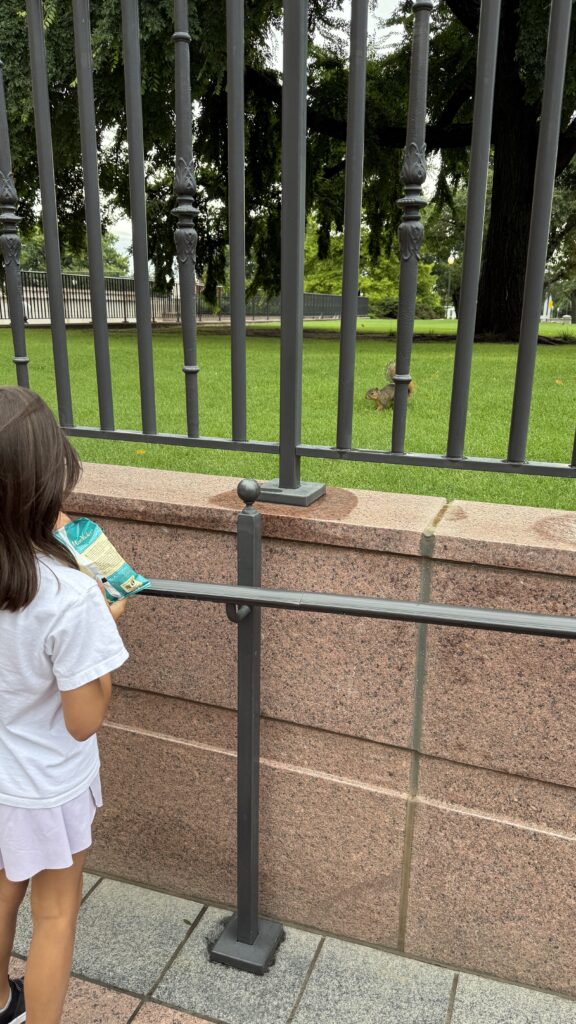
Lastly, there were some pretty ceiling decorations. As we were leaving the building, a friendly squirrel came running over to see us, but when Alison offered it a potato chip it quickly ran away squeaking and squawking. Too funny!

State Capitol of Oklahoma

Thanks for reading my blog! God is good. He has given me the strength to live life to the fullest. What’s on your bucket list?


À la prochaine…hasta la próxima vez…until next time!

State Capitol 20: Mississippi

the metastatic breast cancer journey banner

March 17, 2025. Jackson, Mississippi.

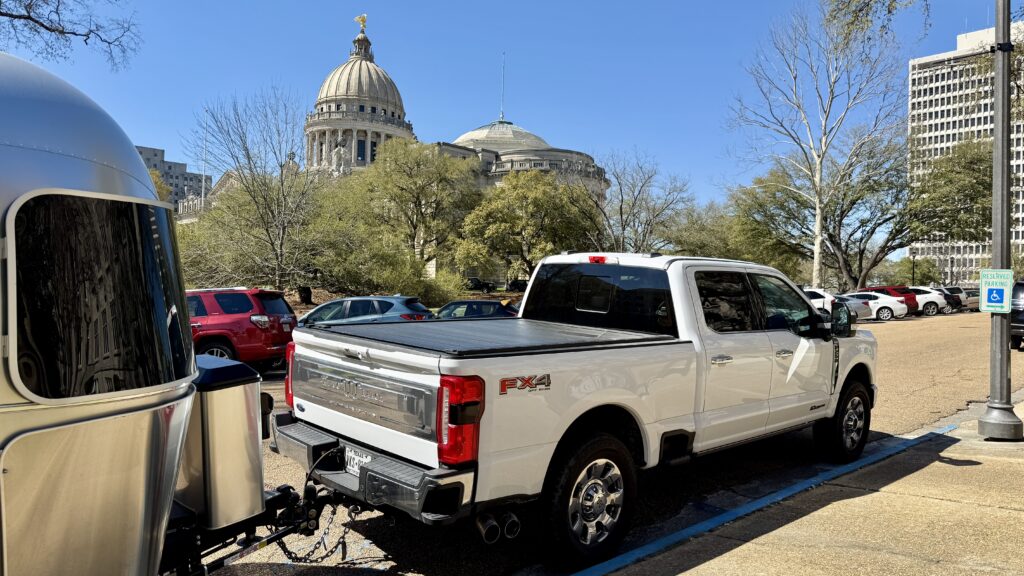
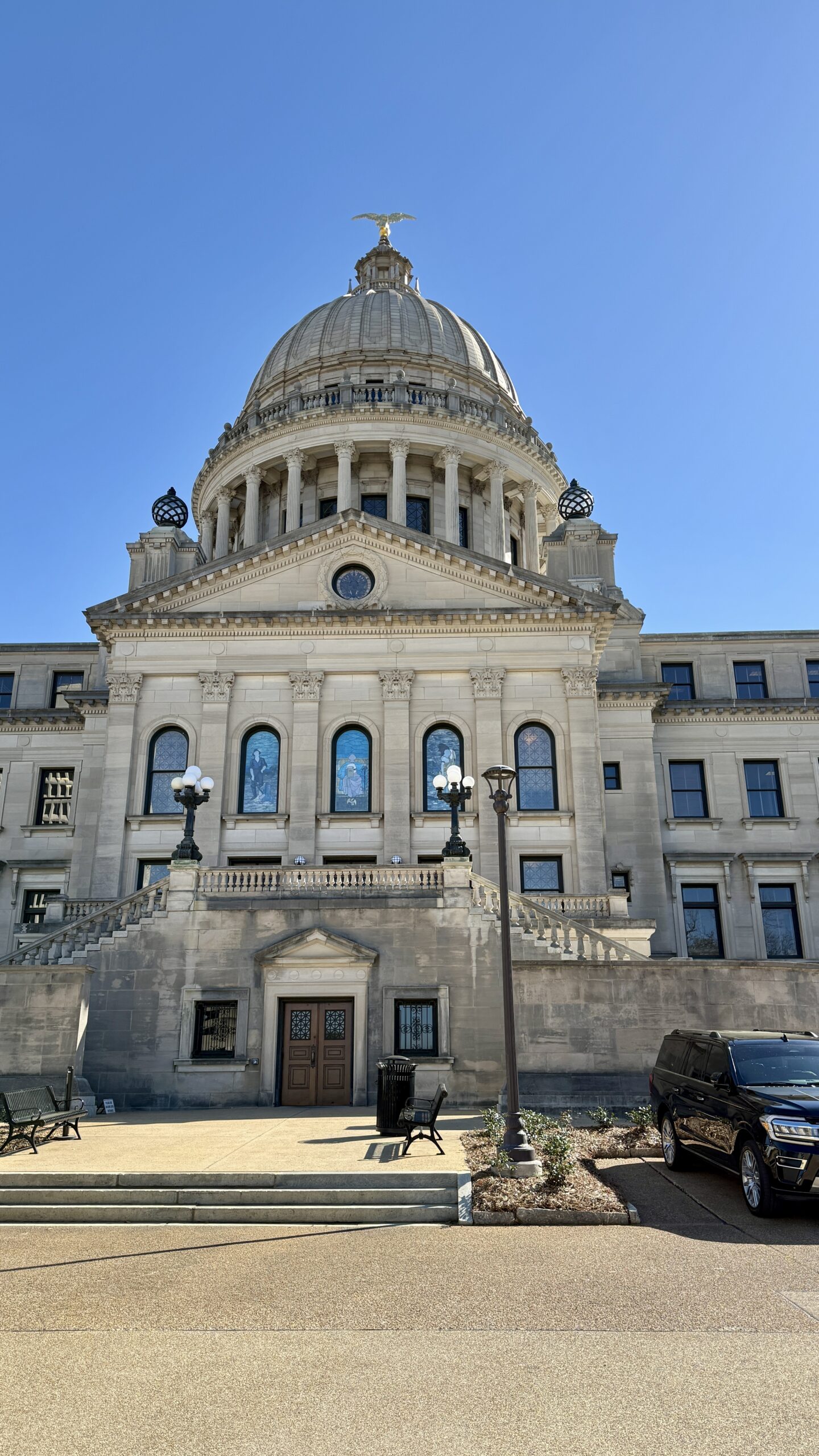
It was a warm day in Jackson. A beautiful day to visit the capital city. This used to be the entrance, but now you have to go around to another side where they have security ready to check your bags and put you through a metal detector. Notice the dome and eagle on top of the building, and the beautiful carving over the entrance. The eagle that stands atop is eight feet tall and 15 feet wide, made of copper, and gilded with gold leaf.

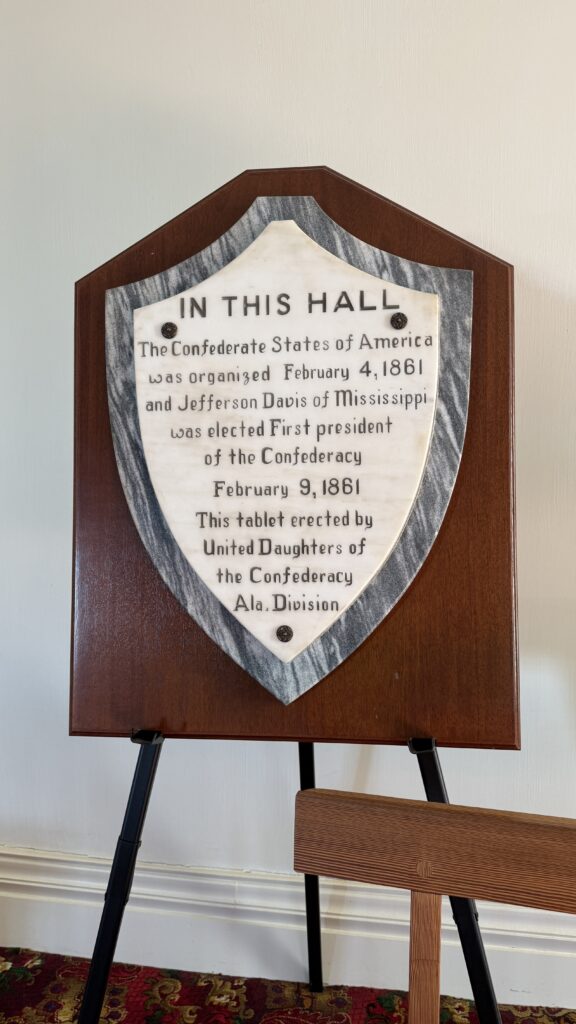
We are almost half-way through our bucket list! Hard to believe. This is the first time we have visited two state capitols in one day. We woke up, toured the Montgomery Alabama state capitol and First White House of the Confederacy across the street, went back to our RV Park, hitched up, then headed out for Jackson Mississippi. 

We hadn’t planned on seeing Jackson’s state capitol today, but our other plans fell through for the day and we were gifted with some additional time in the afternoon. We pulled our Classy Girl from Montgomery to Jackson and stopped at the capitol on the way to our RV Park where we stayed west of Jackson. Fortunately there was parking big enough; a security guard showed us where we could park so we felt safe leaving our Classy Girl there. She thanked us later, as she always wanted to see a State Capitol up close.

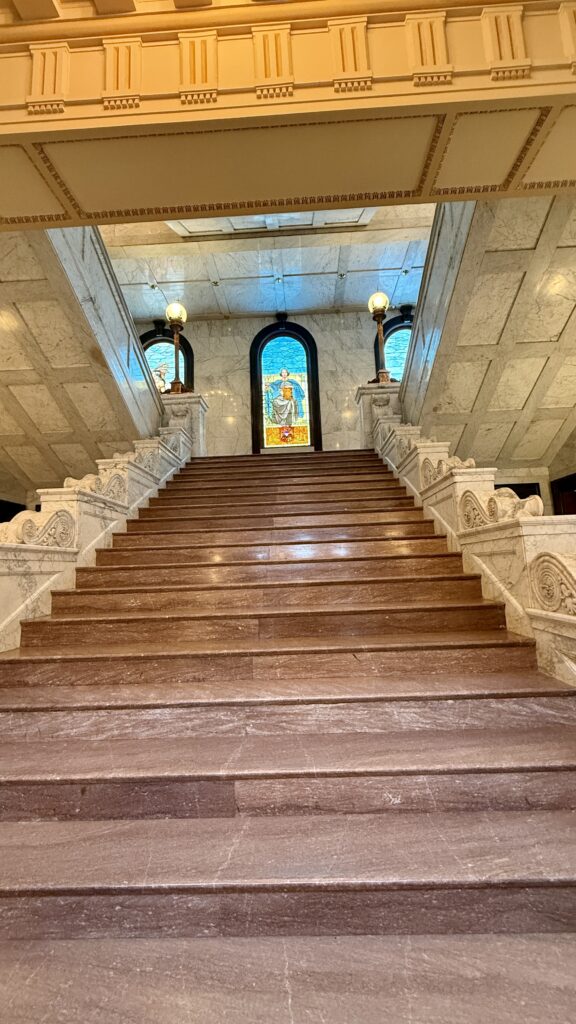
Third time’s a charm! We finally managed to get a tour guide to show us around. The building is quite impressive. According to Wikipedia, “architect Theodore Link used the new technology of electric lighting when designing the Capitol and incorporated 4,750 electric fixtures, which are still being used today.”  The guide reminded us that electricity was only starting to enter the picture, so it was an awe-inspiring experience when people arrived and saw all the floors lit up. People came from far away just to see the lights. The architect didn’t know how many lights it would require, so he may have gone a bit overboard. However, the building is designed after the French Beaux-Arts Architecture, which is quite ornate and majestic, reminiscent of an old-style theatre.

This state’s legislature was in session, as we previously experienced in Atlanta. They were a bit more protective of their senators, so we could not take pictures in the House and Senate chambers, but we did get to go inside and look around from the gallery with our tour guide, in addition to hearing some interesting stories along the way. Wish I had a picture, but the architecture is similar to what you see here.

See the resemblance to an old movie theatre? It reminds me of the movie, “The Majestic.”

Outside the House of Representatives we stopped to look at some of the former members. One name kept popping up, taking our eyes off all others in the frame: John Grisham.

Yes, that John Grisham. You probably know him as a famous author, but he also served in the Mississippi House of Representatives from 1983-1990. His first novel was published in 1989 (A Time to Kill), which he worked on for four years while still serving the government. As a lawyer and State Representative, he heard stories that had a big influence on his writing.

The tour guide spilled the tea. She remembers when Grisham was talking about his novel to various people in the building, while he was still a state representative. They all laughed at him behind his back, having no idea how famous he would be one day. He failed English in his Community College class, but a law instructor saw the value in his writing and he went on to be a lawyer. Did you know he is one of only three anglophones (English-speakers) to sell 2 million copies of the first printing? No one is laughing now! Let that be a lesson to us all. You simply can’t judge someone’s future. Encourage them. They may be the next best astronaut, author, inventor, or physician who finds the cure for cancer.

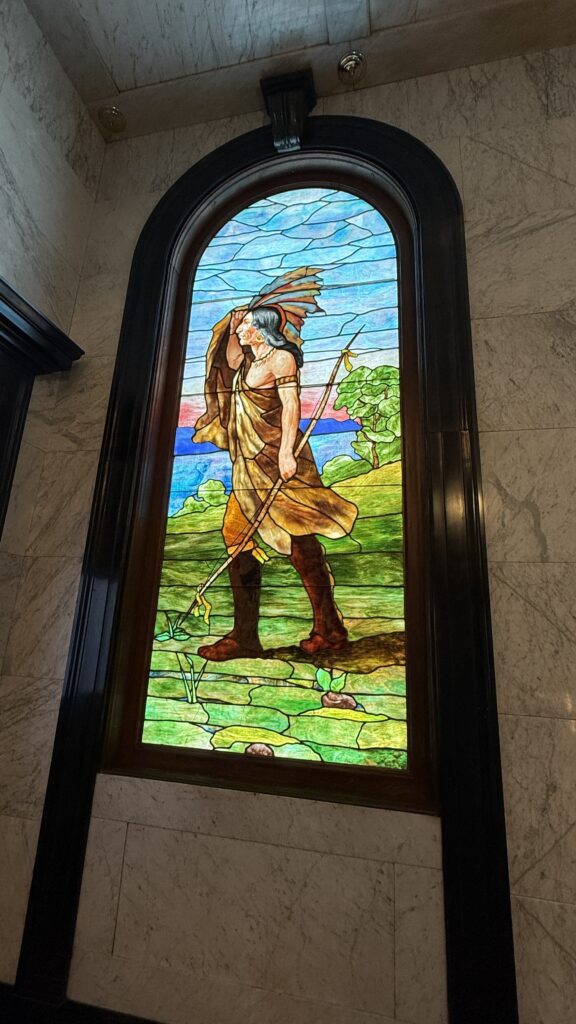
And I’ve digressed. I actually took fewer pictures in this Capitol than most. We were a little tired, and we were also not permitted to take pictures where I would normally take them. Here are a few pictures of the inside.


À la prochaine…hasta la próxima vez…until next time!

State Capitol 19: Alabama

the metastatic breast cancer journey banner

March 17, 2025. Montgomery Alabama.

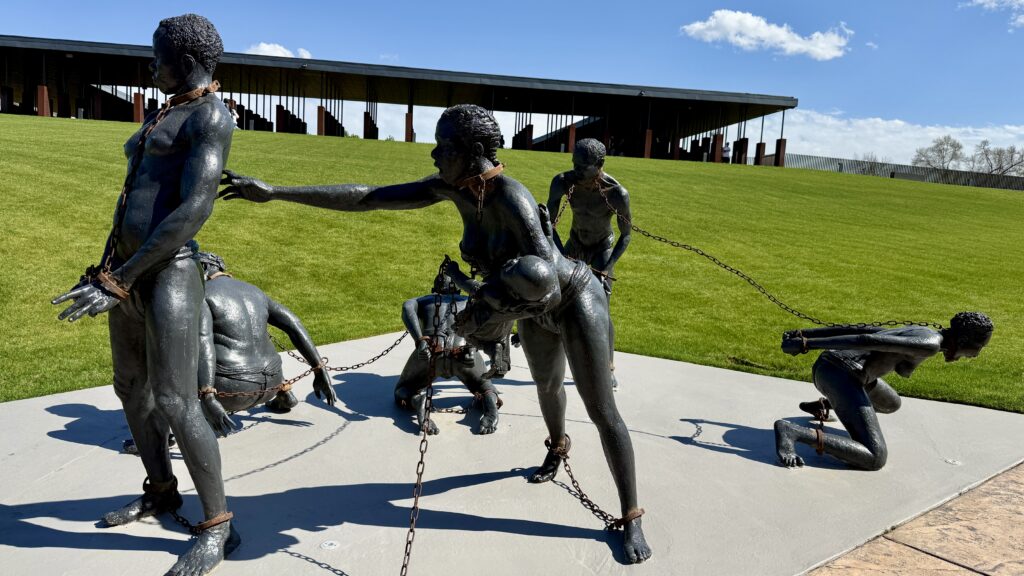
After leaving Georgia, we towed our Airstream to Montgomery Alabama where we spent two nights. We toured the Capitol as well as The Legacy Sites. The Capitol is not open on the weekends, so we walked around the grounds and visited the Legacy sites on Sunday and then went back the next day to see the inside of the Capitol. You can see all three Legacy Sites for a mere $5.00 (The Legacy Museum, The National Memorial for Peace and Justice, and Freedom Monument Sculpture Park). Did you know the Confederacy was started here? We also visited the First White House of the Confederacy. Montgomery’s history is very interesting, as are the stories of those who monitor these sites. My book club just finished reading two books from the first person perspective of slaves who escaped and gained their freedom, so it was appropriately timed for us to see what I have been reading about. This blog will primarily cover the Capitol building, but I recommend seeing all of what Montgomery has to offer if you get the chance. You will learn a lot!

It was a really windy day on Sunday. It died down by the next day and warmed up. Weather can change so quickly.

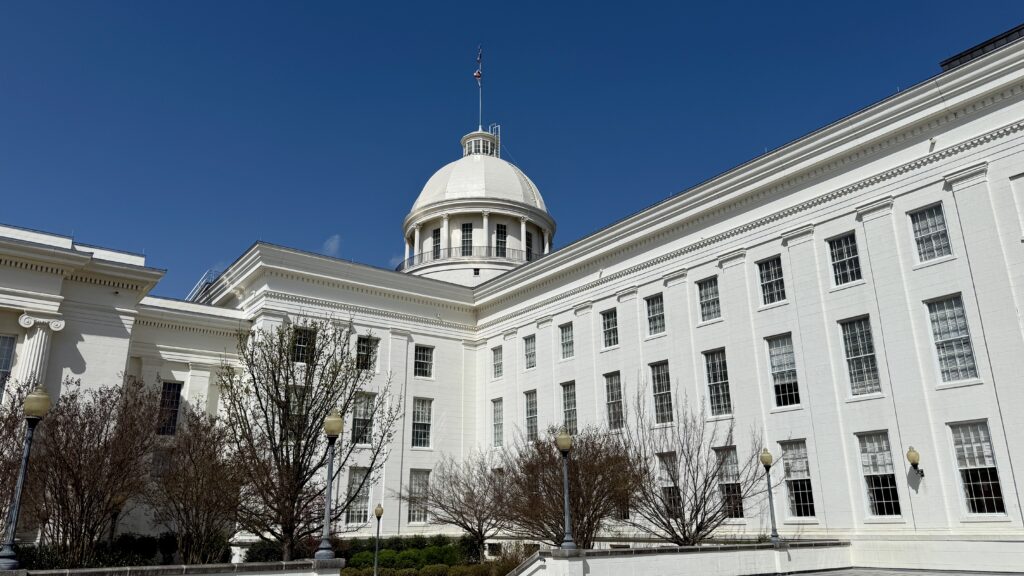
Montgomery holds one of the most beautiful grounds and buildings we have seen. All the government buildings surrounding the Capitol, as well as the Capitol itself, are solid white, well kept and manicured. 

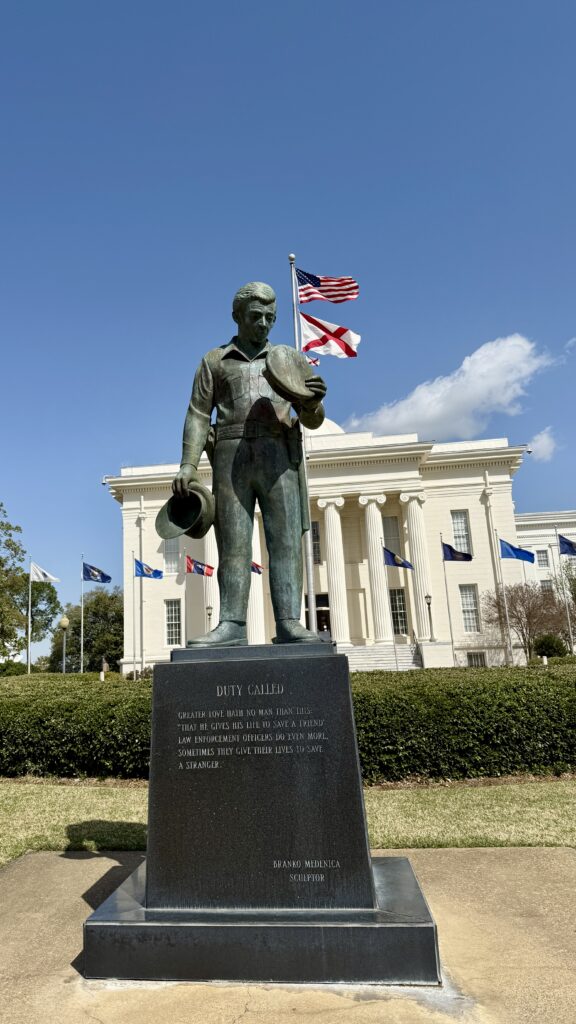
All fifty states flags are represented here. It was a really windy day when we toured the outside of the Capitol.

This “Moon-Tree” was planted on the grounds of the Capitol in 1976. Loblolly pine crown from seeds that journeyed to the moon with 1971 Apollo 14 Mission.


They don’t offer tours of the Capitol unless you come with a large group (mostly schools), so once again we were on our own. It turns out the building is no longer used for legislature. They have their own separate building (which you can also tour, but it’s just a bunch of offices). This Capitol is here for more historic purposes, basically a museum rather than a working government building like the others we have seen. 

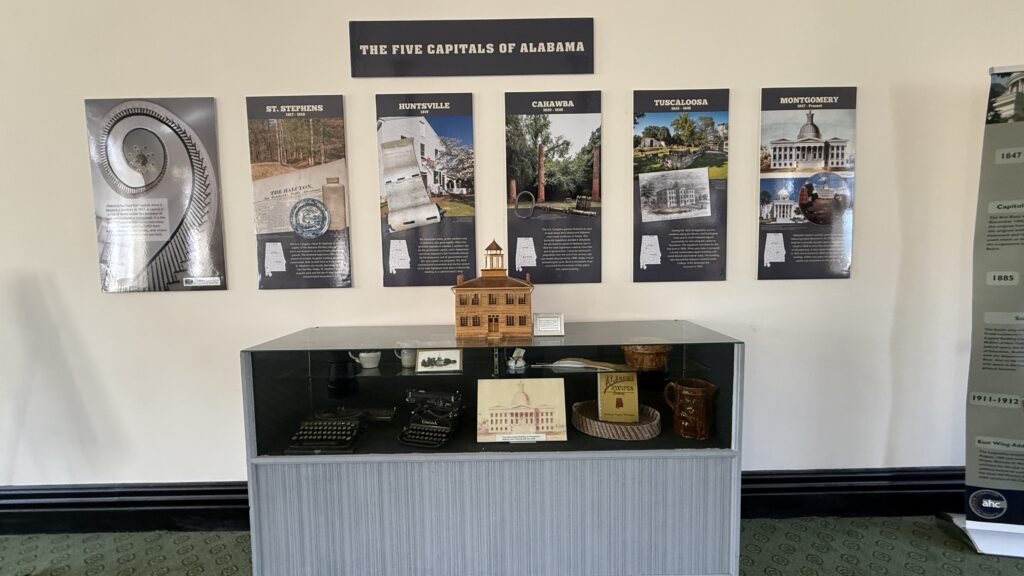
Alabama has had five capitals since it became a territory in 1817: St. Stephens, Huntsville, Cahawba, Tuscaloosa, and Montgomery (where it has been since 1847).

The original rotunda has some interesting factoids. The interior finish was originally very plain. Ornate plasterwork, marble floor and vestibules to House and Senate Chambers were added 1906-1912. Murals depicting scenes from Alabama history painted by Mobile artist Roderick MacKenzie 1927-1930. Building was restored to circa 1930’s appearance.

The eight murals beneath the Dome illustrating Alabama’s history are seen in the video below. They were painted on canvas by one artist named above, and then mounted on the walls. It took him three years to complete them all.

The House of Representatives (1851-1985) was restored in the 1990s to its original state circa 1870-1890. It’s the site of the statewide convention which took Alabama out of the Union in January 1861. Trompe l’oeil ( fool-the-eye’) wall painting replicates scheme introduced in 1869. We didn’t know at the time Tim made this video that they really don’t do any work in here LOL.

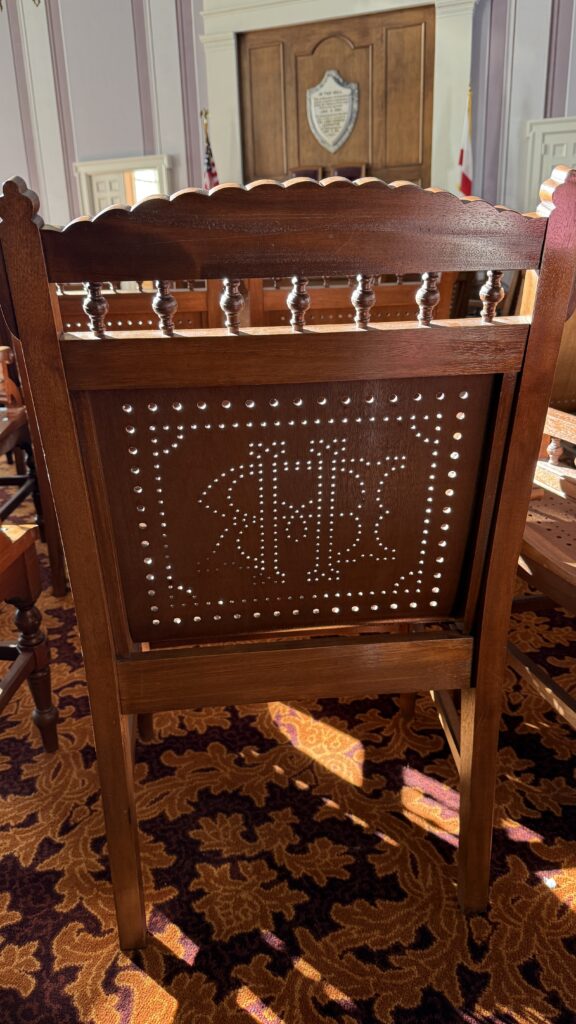
A few other artifacts are found in the House Chambers. Two were of interest to me: The ART LAUREL STOVE #16 (c. 1904. Constructed of nickel and embellished with nickel relief and lions heads, the Art Laurel stove #16 was considered to be the top of line model in stove construction. A 1904 catalog described it as “the highest type of base burner construction, surpassing all other base burners in appearance, in heating capacity and economy of fuel.“) and one (of the few remaining) GARDNER CHAIR, (c. 1879. made by the nationally renowned furniture maker, Gardner and Compary of New York. After the furniture was in place, Secretary of State W. W. Screws praised the Gardner Company by stating that he “greatly admired (the furniture) for its strength of make and its handsome appearance.” On loan from the Alabama Department of Archives and History Montgomery, Alabama).

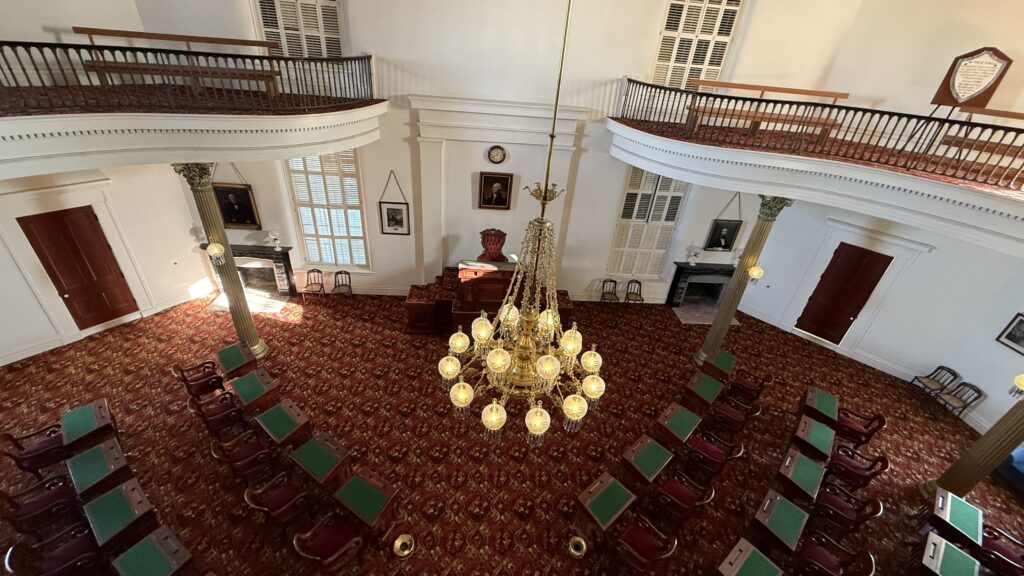
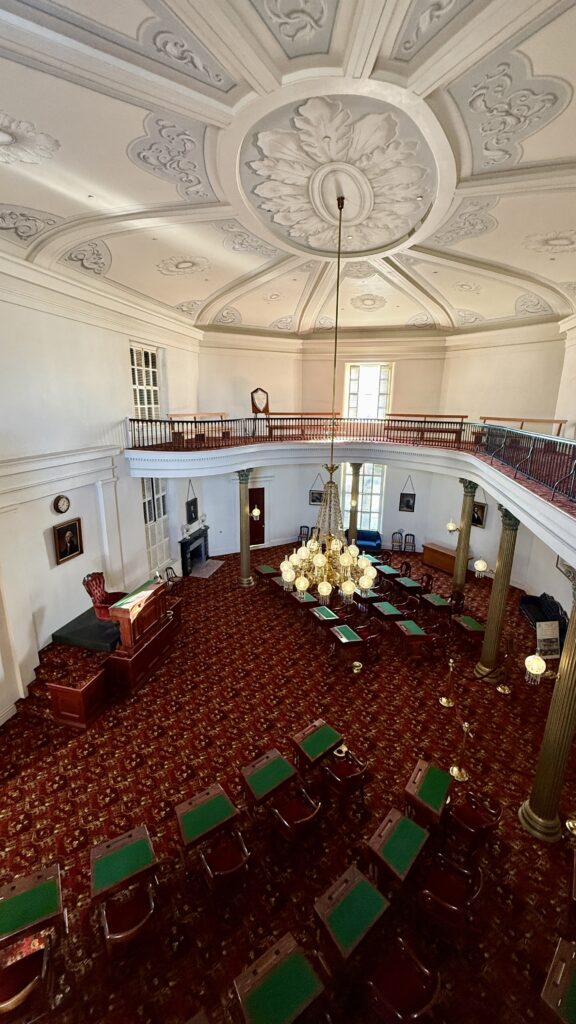
Next we visited the Senate Chamber (1851-1985). One oddity we witnessed was what appeared to be spittoons at the end of the front rows. It was this point where we wished we had a tour guide to tell us more about it.

The Senate was restored to its 1861 appearance, when southern delegates met here to organize Confederate States of America. You will see original “Egyptian” marble mantelpieces and the gallery columns were painted to imitate bronze. It has replicas of original desks and chairs, as well as oil-burning chandelier and column sconces. Period carpet was installed: 27-inch strips hand-sewn in traditional manner.

We walked down the spiral staircase to the first floor, which also holds a unique history. A formerly enslaved man, Horace King, was commissioned to design and construct these twin staircases. Enslaved individuals played a crucial role in building cities, bridges, railroads, and more, yet their contributions were often overlooked. It was meaningful to see his story acknowledged in the brochure.

To wrap things up, I’ll include a few random pictures of the Legacy Sites and contrasting First White House of the Confederacy. I’m thankful my family was not born into bondage, and we never had to endure the horrors of slavery. However, I think it’s important to note we are all born into the bondage of sin. We can only be free by accepting the Lord Jesus as our personal Savior. Regardless of our background, ancestry, race, or ethnicity, He is the ultimate unifier.

Freedom Monument Sculpture Park. Those guards in the distance yelled, “no photos!” There are five places we could take a picture, but we forgot where we were. Oops!
We are allowed to take pictures in front of the waterfall. “Thank God Almighty. I’m Free at Last.”
Mural on the street beside the museum. It’s even more impressive when you look at the detail up close.

I hope you enjoyed this tour of Alabama’s State Capitol, and some of the history of Montgomery. Don’t hesitate to go there!

Please subscribe to my blog. Sign in and comment letting me know what you think. I promise I won’t bug you with spam emails. Your email is just to ensure you are not a bot trying to overtake the world of bloggers.

In case you missed it, I write these blogs to glorify God. He is allowing me to live life abundantly even though I was diagnosed with metastatic breast cancer. It’s only by His good graces that I am still alive today. I want to share the places we visit in addition to updates about my cancer journey as I know my many friends are traveling both journeys with me.


À la prochaine…hasta la próxima vez…until next time!

State Capitol 18: Georgia

the metastatic breast cancer journey banner

On our way from Florida to Texas, we took a circuitous route through three neighboring states to visit their state capitols and mark yet another state (Georgia) on our Airstream map. While I can condense the information from these marvelous stops into one blog each, you may want to go and visit them all to see for yourself!

March 13, 2025. Atlanta Georgia.
We spent the day in Atlanta and earned two passport stamps. One for the Jimmy Carter Presidential Library and Museum, and one for the State Capitol. The Carter Center is also worth a visit, although I was a little disappointed in the lack of display or mention regarding his recent death. On to the Capitol.

Downtown Atlanta. This was our 18th Capitol, and it is by far the hardest to get access to, out of the ones we have toured thus far. There is no parking close by, and our truck made it a bit more challenging with the full parking lots. We were SO glad we weren’t towing our Airstream to the Capitol, as we have been known to do. 😳
State Capitol

The previous picture of us was taken in the back of the Capitol. I failed to get a picture of the front (smh), but they had a nice model of it in the governor’s office.

Perhaps it was busier at the Courthouse because the Senate and House were both in session. We saw at least six school busses full of students eager to get a day out of school while going on a field trip (even if they aren’t fond of government). The building was hopping!! But the staffers did say it’s getting worse downtown, even when legislature is not in session.

Passport stamp! When I asked the security guard where I could get my passport stamped he said, “we don’t stamp passports here.” He thought I meant an actual passport 🤦‍♀️. Yet he was the one with the stamp. 🤷‍♀️

They didn’t have any tours available, so we did our own self-tour. The governor’s office gave us a bag of peanuts, which were delicious!

House of Representatives. See all the papers on the desks? They were in session but currently on a break. We couldn’t go inside, so I snapped a picture from outside the balcony door. These rooms have been restored to their original design.

The Senate looks very similar to the House. Again this picture was taken through a guarded door from the other side of a roped off area for “non-members” outside the gallery. (No one said I couldn’t take pictures.) The desks are original from 1889.

A bit of history of the Capitol for the “buffs” (from the brochure). In 1868, Atlanta became Georgia’s fifth permanent capital city. James Oglethorpe founded the colony of Georgia in February of 1733, on the site of present-day Savannah, which was Georgia’s first capital. After the Revolutionary War, the General Assembly met alternately in Savannah and Augusta. As Georgia grew the capital city moved to Augusta in 1786, Louisville in 1796, Milledgeville in 1807, and, finally, Atlanta in 1868. The General Assembly first met in the Atlanta City Hall/Fulton County Courthouse before relocating to the nearby Kimball Opera House. In 1883, the legislature appropriated $1 million for a new building. Designed by Willoughby J. Edbrooke and Franklin P. Burnham and built by Miles and Horne of Toledo, Ohio, construction began in October 1884 and finished in 1889– $118.43 under budget. The new Georgia Capitol was built using many of the state’s natural resources. Georgia marble is only found on the interior due to high cost. The Capitol’s exterior is Indiana limestone. The Capitol was dedicated as a National Historic Landmark in 1977.

The dome is not the tallest, nor is it the most exquisite. But it still made me stop long enough to get dizzy while looking up.
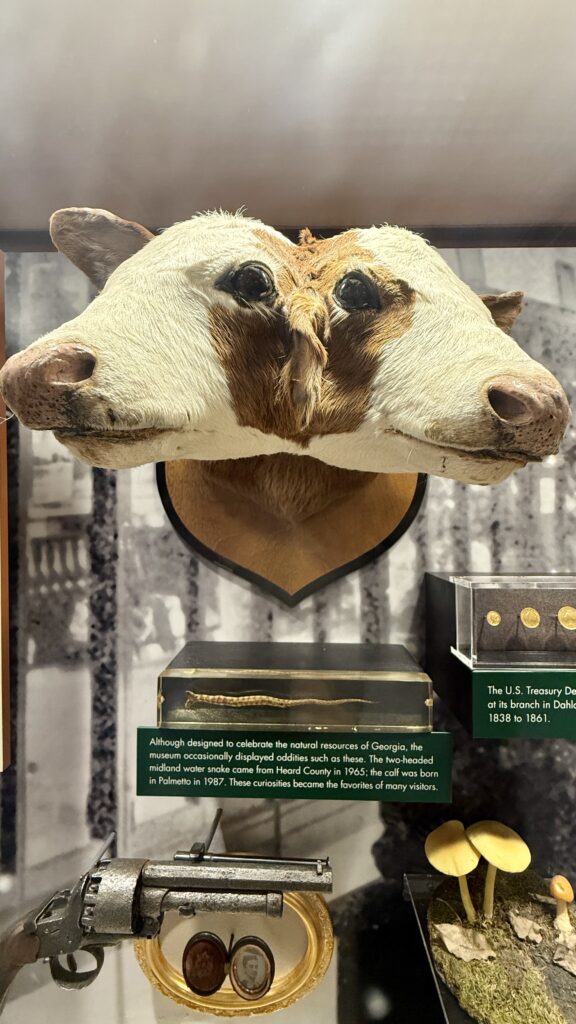
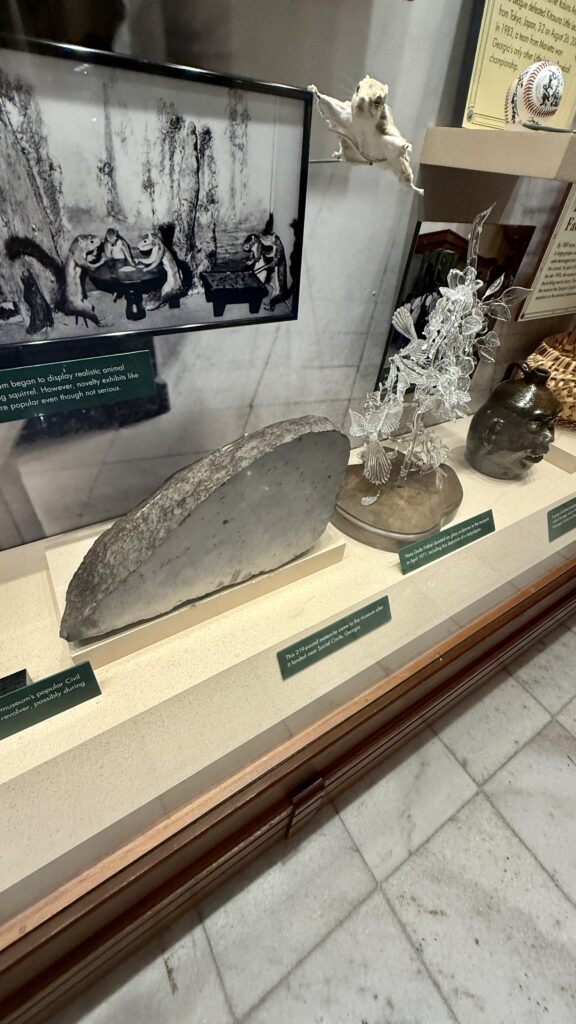
The fourth floor comprises a museum of Georgia artifacts, gems, agriculture, fun facts and oddities. Probably the most intriguing are the two-headed cow and two-headed snake. These reminded me of the movie Dupont, and made me wonder if there was something in the water from where these animals drank. Here are a few pictures from the museum. One could spend a lot of time reading everything up there.


À la prochaine…hasta la próxima vez…until next time!

State Capitol 17: Florida State Capitol

the metastatic breast cancer journey banner

February 7, 2025. Tallahassee, Florida.

We finally made it to Florida! The weather is so beautiful, as one would expect (hope for) in the Sunshine State. The humidity so common in the summer months has not yet arrived, and we have had a nice pleasant breeze so far. We left Texas two days ago wearing shorts and t-shirts, stopped in Baton Rouge, Louisiana and then on to Tallahassee, where we visited the State Capitol.

I wouldn’t say this is the most exclusive of the buildings we have toured. After seeing 17 to date, we have a general idea of what capitols might include. Big domes, cupolas, grand marble staircases and columns, famous artwork, rare and exotic wood, historic artifacts, governor’s office, senate, house, and the supreme court amongst other things. Tallahassee has a new capitol building that is 22 stories high with an observation deck overlooking the city. It houses all the current workforce. The New Capitol overshadows and dwarfs the smaller, Old (Historic) Capitol, which the state outgrew many years ago and has since been turned into a museum.

This is the fourth building to serve as a capitol for Florida. A log cabin served as the first capitol, erected just two days after Tallahassee became a territory in 1824 (Florida would later become a state in 1845). The cabin was replaced by a 2-story frame structure. The third Capitol was built in 1845. (Can you guess why? Hint: the date.) They considered demolishing that Old Capitol building, but thankfully cooler heads prevailed. The Old Capitol was restored to its 1902 state, and is now home to a museum similar to the ones we have seen in so many of the other capitols we have visited. The New (current) Capitol was built between the years 1973-1977, and opened in March of 1978.


This building does have a couple of interesting features. The State Capitol is one of four official Welcome Centers for the State of Florida. We stopped at the one in Pensacola and got some free orange juice, which they do not serve at this one. I’m not sure other state capitols have official welcome centers inside their buildings. Wikipedia was not helpful.

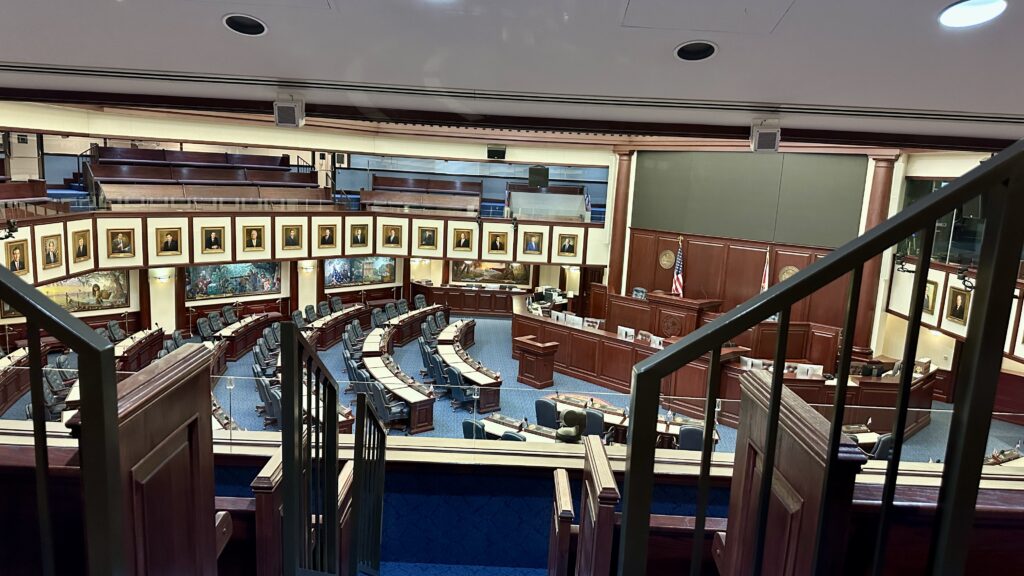
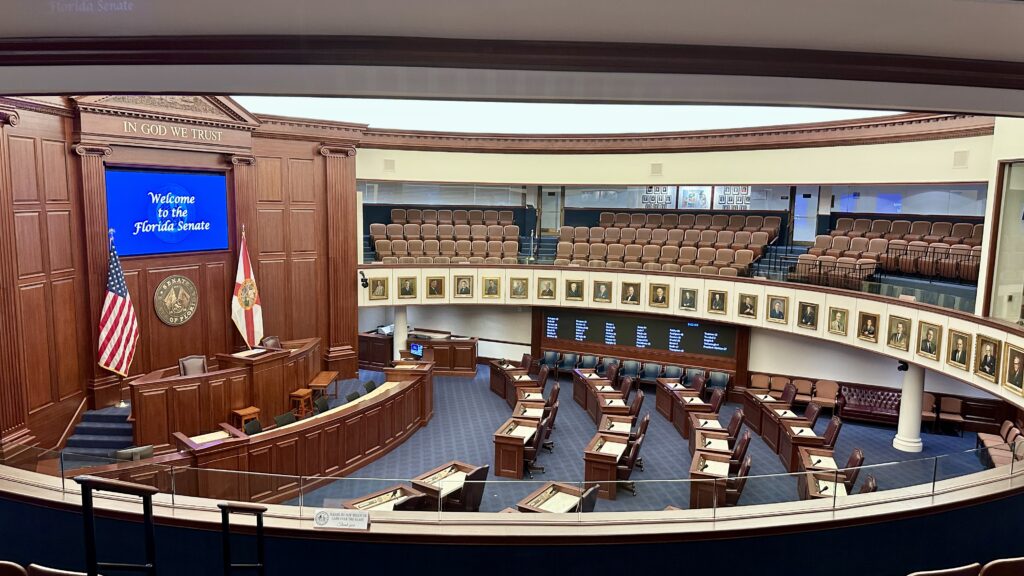
The lower floors have a nice display of the Florida State Seal, Florida Halls of Famers, and Florida fun facts. Of course there are chambers for the House of Representatives and Florida Senate where we looked down on from the galleries, but we couldn’t go inside.

FLORIDA FUN FACTS

  • STATE DAY: April 2nd
  • STATE MOTTO: In God We Trust
  • STATE NICKNAME: Sunshine State
  • STATE FLOWER: Orange Blossom
  • COUNTIES: 67
  • STATE PIE: Key Lime
  • LENGTH NORTH & SOUTH: 447 Miles Long from St. Mary’s River to Key West
  • WIDTH EAST & WEST: 361 Miles Wide from Atlantic Ocean to Perdido River
  • ACQUIRED BY UNITED STATES: From Spain by Treaty 1821
  • ADMITTED TO UNION AS STATE: March 3, 1845
  • RANK AMONG STATES OF ADMISSION: 27th

More Florida Fun Facts:

  •  27 first magnitude springs – more than any other state – and more than 200 total springs. (Wakulla Springs has the longest and deepest known submerged cave system in the world.) 
  • Ranks first in amount of groundwater of all states. More than 11,000 miles of rivers, streams, and waterways. Approximately 7,700 lakes of 10 acres or more.
  • Approximately 1,200 miles of coastline,
    2,300 miles of tidal shoreline, 650 miles of beaches.
  • 4,510 islands of 10 acres or more.
  • 3 national forests comprising more than 1.1 billion acres.
  •  Sunshine about 66% of daylight hours
  •  No point more than 60 miles from coast
  •  4th largest state by population; more than 80% of Floridians live less than 10 miles from the coast

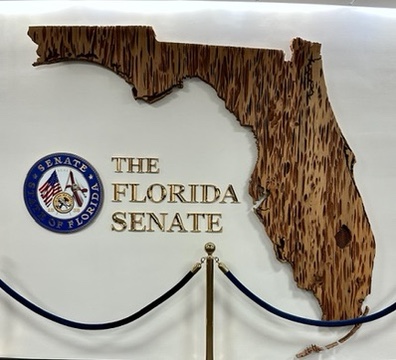
An interesting carving titled “Resilience” is on display outside the State Senate. The plaque tells the story of the carving and the wood, which I’ll repeat here as well.

“Resilience”

Signifying the resilient and enduring spirit of Floridians, Resilience showcases the unique silhouette of Florida, highlighting the barrier islands of the Space Coast, the Northern flowing St. Johns River, Tampa Bay, the beaches and islands of the Emerald Coast of North Florida, the Florida Keys and many of Florida’s other unique natural features.

Resilience is constructed of pecky cypress recovered from the Ocklawaha River in North Central Florida.

This distinctive wood is unique to the Southeastern and Gulf Coastal Plains. The holes within the wood occur when a fungus enters a cypress tree after a limb falls or an injury to the tree occurs, typically in cypress trees more than 100 years old. Over time, the holes grow in number and size; however, the spring fed, low oxygen waters of certain Florida rivers protect the wood from decomposition. Estimates indicate the cypress wood used in this sculpture was originally harvested during Florida’s Steamboat Era, the time of the territorial State Senate.

We enjoyed visiting both the New and Old Capitol buildings. The New Capitol has an enclosed observation deck on the 22nd level, overlooking the city. It was foggy and cloudy when we went up there, so we couldn’t see very far away, which of course was disappointing. Try to go on a sunny day if you have options. Two groups from very different schools were also touring the building. It was interesting to see the first group, dressed in street clothes. They were not necessarily unruly, but they didn’t demonstrate the same decorum and level of respect as the second group, dressed in Ivy League uniforms.

Art exhibits are rotated on the top floor. Famous Noh Masks were on display around the deck when we were there. There are a few other interesting pieces of art, but otherwise, it’s a pretty neutral building. The exterior is also under construction, which makes it hard to find one’s way around to the visitor’s entrance. The Old Capitol has a small dome with stained glass,

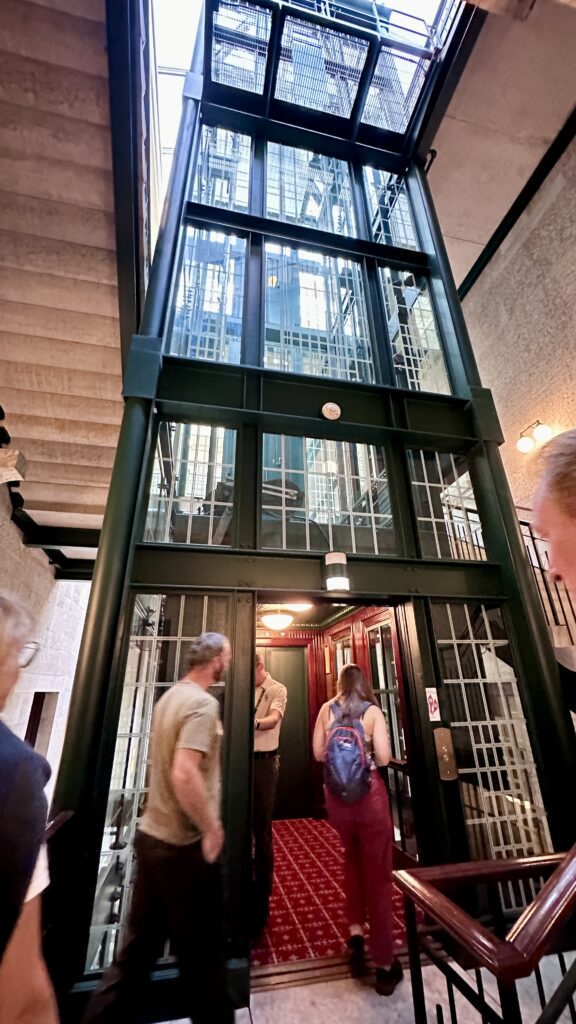
One thing that really impressed me about this capitol was the elevator system. I know! It’s not a big deal, right? But it was the first time I have seen this technology in use. It has apparently only been around for the past few years, and is used in tall buildings around the world. Quite cool if you ask me. Watch this brief video of us using the elevator system, and be sure to watch to the end for views from the observation deck (and Noh masks).

Florida State Capitol Elevator to the 22nd floor (observation deck)

The Old Capitol. The Old Capitol building has been turned into a museum, displaying artifacts among the hallways and chambers of the three branches of government: executive, judicial, and legislative.

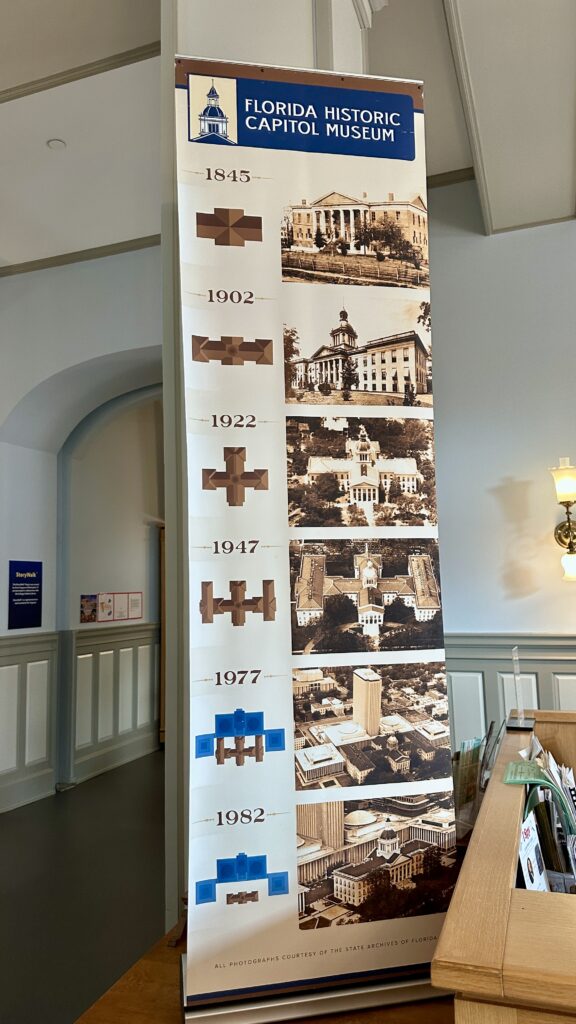
One of the historians showed us how the Old Capitol has changed shapes over the years, and how it now fits inside of the New Capitol as it has been since 1982. You can see its transformation in the banner at the welcome desk.

There is a glass dome, which is a replica because the old one was removed when it started leaking within the first year after it was installed. Interesting fact: When they restored the building to its 1902 glorious self, they found over 100 pounds of broken dome glass in the walls of the building. The original glass was made by the Opalescent Glass Works, who also made the glass used by Louis Comfort Tiffany in their famed lamp designs. Perhaps hiding it in the walls was some worker’s way of saving the beautiful glass pieces. Or, it was simply easier than throwing it all away. Makes me wonder what we will find inside the walls of our new house that is currently under construction. The things that make you go “hmmm.”

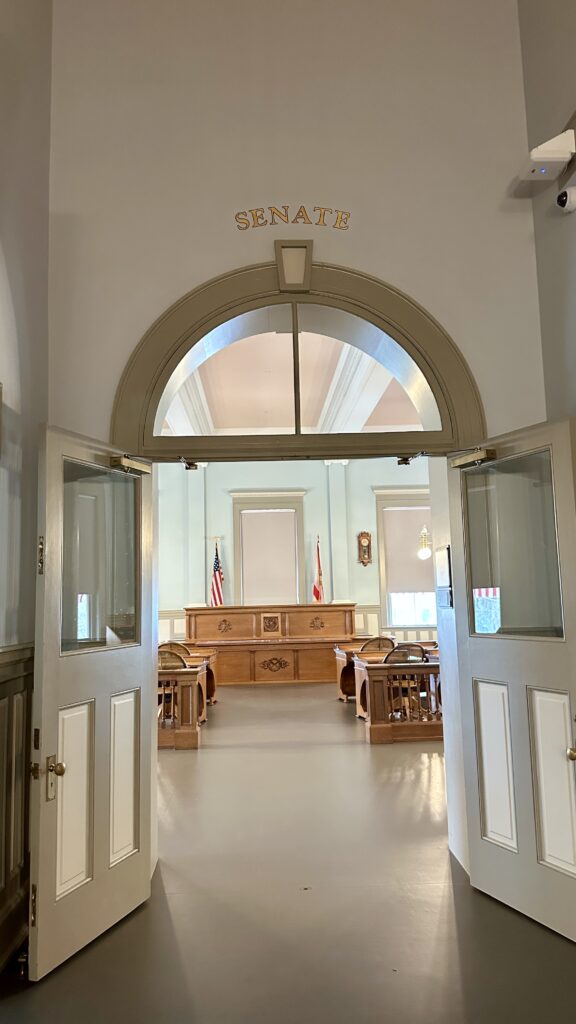
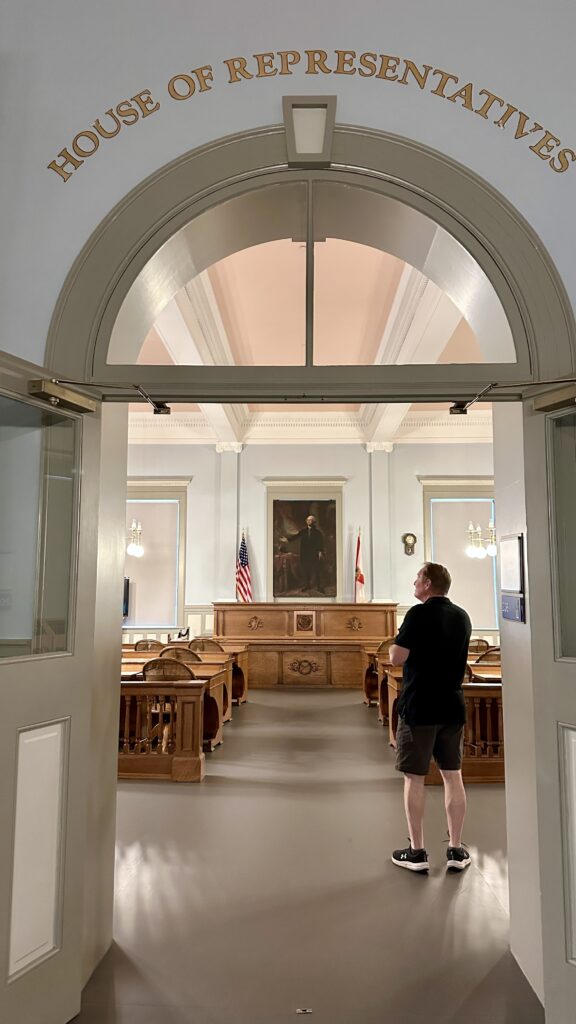
Senate, House of Representatives, and Supreme Court in the Old Capitol are interesting to look at. Hard to believe Florida population used to be small enough to only need a building this size.

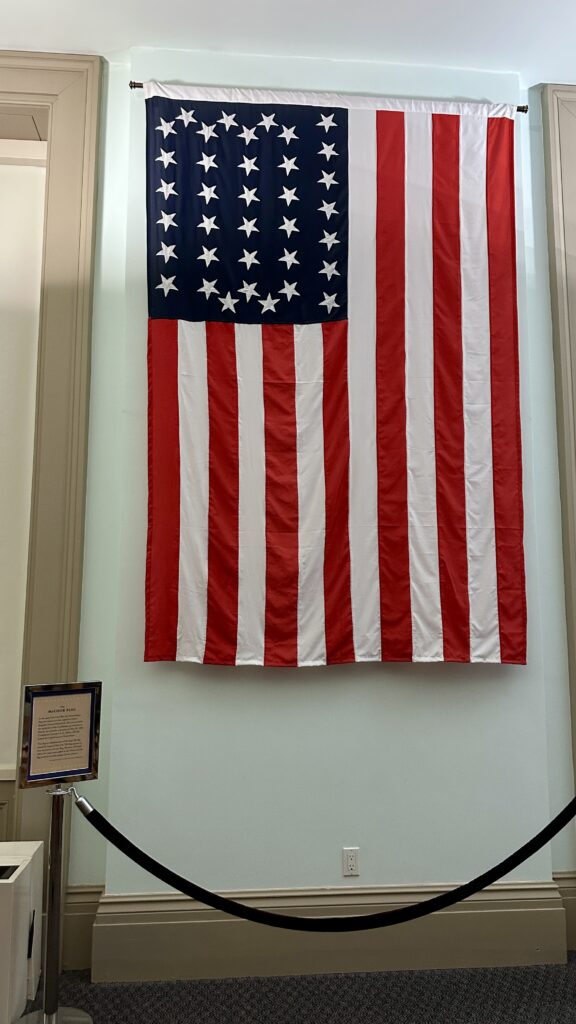
THE McCOOK FLAG

At the end of the Civil War, the United States Flag was raised over this Capitol as Union Brigadier General Edward M. McCook received the surrender of the Confederate government in Florida. In a transfer ceremony on May 20, 1865, Confederate Governor A. K. Allison officially turned the Capitol over to Union forces.

This flag is a reproduction of the large silk flag owned by General McCook. The flag appears to have started as a 31-star flag. Between 1858 and 1865, five states were added to the Union and the flag evolved into this unique 36-star pattern.

The original McCook flag is in the collections of the Museum of Florida History.

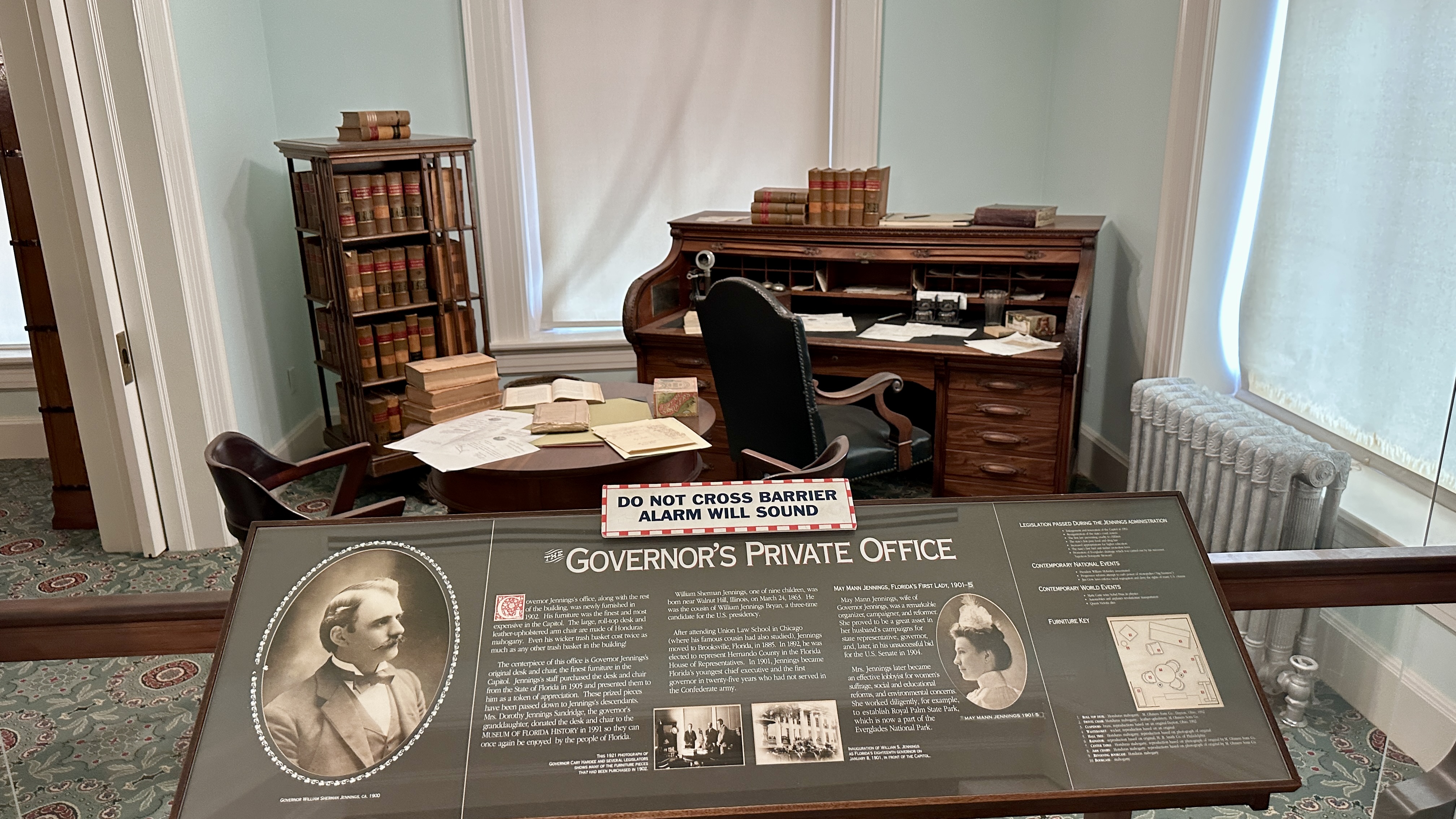
The governor’s private office is seen in the Old Capitol Building, along with some more historic flags and the Mountain Howitzer that sat on the Capitol steps for 70 years. “The roll top desk, made of Honduras mahogany, is Jennings’ original desk. William Sherman Jennings served as Florida’s governor from 1901 to 1905.”

This was the office room for the governor’s staff; a secretary, Mr. Charles Dickinson of Madison, Florida, and a stenographer, Grace Irene Marietta Mann, Governor Jennings’ sister-in-law. The large document file cabinet was in the room after 1902 and is almost completely original. Some of the original labels can still be seen, including “W. S. Jennings Private” and “Bank Pardons.”


When we got back to our hotel (where we stayed for one night), Tim had some things to say about the Capitol as well. This brief video pretty much says it all.

I hope you enjoyed our little tour of the Florida Capitol. Sign in and comment below to let us know what you think! I promise we won’t bug you or send you a bunch of spam emails, but it will give you an opportunity to interact with us in the comments.


À la prochaine…hasta la próxima vez…until next time!

State Capitol 16: Kentucky State Capitol

November 1, 2024. Frankfort Kentucky.

I grew up in southern Ohio, and I remember hearing as well as repeating this joke. How do you pronounce the capitol of Kentucky: Lou-EE-ville, or Lou-IS-ville? Answer: Neither, it’s Frankfort (insert rimshot) 🤪.

The entrance to the building is nicely decorated with flowers, paths, and street parking big enough for a King Ranch pulling an Airstream 😁. It was a little confusing as to where we should enter the building, as the signs were misleading. We just missed an opportunity to enter the Capitol a day earlier. Costumed trick or treaters were given candy by the governor inside the building last night. Mischievous ghosts and goblins might account for the entrance signs leading you in a circle 😂. But today we were the first (and sole) visitors, so it was a peaceful tour. 

From the top of the stairs, at the entrance to the KY State Capitol.

The guided tour wasn’t for another hour, and we were on our way home, so we just walked on our own with the self-guided brochure. The tour desk lady provided some valuable information about things we should not miss before we began. And she stamped our passport on the way out.  (Don’t forget the stamp!)

We met a man under the rotunda who told us that if you rub the boot of Lincoln, it is supposed to bring you good luck. That is why his boot is so shiny under the rotunda. Click the link below to see a short video of our interaction, as well as the changing lights under the rotunda.

Kentucky State Capitol Rotunda

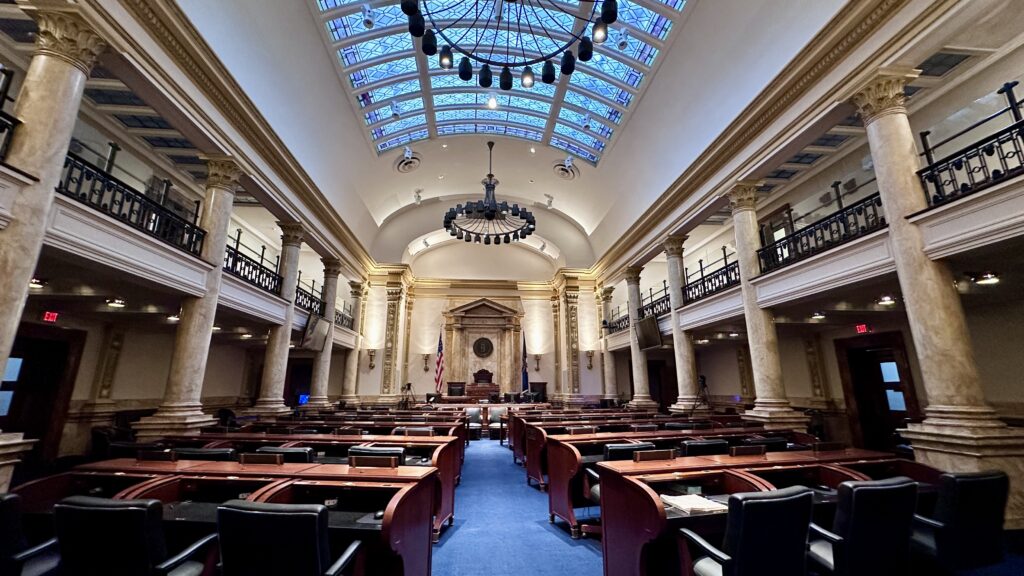
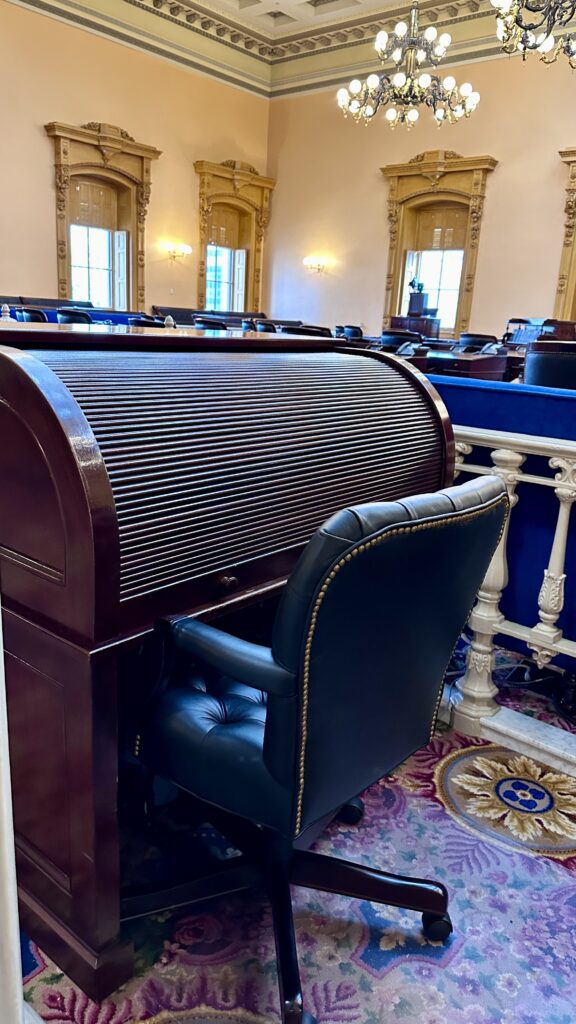
The House of Representatives and Senate were next. While they look alike, you will see the House is more arched and contains beautiful roll-top desks. We walked around and even sat in the chairs (they are very comfy), which isn’t permitted in some of the Capitols we have visited.

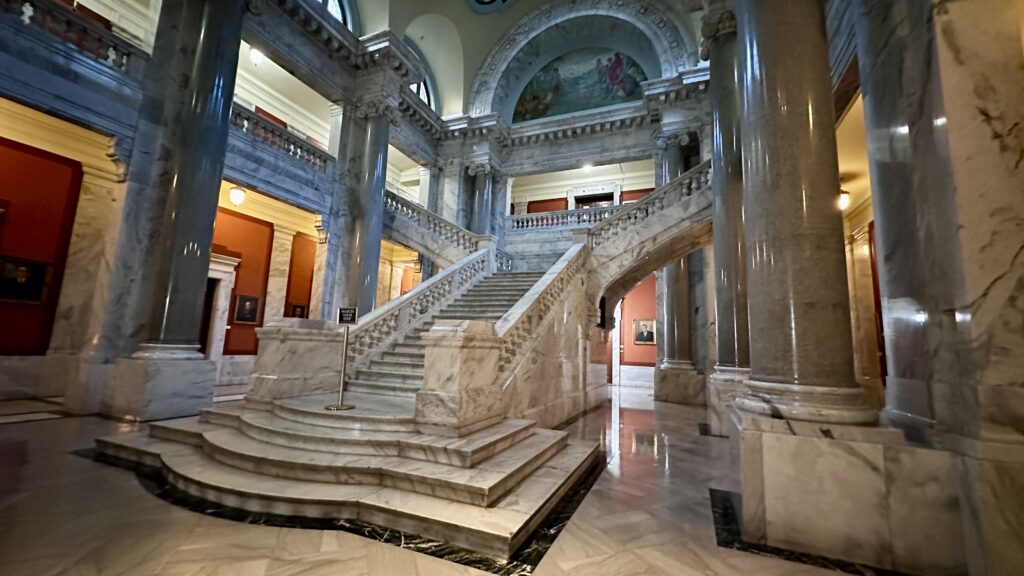
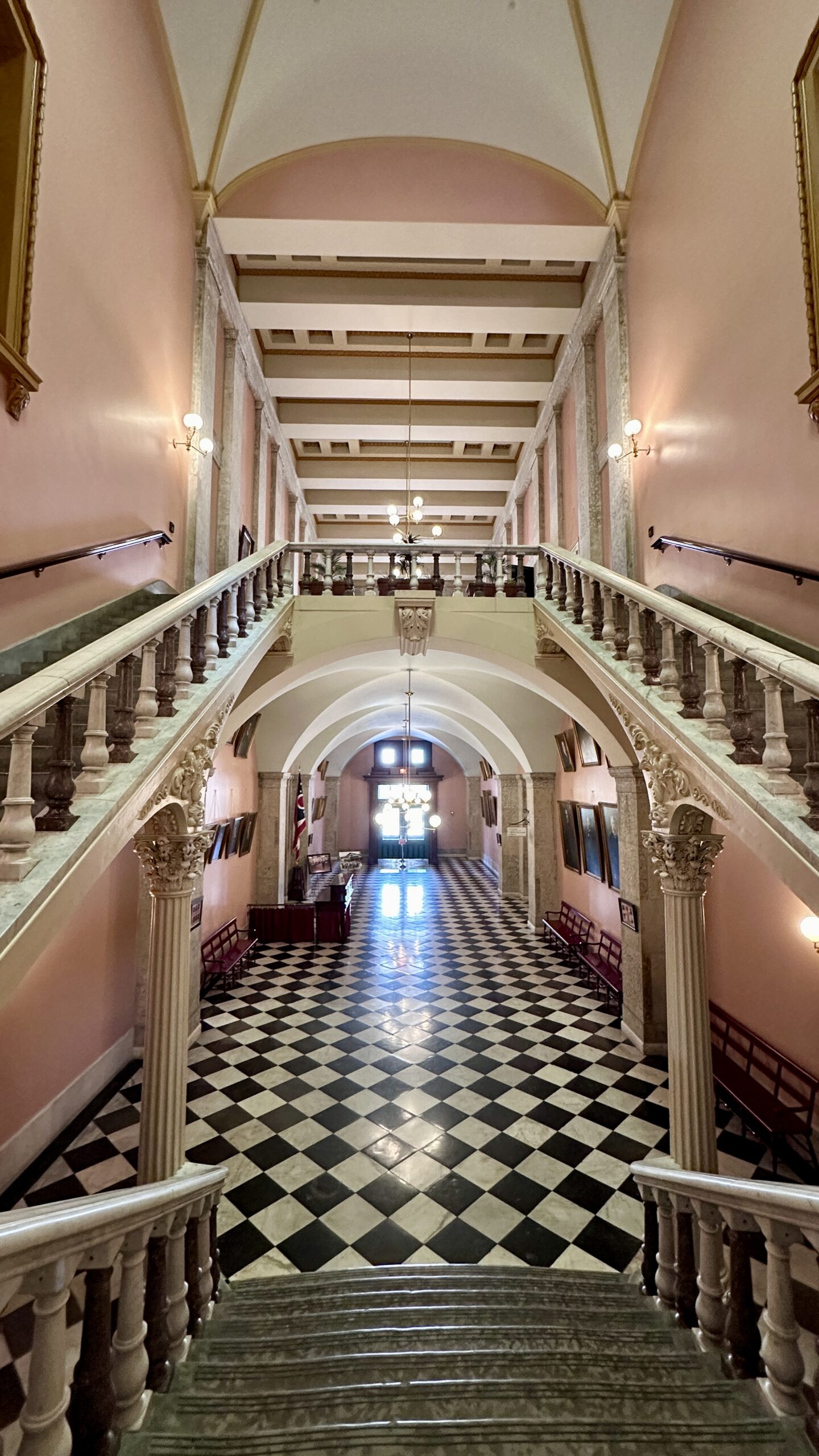
Grand marble staircases lead from one floor to the next, with artwork to greet you at the top. I’m sure all the artwork would have a story if we had taken the guided tour. The lady at the tour desk cautioned us on the stairs. Apparently they can be slippery and a few people have fallen.

Infinity mirrors are a fun find in the State Reception Room. I found it ironic that no food or drinks are permitted in the reception room. Isn’t that what you expect to find in a reception 🤪 😂?? Paintings decorated the walls, painted to look like antique tapestries.

Unique aspects are the shifting light colors in the rotunda seen in the previous video, the infinity mirrors in the State Reception Room, and the irreplaceable mahogany wood from the Honduran rainforest found in the Supreme Court Chambers seen in the short video below. I told Tim I hope they planted some trees after that!

Kentucky State Supreme Court

I always love looking at the displays of First Lady dolls (and even a dog in this one), similar to the ones we have seen in other Capitols. Here are the first and current First Ladies. It’s fun to witness how the dresses have changed over the years.

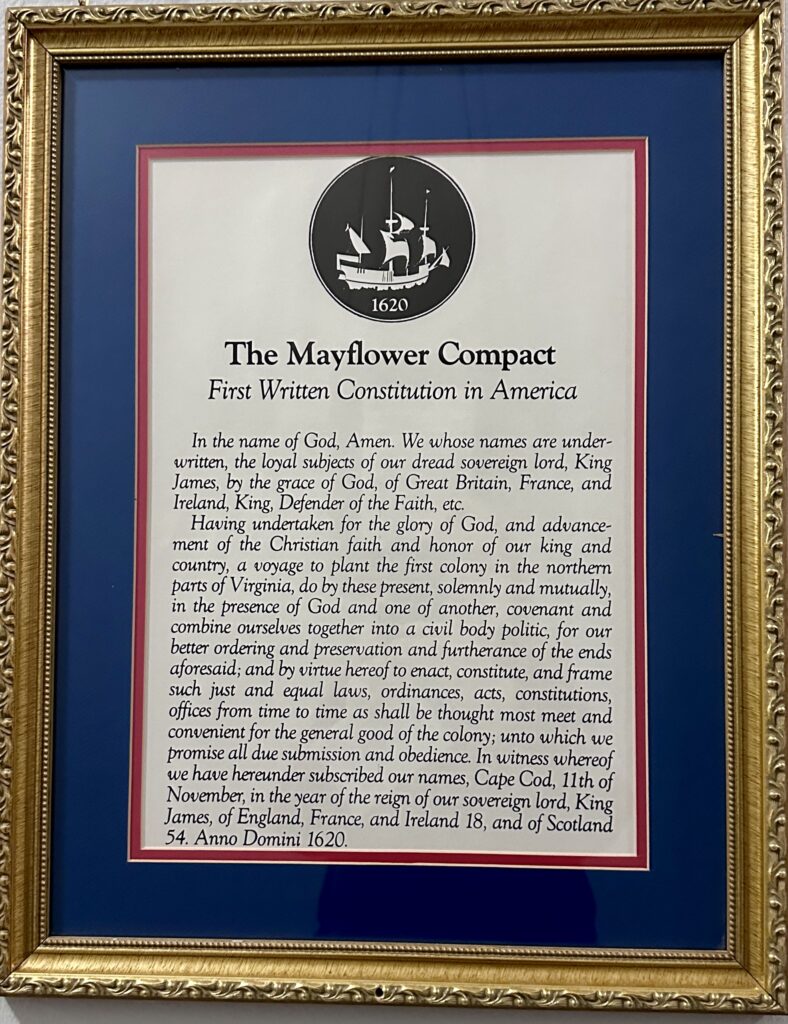
In the basement, frames lined the walls with important documents that have been a part of our American History, including The Mayflower Compact, the Magna Carta, Declaration of Independence, The Bill of Rights, the Constitution of Kentucky, The Star Spangled Banner, a picture of Lady Justice, and several more. Amongst these prestigious documents governing our land was The Ten Commandments. We were pleasantly surprised to see it there.

Even though this might not be the most ostentatious of the Capitols we have seen, it is certainly noteworthy. Tim described it as the “most comfortable” of the Capitols we have toured thus far. It is certainly roomy, and one could easily get lost in there.


À la prochaine … hasta la próxima vez … Until next time!

State Capitol 15: Ohio Statehouse

the metastatic breast cancer journey banner

Wednesday, October 30, 2024. Columbus Ohio.

We dropped off our Airstream at the Mothership for some warranty repairs, which I’ll cover in another blog. While they were working on it, we rented a car and took an overnight trip to Columbus so we could get our passport book stamped at the Statehouse. Somewhere around Zanesfield, we saw one of the transport trucks carrying new Airstreams to their destinations. It could be yours!

I grew up in Ohio, but I don’t recall ever spending much time in Columbus. It was fun to visit the city and spend the night in a King-sized bedroom with a walk-in shower that we could stand under as long as we wanted. Fortunately we looked ahead and learned that the Statehouse was not doing any tours on October 31st. We originally planned to go on Halloween, but we changed our plans when we discovered they would be closed, stopping on the way to the hotel rather than going the next day.

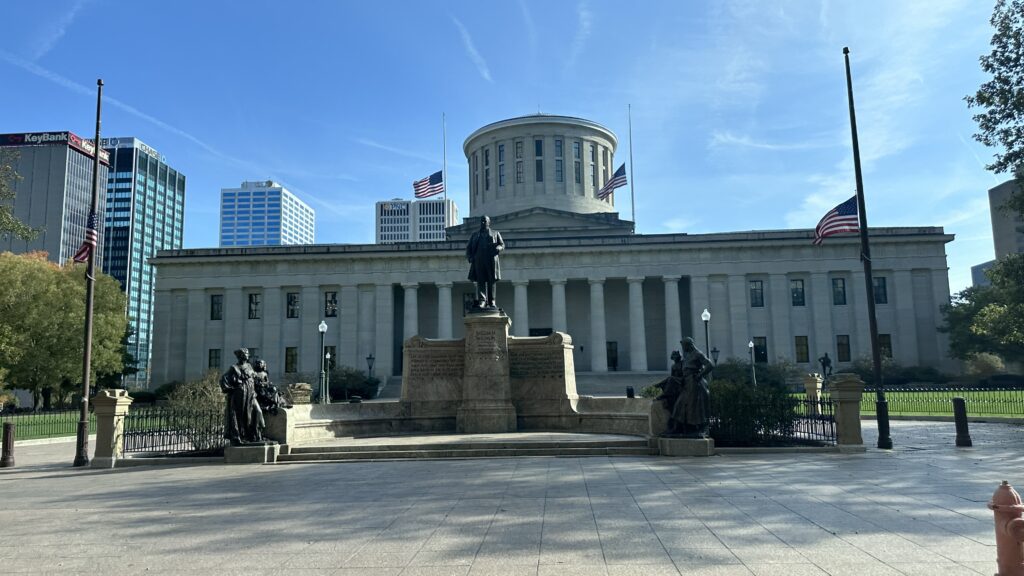
It’s always a good idea to check for hours of operation before your visit to any State Capitol. You will see flags flying at half-staff in this picture. We would later learn from our tour guide that Ohio’s first female House speaker, Republican Jo Ann Davidson, died at 97 years of age earlier this week. Among her many other accomplishments, she was largely responsible for the Capitol’s restoration project. She made a commitment to keep the old Statehouse features rather than building a new one. Her portrait is the only one displayed in the entire building. Tomorrow is her funeral so there will be no public or private tours. 

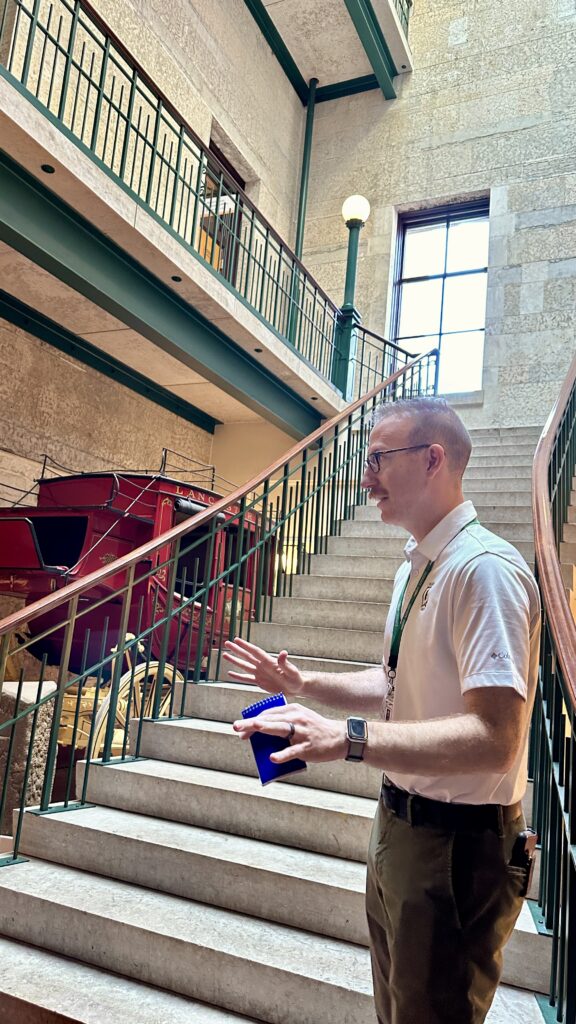
Ohio Statehouse. We had a good tour guide. Take away the mustache and he reminded us of one of our pastor friends (you know who you are). He started by having us stand on the map of Ohio that was crafted into the floor. The information was reminiscent of my early school years, learning Ohio History.

Ohio is the 7th largest in population. This building is called a Statehouse because of its architecture, rather than a “Capitol,” although it is the capital of Ohio. The interior and exterior have different architectural designs, built in the Greek Revival style, constructed from 1839-61. The interior is Roman, whereas the exterior is Greek, plain and unadorned. This was intentional to save money.

Private citizens exerted their wealth and will to get the Capitol where they wanted it, and that’s exactly how it was paid for. Because of their economic influence, the capital of Ohio moved cities several times in its early history. Ohio limestone is found on the stairs and the walls. The building was restored in the 1980s, back to its original 1861 style.

After much movement, Ohio finally established a law that says the state Capitol has to be within 40 miles of the center of the state. That’s how it ended up in Columbus, and that’s where it has stayed since 1861. Interestingly enough, the state motto is “With God All Things Are Possible,” which is written in the Passport Book.

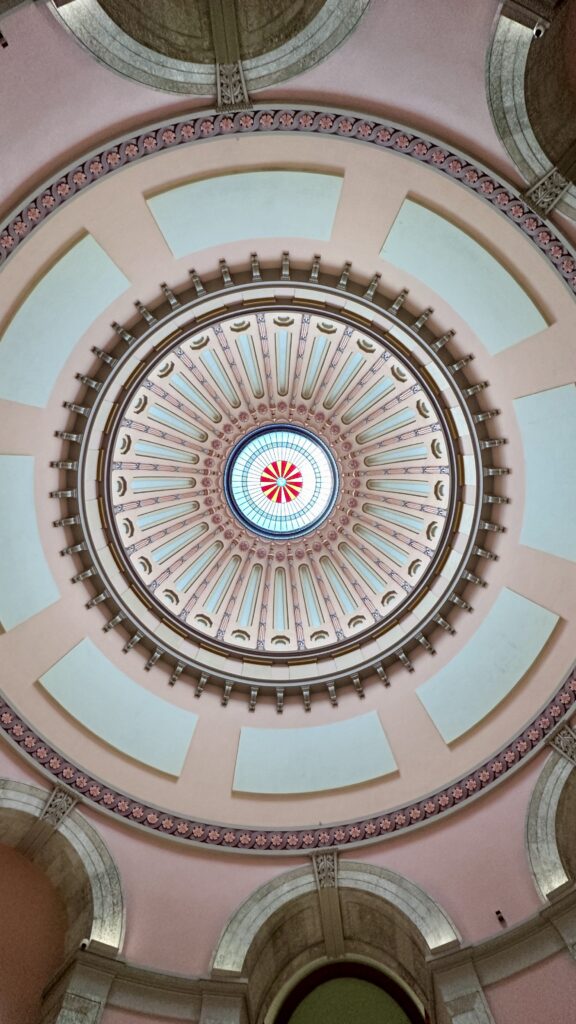
I learned (re-learned?) something about architecture during this tour. Domes are Roman. Cupolas are Greek. (The Florence Cathedral provides an example of both, if you want to click on the link or Google it.) The Statehouse has a dome pictured here, but since the outside of the building was meant to be Greek, and the style of the dome did not conform to the Greek architecture of the exterior, they had to cover it with a cupola.

While we were there, they were hosting a reception and making preparations for the big funeral about to take place. Normally the tour would go right through that hallway, but we had to take the long way around to avoid any interruptions.

Corinthian columns are found in the Senate and House chambers, but this was considered too ornate. An architect was fired for going over budget with the details. 

Unlike other Capitols we have seen with expensive wood from exotic places, Ohio used pine throughout the building to save money. They painted the pine with a wood grain to look more prestigious. 

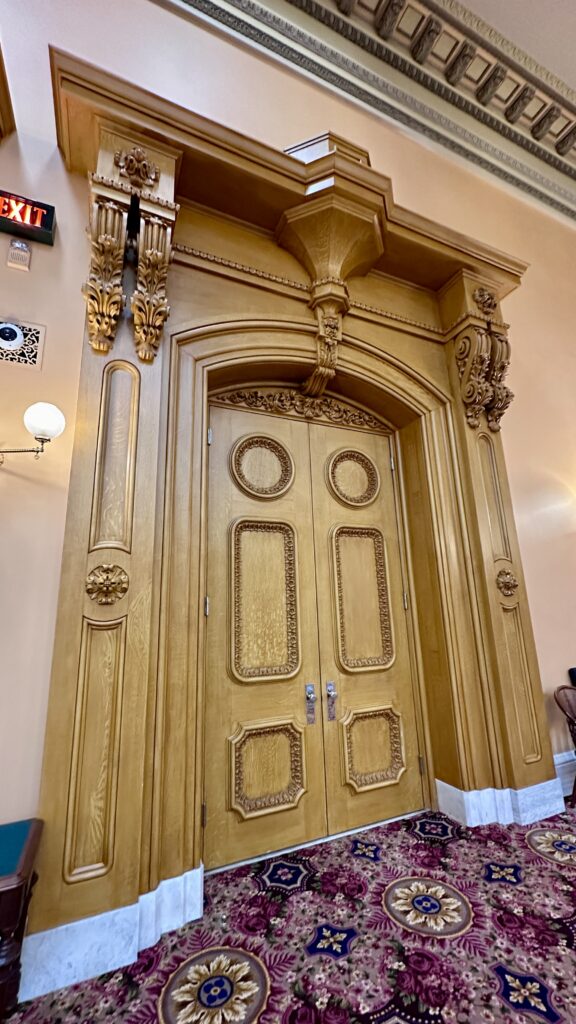
It was hard to tell the wood on this door and frame was pine at first glance, so it’s always nice to have a tour guide point out those intricate and interesting details. I was raised with this type of frugal mentality, which was common in southern Ohio at that time, possible values passed down from the government.

The Senate and House look very similar, except you can see the Senate has telephones on the desks, and the podiums are different. They didn’t spare the same expense there, as they are made mostly out of marble. This is unique than most of the Capitols we have toured, as the House and Senate are typically very different in their appearance, from the carpet to the chairs, the podium and the chandeliers. Again this speaks to their financial frugality while making a very nice place to hold sessions.

During renovations in the 1980s, they uncovered muse murals and other features that were covered up and “lost” sometime in its history. 

I may have shared a bit more in this Statehouse blog, since it’s from my home state. It was an interesting visit, and I do recommend taking the tour. We may go back for a second visit, as there is an entire museum we had to miss in the timeframe we had. I also read online the “World’s Largest Steel Gavel Sculpture” is located in downtown Columbus near the Ohio Supreme Court building. Somehow we missed that.


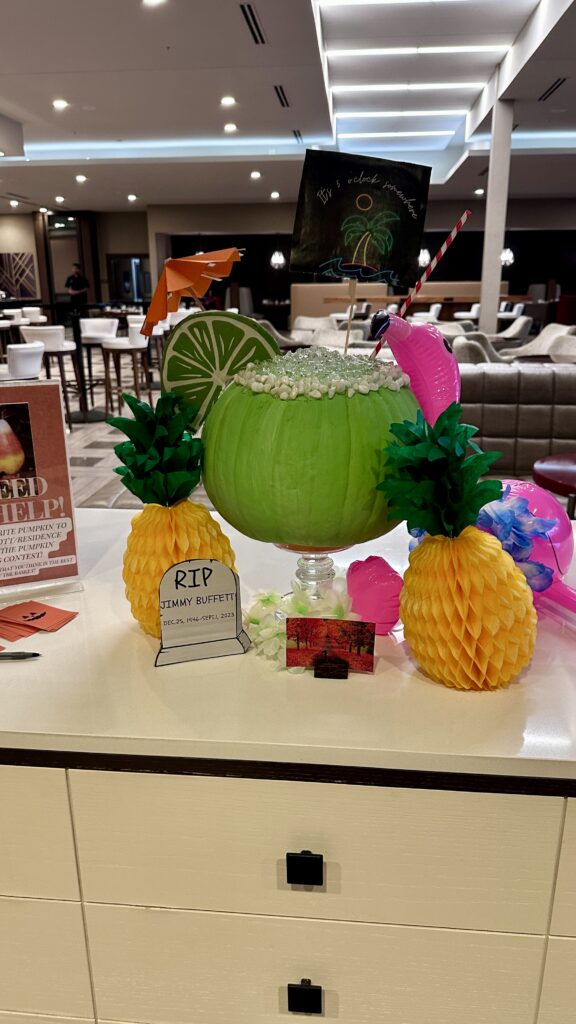
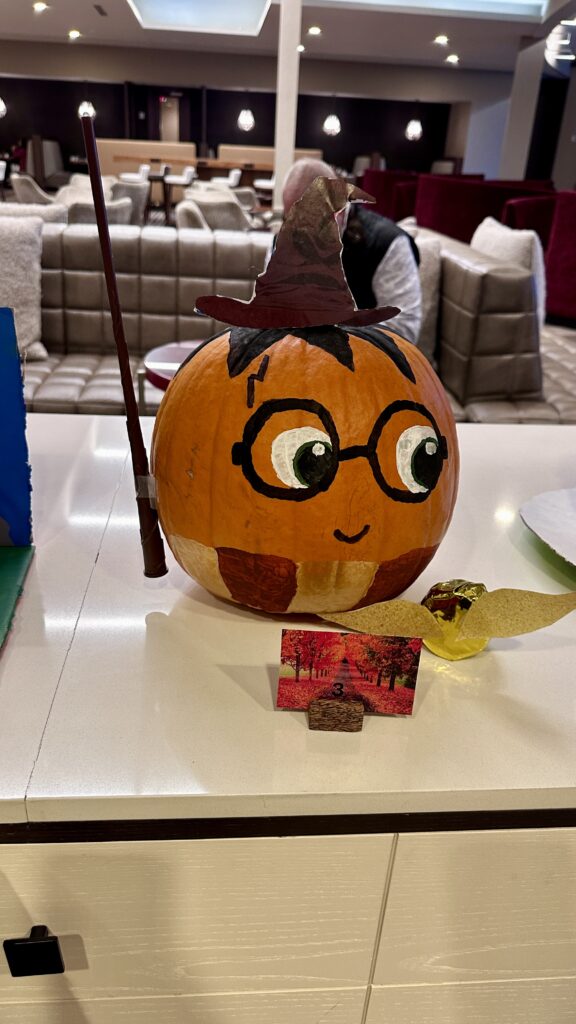
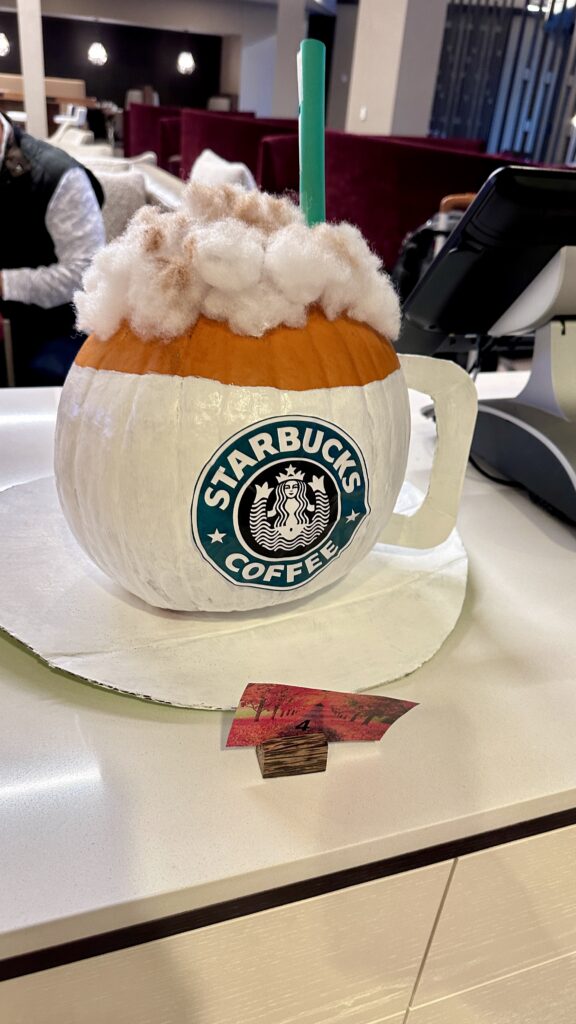
Back at the hotel, a pumpkin carving contest was in process. Here are the very creative pumpkins the staff came up with, one of them nodding at the famous Jimmy Buffet. It seems “carving” has morphed into “painting” these days. But hey, in the words of C. S. Lewis, “Have fun, even if it’s not the same kind of fun everyone else is having.”


À la prochaine … hasta la próxima vez … Until next time!