March 25, 2026. Raleigh North Carolina and Columbia South Carolina (with a little Congaree in between).
After passing security, the tour desk worker stamped our passport and handed us a slick 6-panel, trifold brochure for our self-guided tour of the North Carolina State Capitol.
Stamp #38! Sound on.
Back to another short capitol tour! We thought an hour on the parking meter would barely suffice, but we were in and out and down the road before my 45-minute timer went off on my Apple watch. The North Carolina Capitol only does guided tours on the weekends, or for school groups during the week. We were there on a Wednesday, while passing through after eating our cooked-to-order breakfast (French toast) at a hotel along the way.
This is the second Capitol building to be built on this location. The first building was a simple, two-story brick State House, completed in 1796, later enlarged to add a third floor, dome, rotunda, and eastern and western wings. That one burned down in 1831 when workers were fireproofing the roof and accidentally set it on fire (ironic, eh?). The current building was built in the Greek Revival style, popular in Europe and the United States at that time. The roof and dome are made of copper, which patinaed to a green/blue over time.
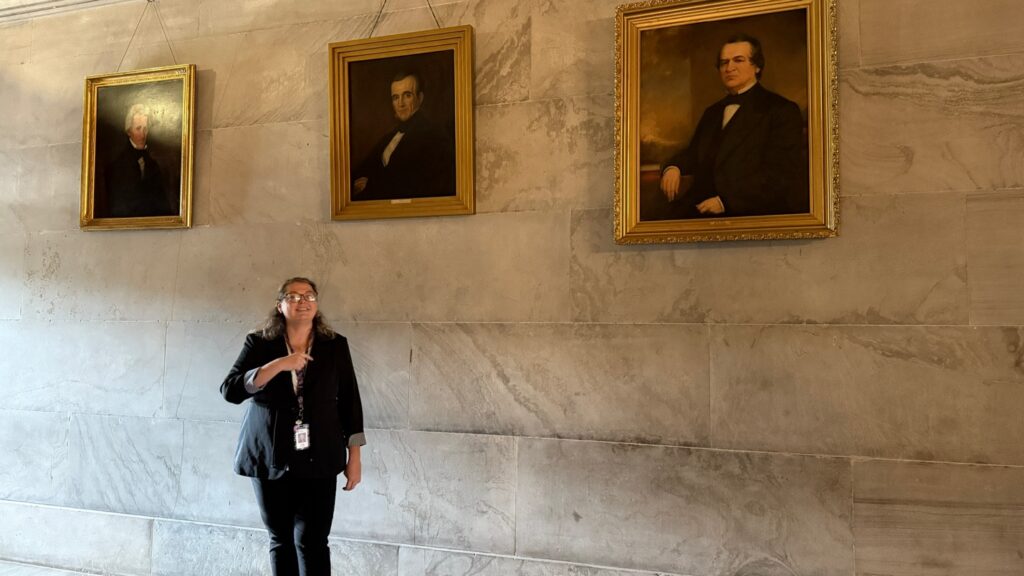
James Knox Polk, Andrew Jackson, and Andrew Johnson are proudly displayed in front of the North Carolina State Capitol, with the title: “Presidents North Carolina Gave Their Nation”
Immediately after picking up our brochure, we were greeted by a larger-than-life statue of George Washington underneath the dome, the same one pictured on the cover of the brochure, but very different from the regal, marble statue we saw yesterday in Richmond. Washington was sculpted to look like a Roman General, wearing the tunic, sandals, tightly fitted body armor, and a short cape fastened at the shoulder. He didn’t look like George at all! The idea was intriguing, but we didn’t really care for it. The original statue by Antonio Canova was destroyed in the State House fire. An Italian artist Romano Vio used his working model to create the replica, which was placed here in 1970. In our opinion, they should have gotten a clue from the fire. But what do we know?
Governor’s Office
Only the Governor’s office remains active here (encompassing the first floor including staff). Official business also occurs from time to time including press conferences, bill signings, oath of office ceremonies, special sessions of legislature, and commemorations.
Senate and House Chambers
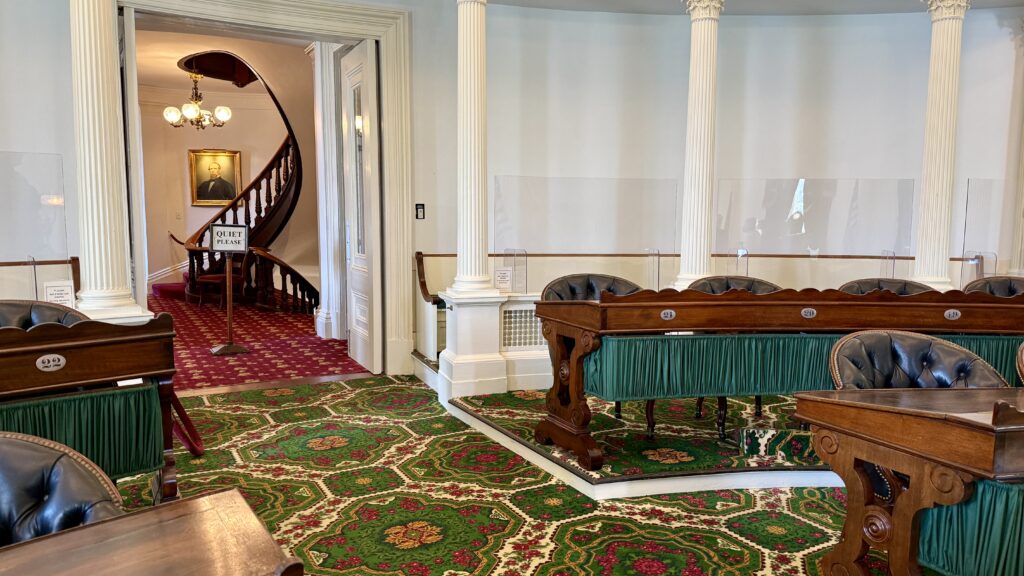
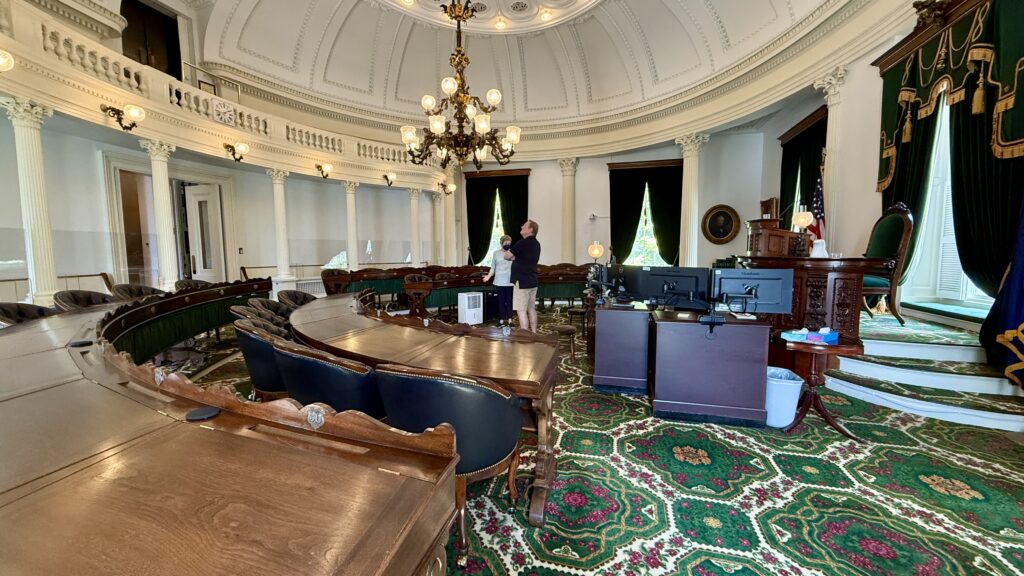
Regular senate and house sessions are no longer held in this building. The second floor holds the two old chambers of Senate and House, restored to their original charm, serving as a museum for visitors like us. First we walked into the Senate, and then the House.
Door to the SenateSpittoon as it used to be!Fireplace to keep warmSenate Chamber 1840-1961.House of Representatives, 1840-1961. Thomas Sully’s 1818 portrait of George Washington is seen above the speaker’s podium. The painting was saved during the State House fire of 1831.
Second Floor.
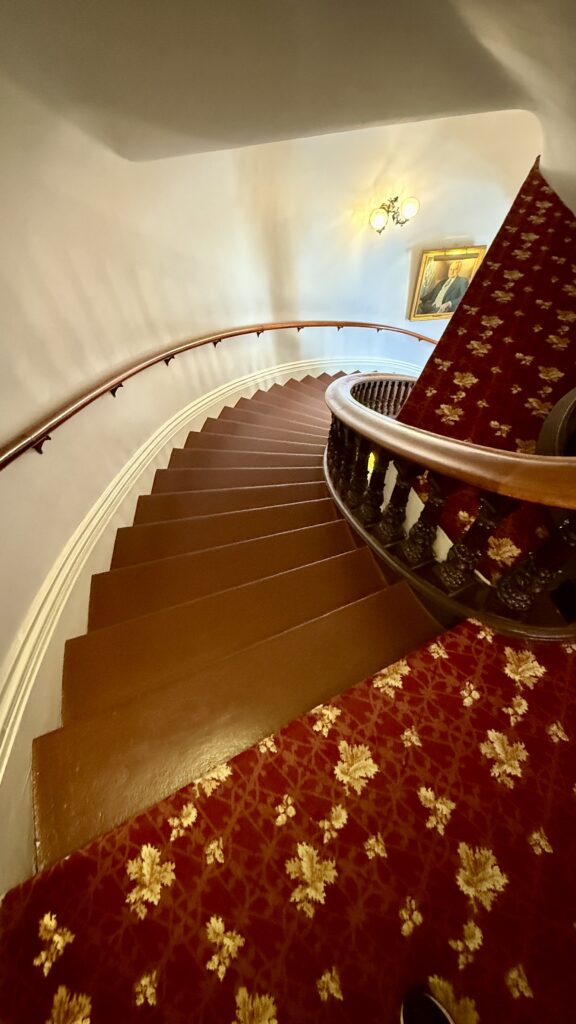
Plaques line the hallways around the staircase leading to the second floor. Several display information about the slavery that took place in North Carolina. One plaque I found interesting revealed information about the State Treasurer John Haywood, who served 40 years and died in office. Not long after his death, they discovered nearly $70,000 missing from the treasury. (That’s about $2.36 million today!) His peers vouched for his character, claiming it must have been an error; however, the state required his personal estate to pay back the debt. They sold all his belongs, including 100+ slaves, at a public auction in 1828, leaving his heirs with no inheritance. The title of the plaque: “110 Valuable Slaves.”
Another slave story is found in the brochure. Local enslavers rented their slaves to the project for the construction and state operated quarry. We can thank over 130 enslaved African Americans who worked on the Capitol from 1833 to 1840 as “quarrymen” and general “laborers.”
Pen-Check Stairs.
Fun Fact! There are two of these staircases between the second and third floors. I don’t feel like rewording the description from the brochure, so I’ll just include it here. “Two free-standing stone staircases…are carved from solid stone and joined so that the weight of each step is directed on the one below it. Ultimately, the weight of the entire staircase is supported by the base step, which is embedded in the stone floor.” Amazing design!!
These stairs lead to the galleries as well as the State Library. We skipped the third floor in the interest of time (and legs). We had a late night last night, and a full day ahead.
Capitol Grounds
On the way back to the car, we saw some flowering trees as well as very large trees. One of the biggest magnolia trees I have seen is below, and look at the tree by Tim in the third picture below. Can you find him? It was still a bit chilly for us Texans, but the blue skies made a beautiful backdrop.
On to South Carolina!
Congaree National Park
This was a fairly easy National Park for us to get to and it was on our drive path where we caught five capitols and a National Park on our road trip home from Connecticut. Tim had two onsite visits with churches who are looking for pastors in Connecticut and Pennsylvania. It’s a long way from our home in Texas, so it’s fortunate we like to be together since we spent a lot of time in the car! We didn’t take the Airstream on this trip, so we will come back one day and stay in South Carolina in the Airstream, but now we can stay where we want instead of vying for space near downtown Columbia or Congaree.
Congaree National Park protects the largest remaining tract of old-growth bottomland hardwood forest in North America. It contains over 26,000 acres, with 15,000 of those acres designated as a wilderness area. The park received its official designation in 2003 as the culmination of a grassroots campaign that began many years earlier, in 1969. They welcomed 287,833 recreation visits in 2025 (ranking 49th out of 63 National Parks). The park is gaining popularity as this increased from 145,929 visitors in 2018 when it ranked as the United States’ 10th-least visited national park. By comparison, Smoky Mountain National Park (#1) received 11.5 million visitors last year.
The Visitor Center.
The Visitor Center is a pretty standard looking building, but it had some visuals to demonstrate the heights and breadth of the trees in this forest. Those were pretty cool. We got another National Park stamp as well!
This year is the Park’s 50th Anniversary, so I nabbed that stamp as well.Haha! The mosquito gauge by the restrooms was fun. We didn’t have to worry about bugs while we were there. This shows how tall the trees can be. They have holes showcasing woodland critters that live inside the trees
The Boardwalk.
This is a nice park to visit when you are time-limited. You don’t have to hike a long way, or see multiple sites that are miles and miles apart from one side of the park to the other (think: New River Gorge). Congaree is basically a walk through the woods on a nice wooden boardwalk.
We walked about 15 minutes or so, then turned around as our time was limited. There are approximately 2.4 miles of boardwalk, but half of it was closed due to repairs while we were there. It’s a peaceful path through an ancient place surrounded by sounds of nature. Well, mostly peaceful. We thought it was a bit crowded for a Wednesday and there is some construction.
Enjoy a few seconds of pure nature. Sound on!
I would like to go back to Congaree and spend a bit more time there walking the entire boardwalk. I would also like to see the fireflies. This is one of the only places in the world where you can see synchronous fireflies, all lighting up at the same time while trying to find a mate. The females have a lot to choose from!
And now, on to our final Capitol on the eastern seaboard.
South Carolina State House
A morning visit to North Carolina’s State Capitol, an afternoon walk through the Congaree National Park, and a final stop to see the building and property at the State Capitol in South Carolina rounded out our long, yet fulfilling, day.
This Capitol was … okay. Not overwhelming. Not underwhelming. We did not get a guided tour…again. It seems we find the capitol buildings less interesting when we have to go it alone, although Tim does make it entertaining!
A Few Fun Facts. If you like history, read the plaque on how the Civil War impacted this building. And then the plaque on how the Poinsettia (yes, the Christmas flower) got its name. Or, keep on scrolling …
Mirror twin wrought-iron staircases face each other, with famous portraits and paintings on the walls. The banisters incorporate the state flower, yellow jessamine.
The Dome.
The Dome is in two parts – an interior and exterior dome. This is a false interior dome, for aesthetic purposes, which fits inside the exterior dome. The exterior dome is made of steel and wood, finished with copper.
Senate and House Chambers.
Legislature was in session, which meant lots of men and women in suits hanging around (and we were in t-shirts and jeans 🥴🤪😂). We were permitted to watch from the gallery upstairs, and take a picture as the Senate debated about bathrooms in the stadium. That was interesting. Or not. 😂😂😂.
We were able to take a quick picture of the House while they were on a break. I’m sure a docent would have fun telling stories about this room!
Representatives in the Main LobbySenate was closed to visitorsSenate Chambers – they don’t usually like it when you take pictures of the lawmakers when they are in session, so I pointed the camera up toward the beautiful coffered ceiling.
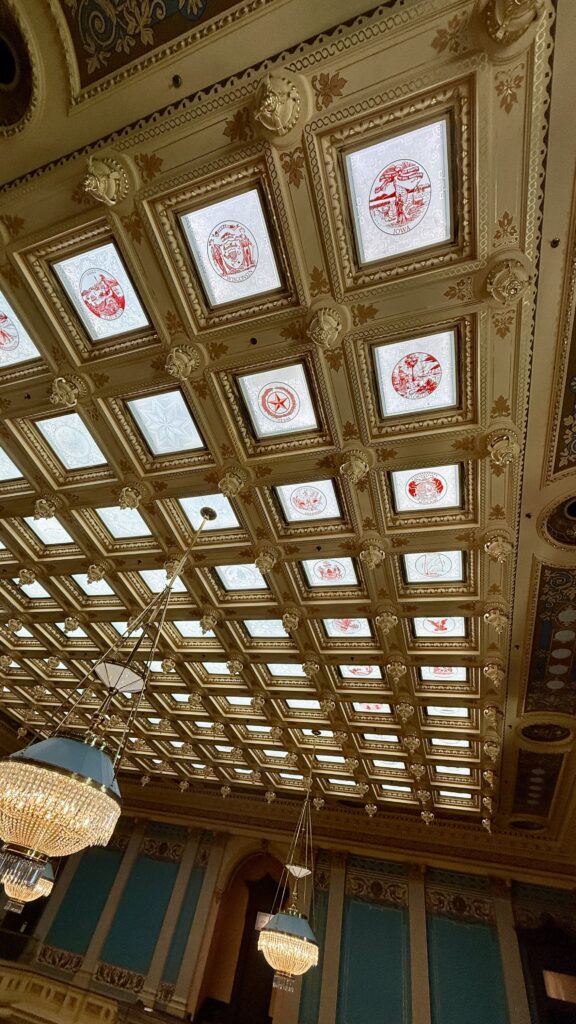
There were a few of these beautifully stained-glass pieces of art. This has the state seal, I believe, with some other state symbols.
The Capitol Grounds
The grounds were some of the most fascinating we have seen to date. They even have a scavenger hunt for school groups to encourage discovery of all the statues and monuments out there. We had fun with the clues. I enjoyed the century-old trees planted around the grounds, in addition to the flowers throughout the landscaping. We probably spent more time outside than in the building, as there was that much to see. This turned the Capitol from “meh” to “cool!”
Notice the statue of George Washington. It’s the same one we saw in Richmond, only this is a replica. There are only six copies of the original marble statue. Notice his walking cane is broken, I couldn’t remember how that happened so I looked it up. According to the University of SC Libraries, the lower part of the cane was broken off in February 1865 by soldiers in General William T. Sherman’s Union Army, who threw rocks and bricks at the statue during the Union occupation of Columbia, aimed at the monument in an act of contempt. The statue is made of bronze on a Missouri Red Granite base.
Also take note of the third picture below. Bronze stars are affixed to the walls in random places, where Civil War cannonballs hit the building.
This southern magnolia tree was planted as a memorial to General Robert E. Lee. Massive! It surpassed the one we saw in North Carolina. Here’s a video for perspective.
The weather was gorgeous, and we were so thankful God had set the sun in the sky for our enjoyment and warmth. I hope you enjoyed the tour of our day, with the three fun stops we took along our path. You can do anything through Christ who gives you strength! Even conquer those steps.
À la prochaine…hasta la próxima vez…until next time!
“I am the Lord, who heals you.” ~Exodus 15:26
My relationship with Jesus Christ motivates me to keep blogging. Though I have metastatic breast cancer*, my faith helps me survive, thrive, and feel alive while staying active. Without Him, I couldn’t achieve anything. With His help, well, my accomplishments speak for themselves on my blog. If you’re interested in learning about building a relationship with Jesus, feel free to comment below. I will never sell or share your email.
*Metastatic breast cancer is Stage IV cancer. Metastatic, or metastasis, means the cancer has spread beyond the original location (breast and immediate lymph nodes). In 2016 the doctors found significant metastasis to my bones, skull, liver, and lungs; then in 2018 to the brain. However, with chemo, immunotherapy, gamma knife, and of course my faith in the Lord, it is all undetectable at this point. I continue in treatment every three weeks via infusions, and receive multiple scans on a regular basis. If you or someone you know has metastatic breast cancer, I recommend these organizations for additional support:
Metavivor and Unite for Her (also for ovarian cancer)
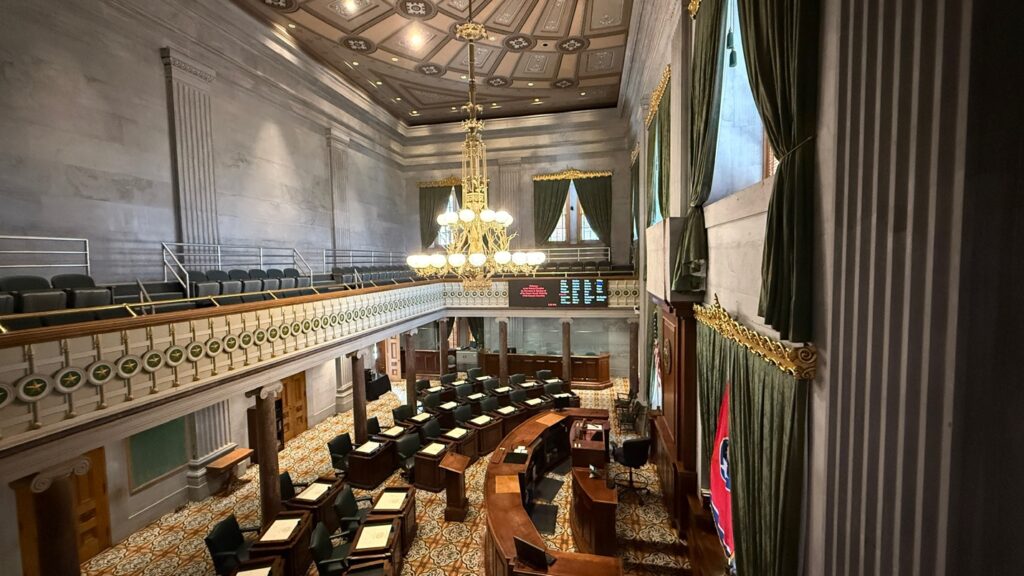
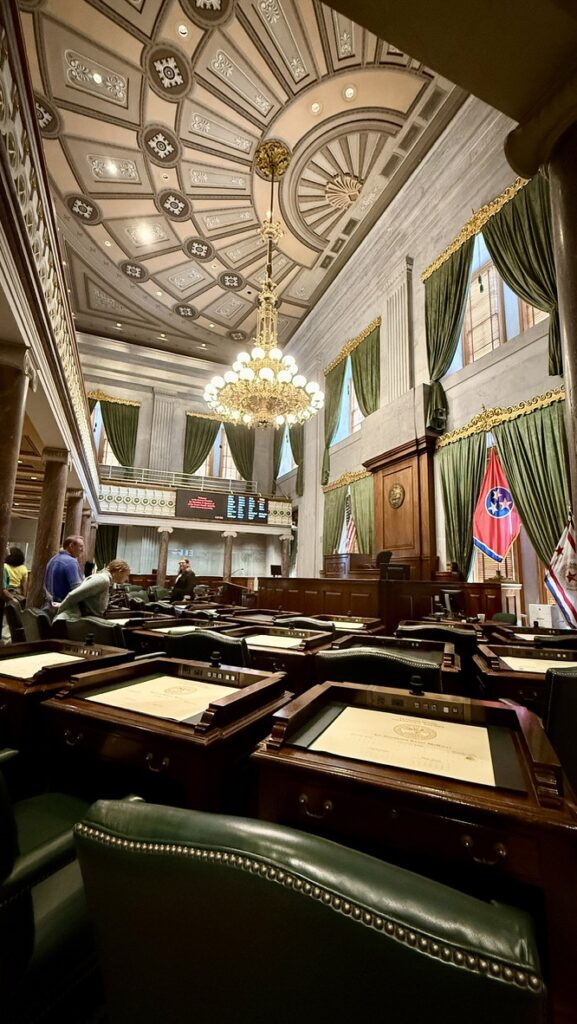
October 6, 2025. Nashville Tennessee State Capitol
Finally, a city where one might expect it to be a state capitol (haha). We visited the Tennessee State Capitol on this 551st day of our full-time Airstream journey.
The cornerstone was laid on July 4, 1845, but the building was not completed until 14 years later in 1859. The building is designed in the Greek revival architectural style, with a Cupola typical of that style. Therefore, it has no dome or rotunda as we see in the Roman style.
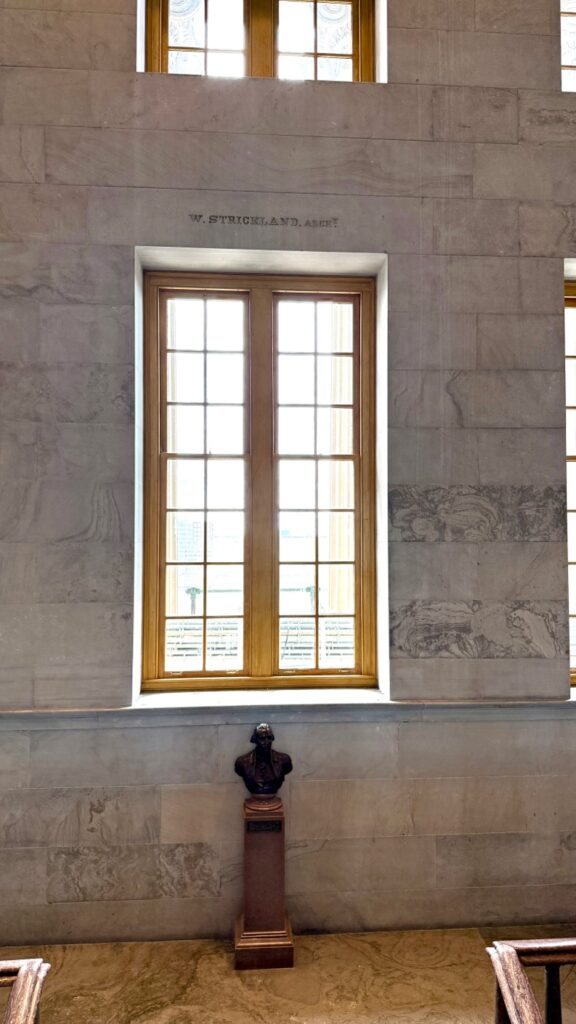
William Strickland was the first architect on the Capitol; he also built the downtown Presbyterian church, which he designed in Egyptian style. You can see some of that influence on the inside of this building as well.
Our tour guide Hannah was a great teacher, entertainer, and seemed to really enjoy interacting with the crowd. She told us Nashville became known as the “Athens of the south” due to all the schools and learning surrounding the city. Each of the blocks of limestone that makes up this wall weighs four to six tons. The limestone came from a local quarry. The walls are several feet thick, heavy load bearing, and the floor is made of marble. The Capitol has withstood several tornadoes throughout the years.
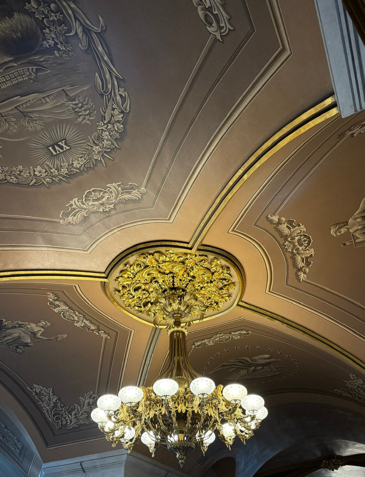
Fifteen enslaved men worked here. They were hired out for a year. All 15 reached emancipation later. The second group of workers consisted of prisoners. They were responsible for digging stone and moving it. A third group of Irish and German Immigrants were stonecutters and painters who painted frescos on the ceiling. The frescos got dirty from gas lamps and cigars, and they whitewashed over the frescos. Many years later, during restoration, they found the frescos under the whitewash and refurbished them. Sadly, I can’t find my pictures of the frescos.
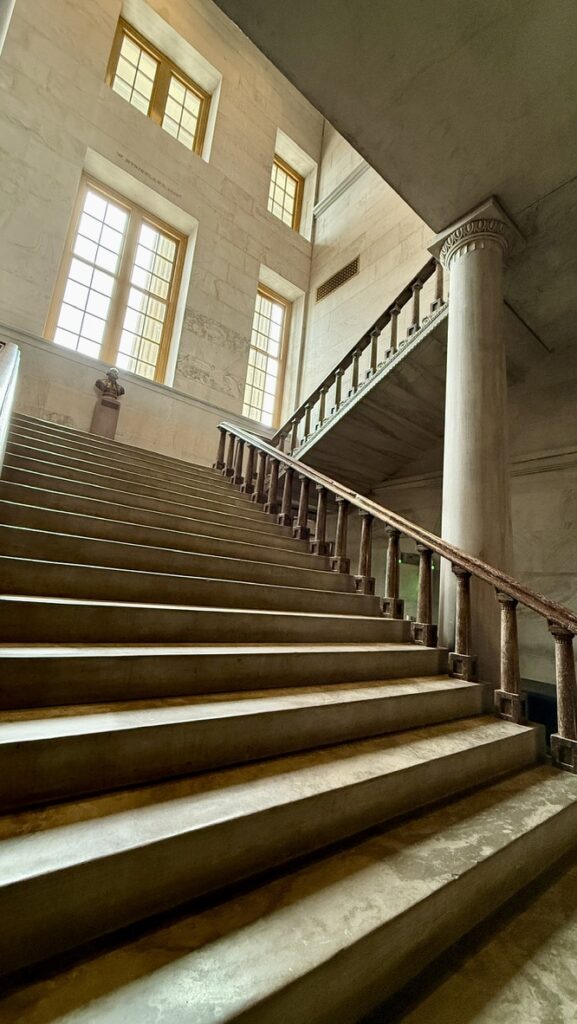
Unlike some Capitol buildings with rotundas, you won’t find an elaborate staircase here. Instead, the staircase highlights marble flooring and an intriguing tale. A chip in the handrail is said to have been caused by a bullet shot from above during a heated dispute over the 14th Amendment in 1866.
Old Supreme Court
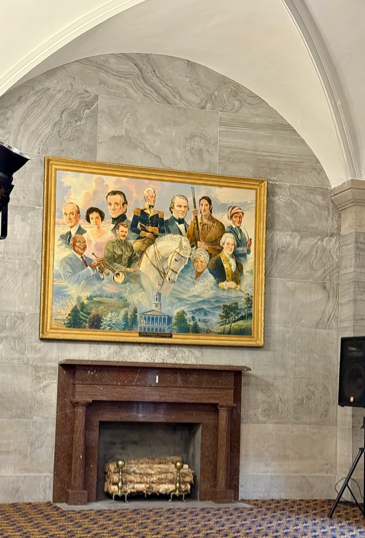
The Old Supreme Court Room, located on the first floor of the Tennessee State Capitol in Nashville, features a prominent 6′ x 8′ oil painting titled “The Pride of Tennessee.
The painting features eleven Tennesseeans notable for their unique contributions to the state and to the nation. Andrew Jackson’s horse is my favorite.
Fun fact…This is the only Capitol building to have someone buried in the wall. The architect (Strickland) didn’t want to leave, and because he felt this was his grandest achievement he made plans to be buried on the Northeast end. He died before the project was finished and was buried in the Capitol after his wishes. The second architect got the same honor, as he didn’t want to be outdone by his predecessor. He was buried in the wall on the southeast end.
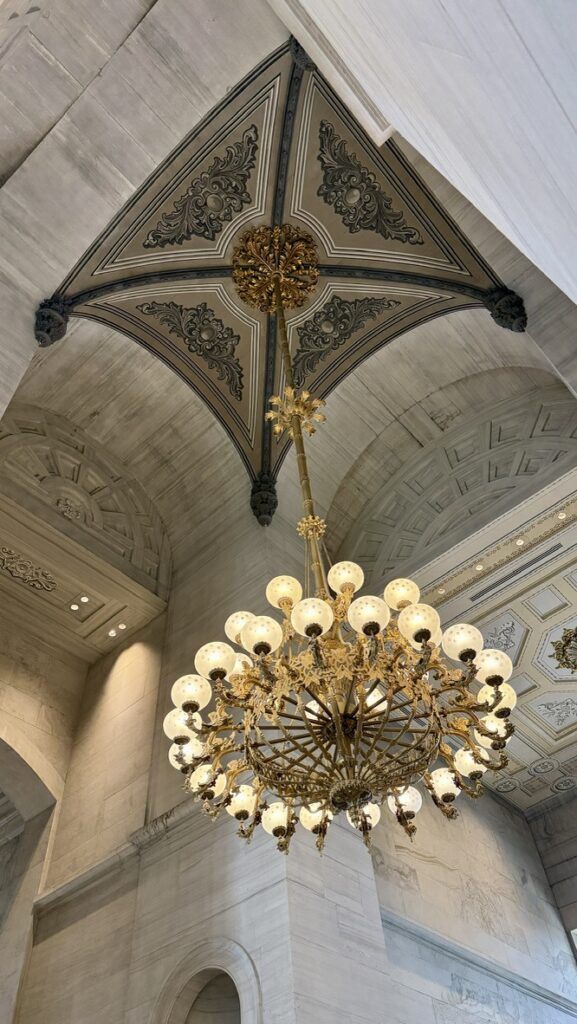
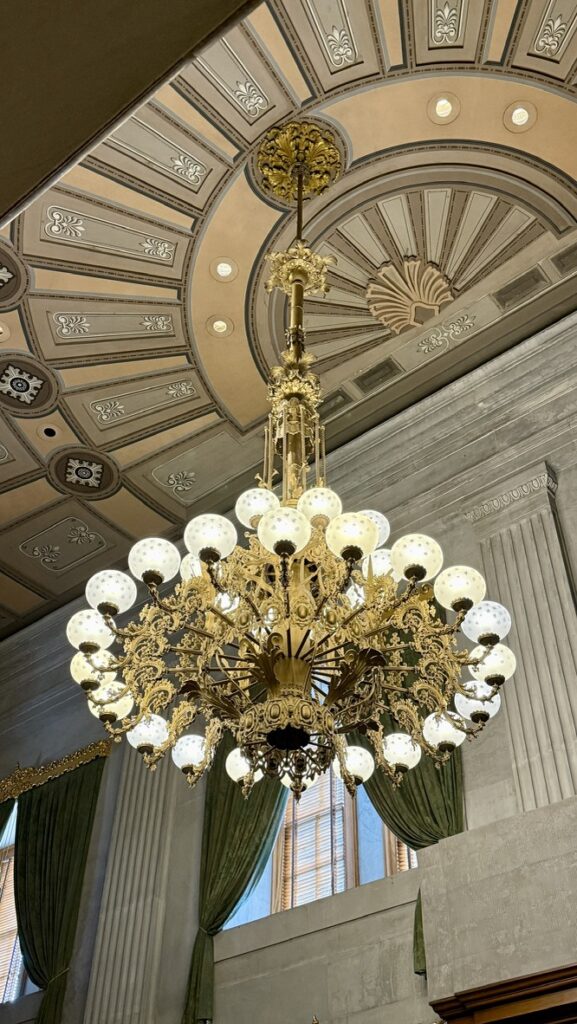
They had gasoliers versus chandeliers throughout the building until late 1880s when they installed electricity. The original chandeliers still hang in the hallways and chambers, except for one in the center of the House, which I’ll tell you about in a minute.
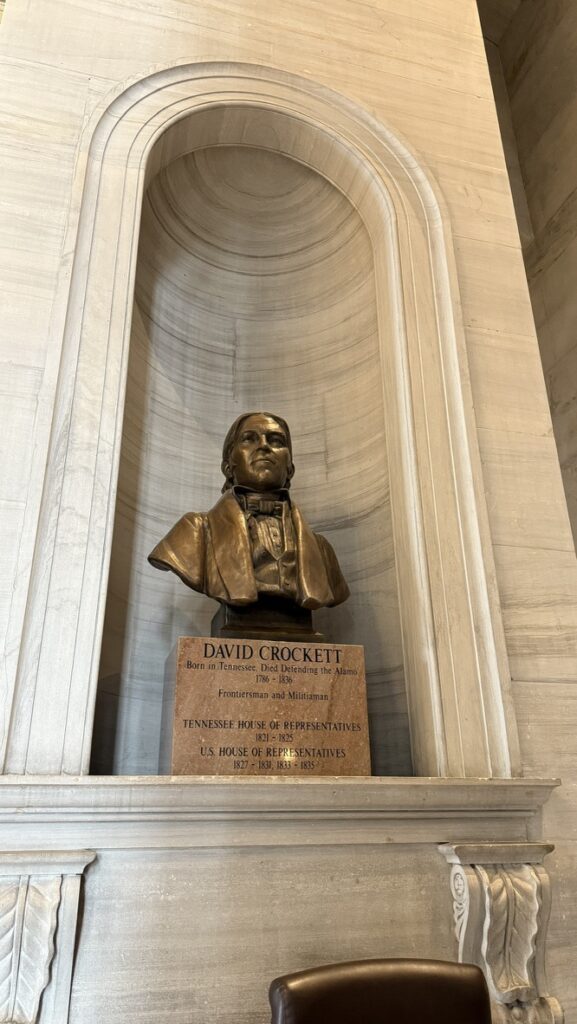
Davy Crockett was born in Tennessee. Of course, he’s also famous in Texas. Remember the Alamo.
House of Representatives
The House of Representatives was our tour guide’s favorite room because of the following story about the 19th Amendment (remember which one it is?), which she told so eloquently. Here’s a recap of the story…
The House Chambers has 16 columns, because Tennessee was the 16th state.
Multiple unrelated historical events in Tennessee have been called the “War of the Roses,” borrowing the name from the 15th-century English dynastic conflict. The most notable instances in Tennessee occurred during the 1886 gubernatorial race and the state’s ratification of the 19th Amendment in 1920.
The 1920 Women’s Suffrage “War of the Roses” was the dramatic final battle over the ratification of the 19th Amendment, which gave women the right to vote.
The conflict took place in Nashville in August 1920, with supporters of the amendment wearing yellow roses and opponents wearing red ones.
With 35 states having already ratified the amendment, Tennessee’s vote was the last one needed for it to become law nationwide.
The vote in the state House of Representatives was tied 48–48. The stalemate was eventually broken by 24-year-old Harry T. Burn, who had been wearing a red rose.
After receiving a letter from his mother urging him to “be a good boy” and “you know what to do,” (e.g. vote for the amendment), Burn switched his vote to “aye,” making Tennessee the “Perfect 36” and securing the right to vote for women across the country. After the vote, he went up into the cupola and hid from the press for four days. He was questioned and challenged, as they thought he was paid off or threatened, but his response was that he did what every man should do, “listen to his mother.”
Hannah also shared an interesting story about the original chandelier in the House, which was 14 feet wide and hung in the center (see ceiling picture below). When the windows were open, the chandelier would swing from side to side. This scared people who sat beneath it, so in the late 1800s they voted to take it down—after which they learned it was architecturally sound and would not have fallen—but it was too late as the vote was final. Getting it out the door was a challenge, and they ended up breaking it into pieces with axes. So sad, and would have been a site to see, but the historic society did recover some of the beautiful carvings that were a part of that chandelier and it’s in the Tennessee museum.
Senate Chambers
The Senate Chambers is much smaller than the House, as is typical in State Capitols. The columns are made of Tennessee limestone (a/k/a chocolate marble). You can find corn, cotton, and tobacco (three main crops) carvings in the original chandelier, which is still hanging in the chamber.
Legislative Lounge
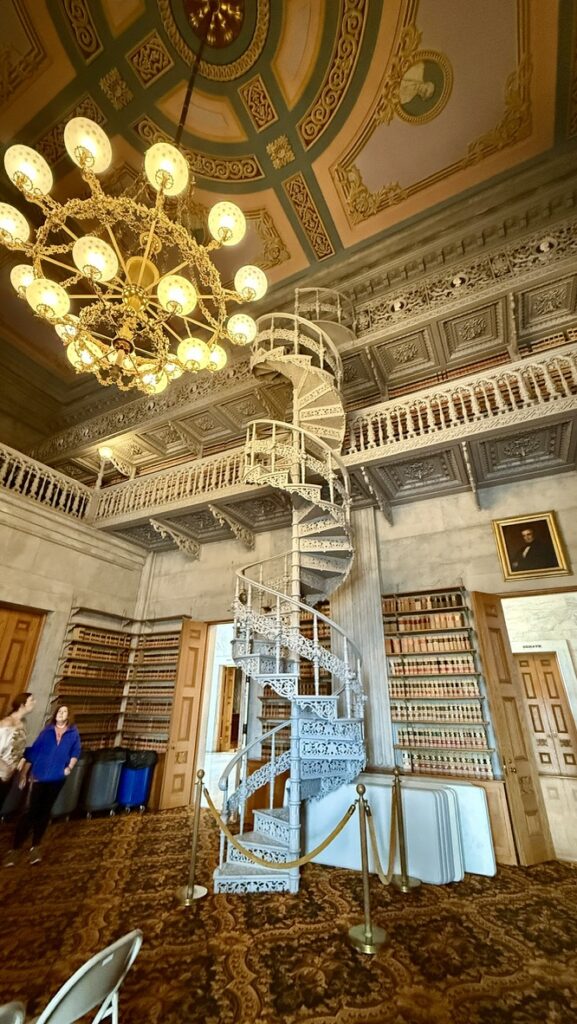
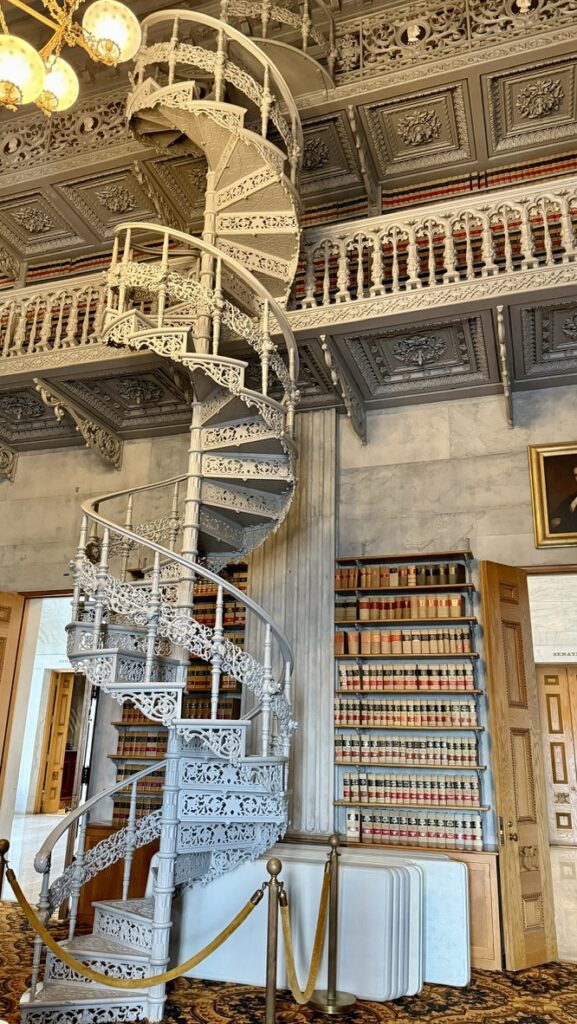
This intriguing room used to be the state library. About 250 tons of books were moved to another building across the street. This was the last room to be finished and by then Strickland was dead, so the new architect designed it in the Gothic revival style, very different from the rest of the building. It looks like something from Harry Potter! The Chandelier is original. Its design contains elements of the purple passionflower, which is the state wildflower and native to Tennessee.
Sequoyah Bust
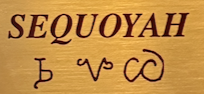
Sequoyah was a Cherokee, which of course was interesting to me since my great-grandmother was a Cherokee. I love the story about him developing the Cherokee syllabary. Here’s Hannah telling us the story in a 3-minute video, if you’d like to hear more of the history. Or you can read the plaque below for brevity.
The plaque says, SEQUOYAH, Griffin Chiles, Sculptor, 1994, Bronze
Sequoyah, or George Gist, born in the late 1700s near the Cherokee town of Tuskegee in present-day Monroe County, invented the first form of written communication for his people. Comprised of 85 characters, each representing a syllable of the spoken language, Sequoyah’s syllabary was adopted in 1821 and widely used by 1823 among the people of the Cherokee Nation. Sequoyah died in August 1843 near San Fernando, Tamaulipas, Mexico, while seeking a band of Cherokee he thought had migrated to the Southwest.
Capitol Grounds
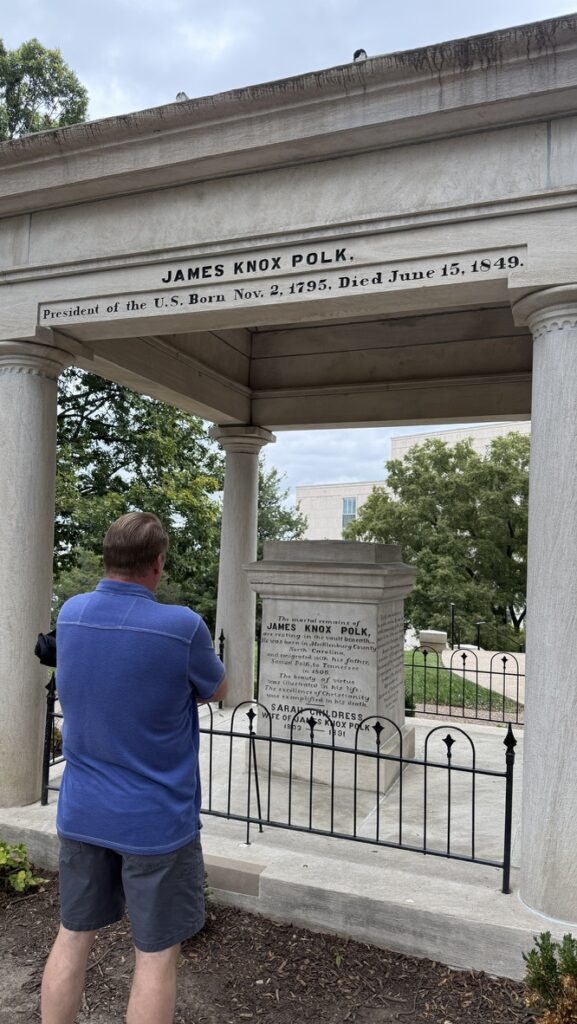
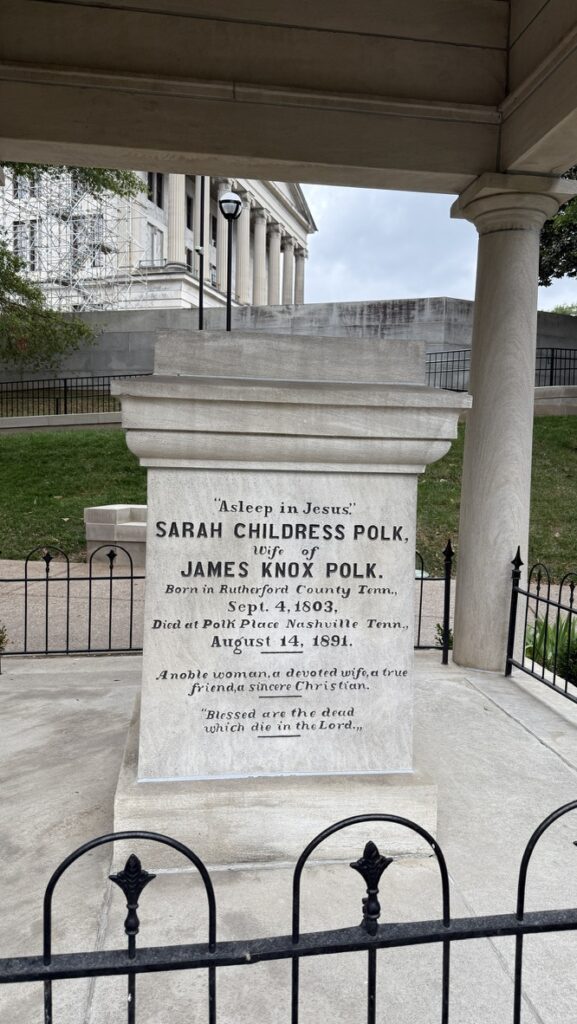
A walk around outside is pleasant on a day like today. There are several monuments, markers, and statues to see outside as well. An equestrian statue of Andrew Jackson, statues of Andrew Johnson and Sergeant York, and the tomb of President James K. Polk and his wife are just a few. Polk and his wife Sarah are buried on the property, underneath a beautiful monument. His body had to be moved several times after his death before its final resting place here. He moved to Nashville after he left office where he planned to live out his life. Sadly, they were battling a cholera outbreak in Tennessee, which he died of just three months later.
I love the inscriptions on Sarah’s grave, “Asleep in Jesus” and “Blessed are the dead which die in the Lord.” It’s so comforting to know when your loved ones die they are going into the arms of Jesus.
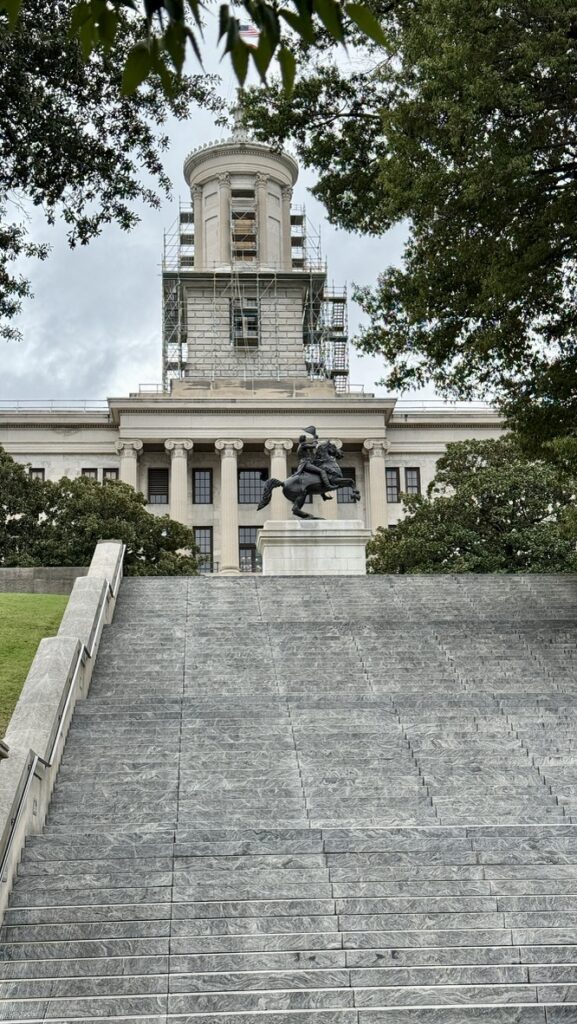
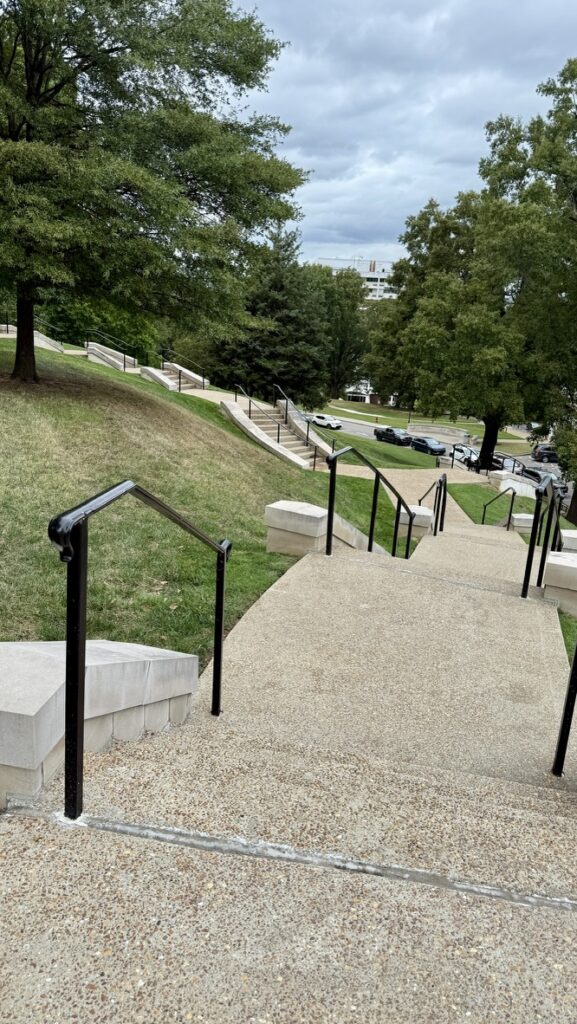
Heading back to the truck. There is a way to get to the Capitol without climbing all these stairs, as they have dug a tunnel for ADA access with elevators, but we didn’t know it sits on the highest hill in downtown Nashville when we started walking there from our parking spot. 🥴 The Tennessee State Capitol is built on Cedar Knob, a prominent elevation overlooking the Cumberland River. The site was selected in the 1840s to ensure a commanding view of the city. The first Catholic Church was originally built here and had to be demolished to make room for the Capitol (there’s a marker on the Capitol grounds where it stood). There is no private parking for the Tennessee State Capitol. During the week, visitors must park in paid lots or at street parking meters.
I hope you enjoyed this little tour of Tennessee’s State Capitol in Nashville. It would be great if you would leave a comment and let me know if there is something else (of less) you would like to know, as we have several more capitols to see before we complete our bucket list. Thanks for following my blog!
À la prochaine…hasta la próxima vez…until next time!
“I am the Lord, who heals you.” ~Exodus 15:26
My relationship with Jesus Christ motivates me to keep blogging. Though I have metastatic breast cancer*, my faith helps me survive, thrive, and feel alive while staying active. Without Him, I couldn’t achieve anything. With His help, well, my accomplishments speak for themselves on my blog. If you’re interested in learning about building a relationship with Jesus, feel free to comment below. I will never sell or share your email.
*Metastatic breast cancer is Stage IV cancer. Metastatic, or metastasis, means the cancer has spread beyond the original location (breast and immediate lymph nodes). In 2016 the doctors found significant metastasis to my bones, skull, liver, and lungs; then in 2018 to the brain. However, with chemo, immunotherapy, gamma knife, and of course my faith in the Lord, it is all undetectable at this point. I continue in treatment every three weeks via infusions, and receive multiple scans on a regular basis. If you or someone you know has metastatic breast cancer, I recommend these organizations for additional support:
Metavivor and Unite for Her (also for ovarian cancer)
Planning ahead is absolutely key for this State House adventure! Security here is on another level—more intense than any Capitol we’ve visited yet. No wandering on your own; you’ve got to pre-register in advance for a guided tour. When you arrive, get ready to flash your photo ID, pass through security, and pose for a sticker-worthy headshot to wear during your visit. It almost felt like visiting my granddaughter in the NICU—except with a bit more official flair.
Fun Fact: This building is the third oldest State Capitol in America and claims the silver medal for longest continuous use! Trenton snuck into second place when Virginia’s streak got interrupted—they seceded during the Civil War, officially pressing pause on their run. Maryland still reigns supreme as the oldest and most continuously used statehouse, but New Jersey’s State House isn’t far behind. History loves a good comeback story! 🙃
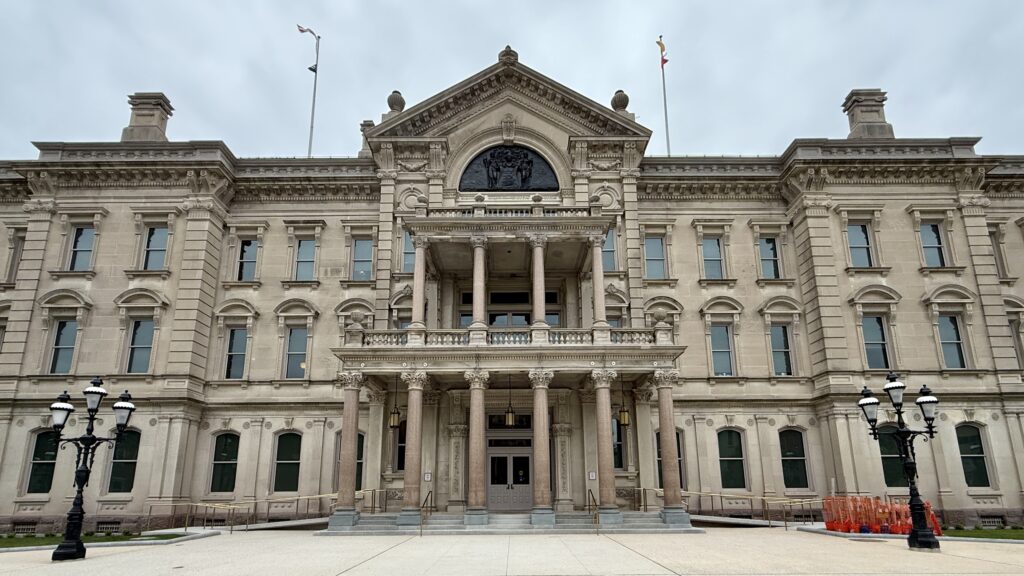
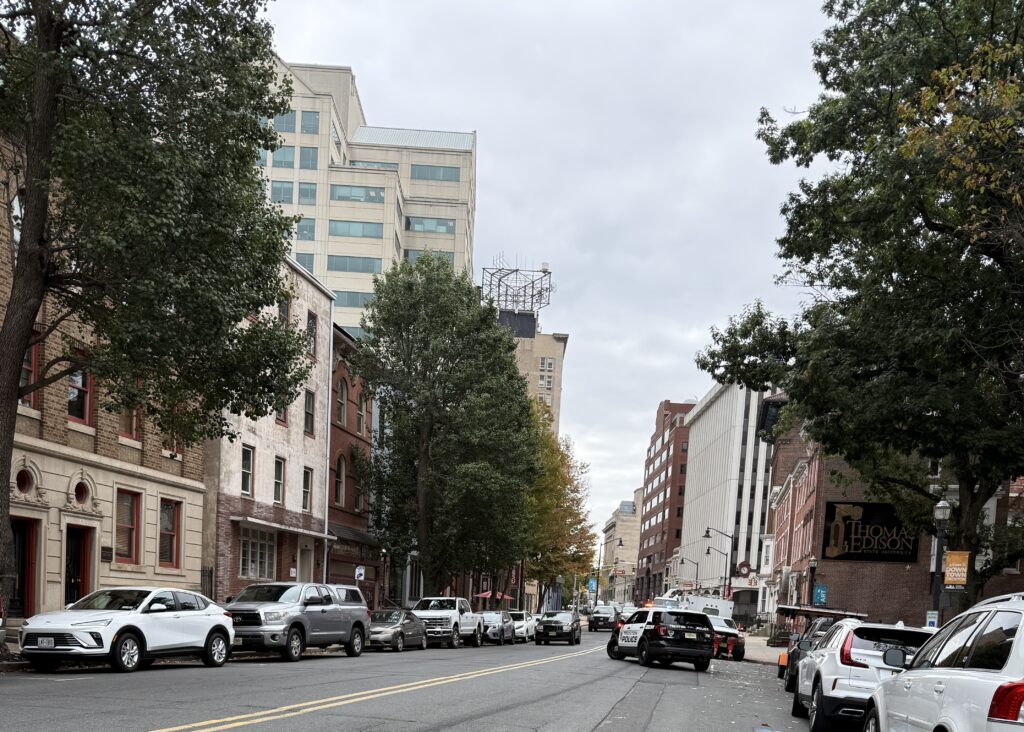
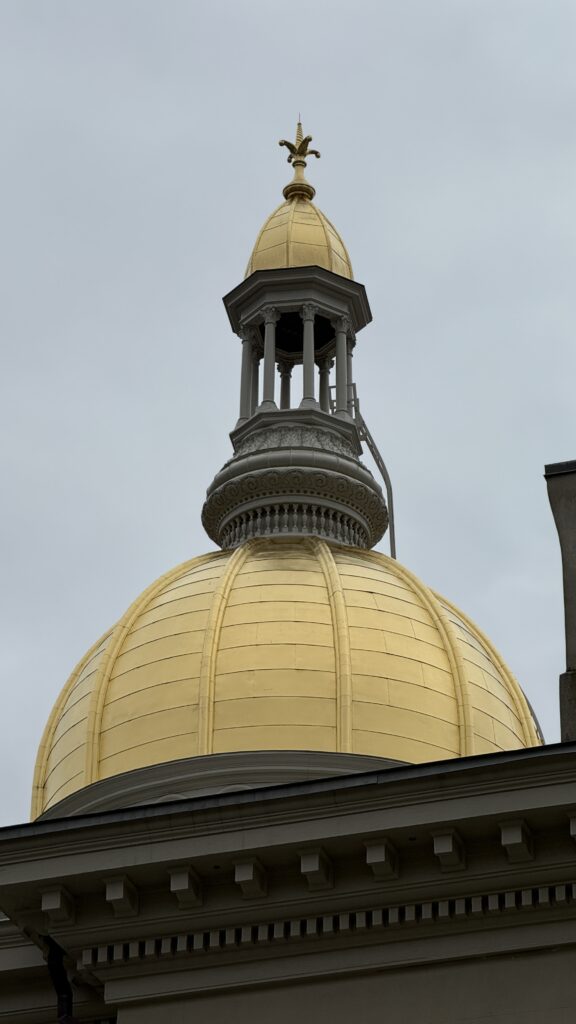
Unlike those stately capitols perched on sprawling lawns, New Jersey’s State House is smack in the heart of downtown—hugging historic State Street and flanked by its legislative neighbors. From State Street, you’ll have to squint to spot the dome peeking out—blink and you might miss the building’s true size and style! See the first picture in this blog.
Parking was an adventure of its own. With our big truck (and that pesky hitch), we were thankful we’d left the Airstream behind—otherwise, parking would’ve been impossible. We lucked out with a parallel spot by a busted meter, right next to a police car with flashing lights. We asked the officer what to do; he just smiled and said, “Don’t worry about it.” We returned after our tour to find no ticket and our truck exactly where we left it. Small victories!
After sticker duty, we were corralled into the courtyard—security watching us through giant windows—until our tour guide came to collect us. Exploring freely isn’t allowed; when the tour ended, we had to exit right away (though our guide kindly let us stop off at the restroom first). The strict rules? Our guide said it’s all because of 9/11, New Jersey lost more people in the attacks than any other state except New York, so security has stayed extra tight ever since.
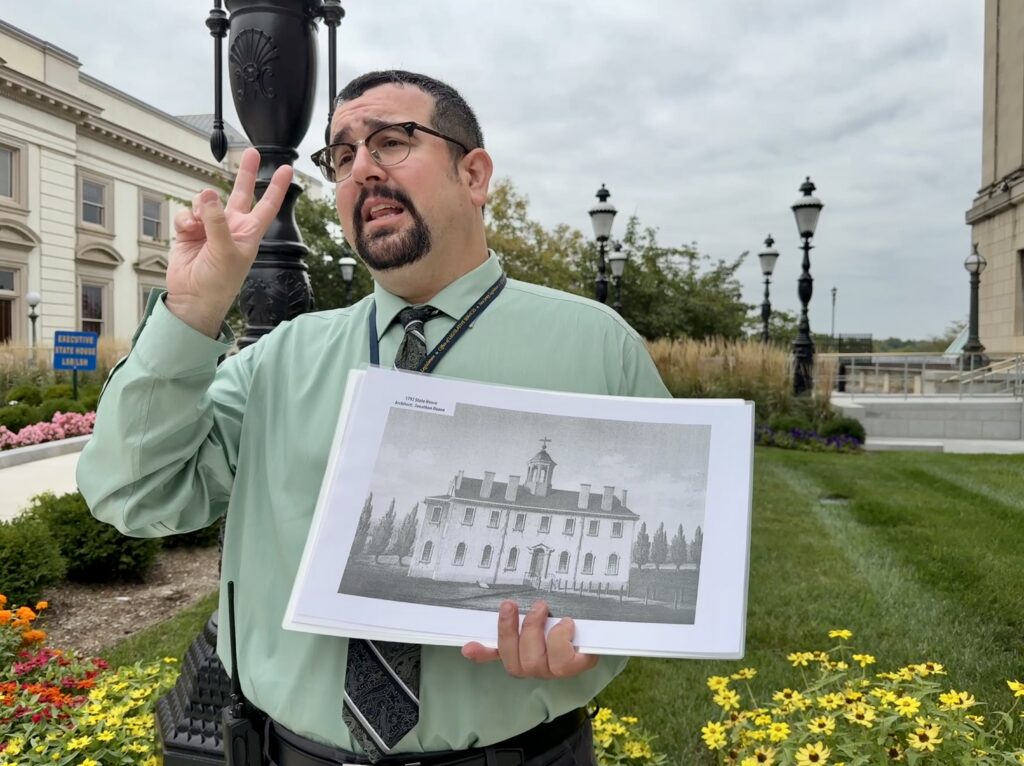
It’s official now. We have stickers. I’m glad they didn’t use my driver license photo – it looks like a mug shot LOL.Our tour guide shows us the progression of the original building to what it is now. Different architects with different styles built the add-ons, so it is a bit of a maze inside. This is another reason they do not let you go on your own. Even the legislators get lost in the hallways.
In 1996, the New Jersey State House began renovations of its golden dome. That project wasn’t completed until 1999, but was no simple job. The dome is covered with 48,000 pieces of gold leaf.
Each piece of gold leaf cost $1.00 and was paid for with money raised by New Jersey school kids through the “Dimes for the Dome” program.
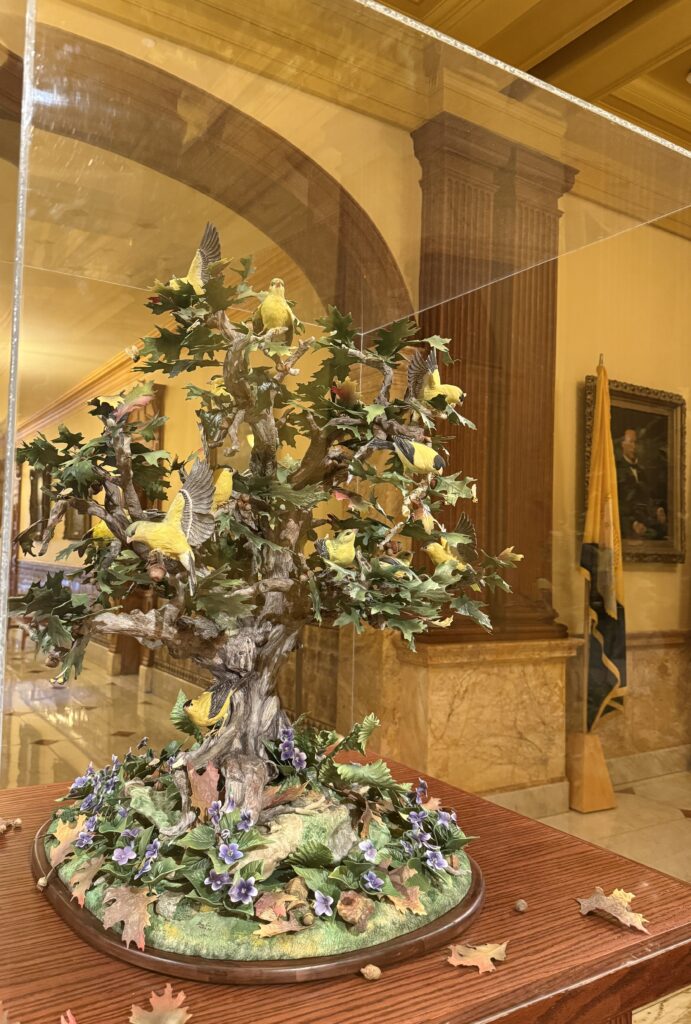
Boehm Porcelain Sculpture: “The Glory of New Jersey”
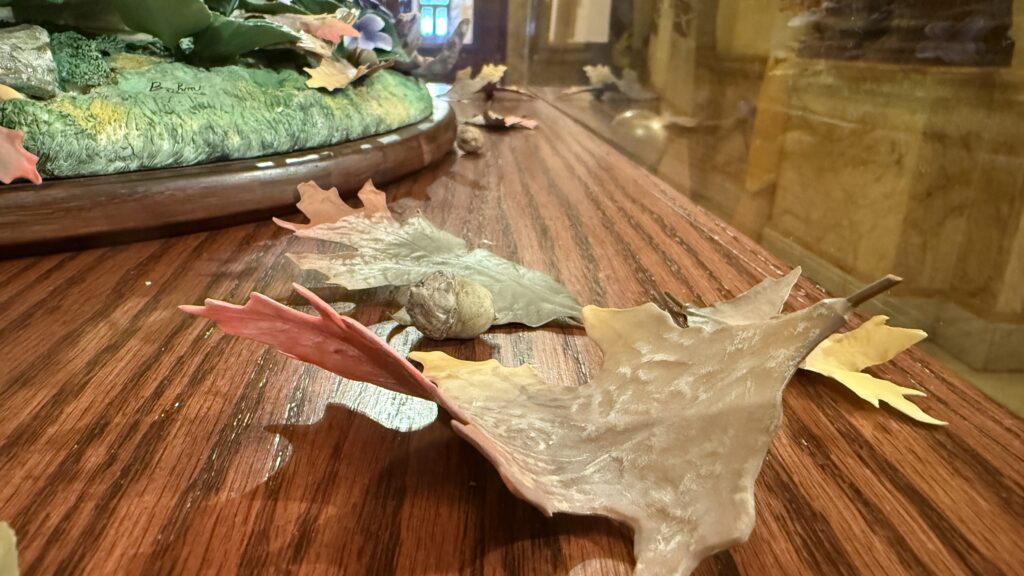
Step into the crossroads of the State House halls and you’ll spot a dazzling showstopper: a glass case holding “The Glory of New Jersey,” a porcelain masterpiece by Boehm Studio, crafted right in Trenton in 1995. This isn’t just any sculpture—it’s a vibrant northern oak (NJ state tree) loaded with 21 goldfinches (NJ state bird), each one representing a different New Jersey county. Look closer and you’ll find violets (NJ state flower) blooming at the roots, 13 honeybees symbolizing the original colonies, cranberries, horseshoe crabs, and—here’s a quirky touch—a single ladybug saluting New Jersey’s first female governor, Christine Todd Whitman. The whole thing stands three feet tall, weighs in at 75 pounds, and was brought to life by 12 artisans using 129 molds and 326 individual pieces. Now that’s Jersey pride, captured in porcelain!
Not only does this piece add a splash of local pride to the building, but it also serves as a playful centerpiece for school groups and curious guests, serving as a fun scavenger hunt. Everyone loves gathering around to learn the stories behind the symbols and snap photos for their own collections of Garden State memories, including us!
Yes, it’s all made of porcelain!
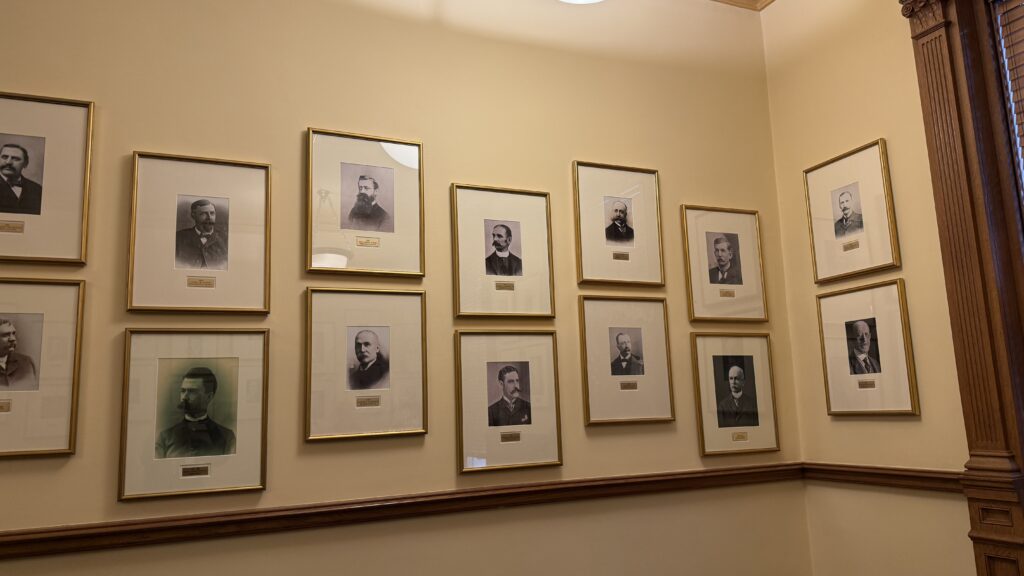
According to our tour guide, younger visitors have pegged this hall the “Room of Epic Mustaches.” Zoom in if you mustache yourself why. 😂 These are portraits of the Speakers of the House. There are 80 assembly members for 40 voting districts.
House of Representatives (General Assembly)
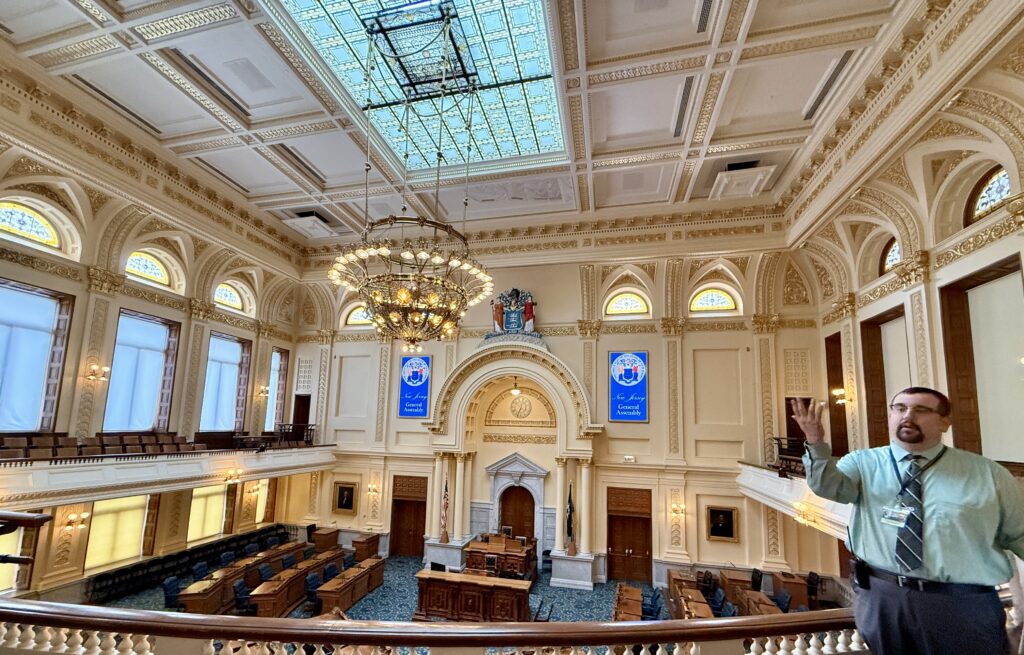
When we stepped into the General Assembly Chamber, it was like taking a trip back in time—right to the moment when Thomas Edison’s Electric Light Company installed a gleaming brass chandelier in 1891. Imagine how exciting that must have been: New Jersey’s Assembly filled with brand-new electric bulbs, like young teenagers at just thirteen years old. Just in case the bulbs fizzled out, the upper wall sconces could switch back to gas light, a clever gesture to remember the old days, or maybe a distrustful nod to the new electric lights. You decide!
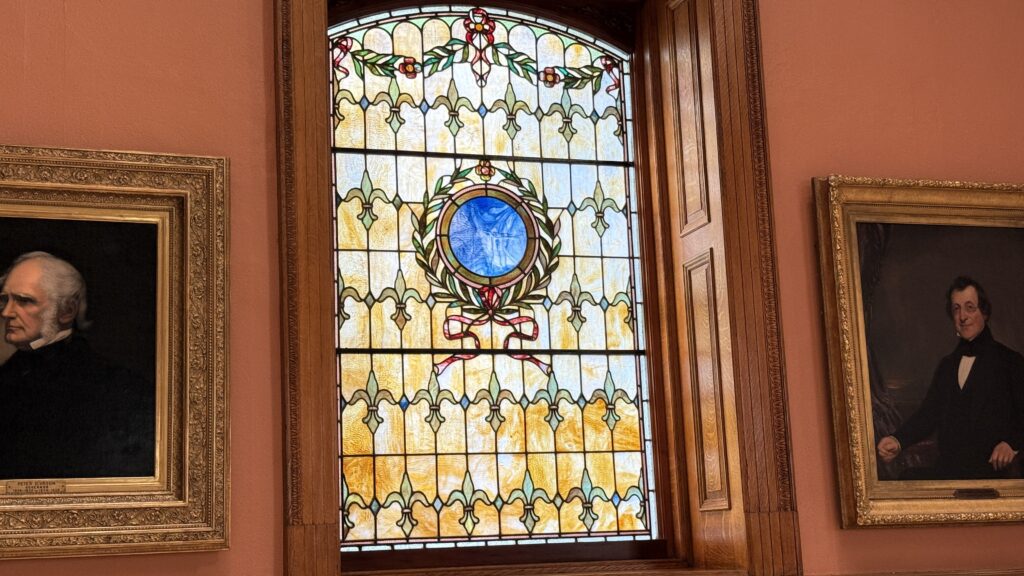
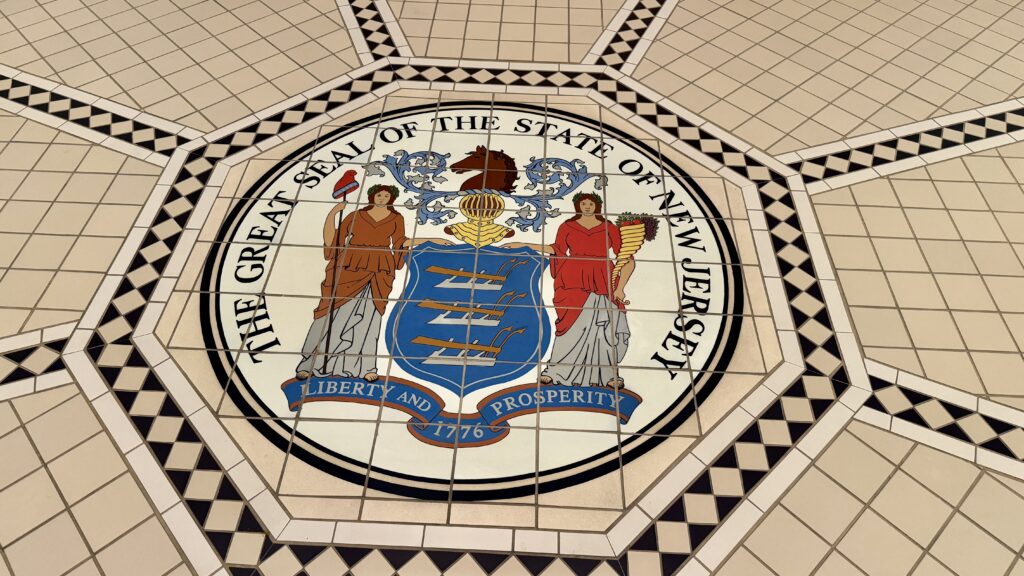
Look up and you’ll see stained glass lunettes and a huge skylight, letting sunlight pour in across the hall. The gold-leaf details shimmer over the ornate plasterwork, giving the place a touch of grandeur. Above the Speaker’s dais, there’s a colorful wooden statue of New Jersey’s great seal—hard to miss and impossible not to admire.
Even the carpet gets in on the action, decorated with New Jersey’s state symbols: the Purple Violet, Eastern Goldfinch, Red Oak Tree, and Honey Bee. Blue is my favorite color, so I really like this even though we only saw it from the gallery. I imagine it is a fun detail for anyone walking through, like a hidden scavenger hunt for Garden State pride woven right into the floor.
House of Representatives (General Assembly)
Notable stories from our Tour Guide
Welcome to New Jersey—a state where most folks are packed up north like sardines in a subway car! Seriously, about 70-75% of New Jerseyans call the northern cities home, with hotspots like Paterson, Elizabeth, Newark, and Jersey City buzzing with energy. Central Jersey holds its own with industrial hubs (hello, Trenton!), but venture south and you’ll find sprawling farmland, earning the “Garden State” name with pride.
But let’s talk about southern Jersey, where the legend gets wild. Meet the “Jersey Devil” (or “Leeds Devil,” if you want to sound fancy)—the state’s most infamous cryptid. Picture this: a creature that’s part kangaroo, part horse, part goat, with bat wings, scary claws, and a tail that’s forked like it’s ready for a barbecue. Where does it lurk? In the Pine Barrens, of course—a place so ecologically bizarre that our guide called it a “weird hybrid,” with only one other similar spot on earth, and that’s somewhere in Africa!
The Pine Barrens are pretty much New Jersey’s own enchanted forest—spanning a mind-blowing 1.1 million acres over seven counties. It’s rural, mysterious, and somehow sits close to bustling cities like Philadelphia and New York. If you love botanical oddities, you’ll be thrilled: Venus fly traps snap up unwary insects, cranberries dot the landscape, and who knows—you might just spot the Jersey Devil (or at least a hammerhead bat) soaring overhead!
So whether you’re a city dweller or prefer the quirky wilderness, New Jersey is ready to surprise you with every mile. Pack your bags, keep your eyes peeled, and remember: in the Garden State, even your myths come with wings!
Let’s dive deeper into the wild tale of the Jersey Devil, also known as the Leeds Devil! Picture this: it’s 1735, and Mrs. Leeds—a 25-year-old mother—finds herself expecting her 13th child. Exhausted and overwhelmed, she supposedly exclaims, “Let this one be the devil!” After the baby arrives, everything seems normal—until five minutes later, when it transforms into a winged monster and shoots up the chimney, vanishing into the mysterious Pine Barrens. Since then, more than 700 people claim they’ve spotted the beast, with sightings stretching from the days of Napoleon Bonaparte (yes, he was in New Jersey!) all the way to 2023. Like any good legend, the Jersey Devil’s story keeps evolving with every “encounter.”
Some say the Pine Barrens is filled with wild creatures—including the hammerhead bat, which could easily spook someone into thinking they’ve seen a monster. But honestly, why spoil the fun? Whether you’re searching for the Devil in the woods, or cheering for the Jersey Devils at a hockey game, this state monster keeps New Jersey’s imagination alive!
No act of Congress made it official, but ask anyone in New Jersey—the Jersey Devil is absolutely the state’s monster.
The legend has even more twists: the Leeds family, famous for publishing astrological almanacs back in colonial New Jersey, supposedly had their own run-ins with the Devil. Some say the creature got its bad reputation because the family supported the American Revolution. And with all those bats swooping through the Pine Barrens, it’s easy to see how a hammerhead bat—feeding on mosquitoes by the thousands—could be mistaken for a dinosaur-like beast by anyone wandering the woods at night. So next time you’re in South Jersey, keep your eyes peeled… you never know what you might spot!
Our guide was incredibly knowledgeable and shared plenty of interesting tidbits throughout the tour. Here’s another fun fact: New Jersey’s capitol is the only one in the country where you can look out and see another state. From the building, you can gaze across the Delaware River and spot Pennsylvania.
The Rotunda
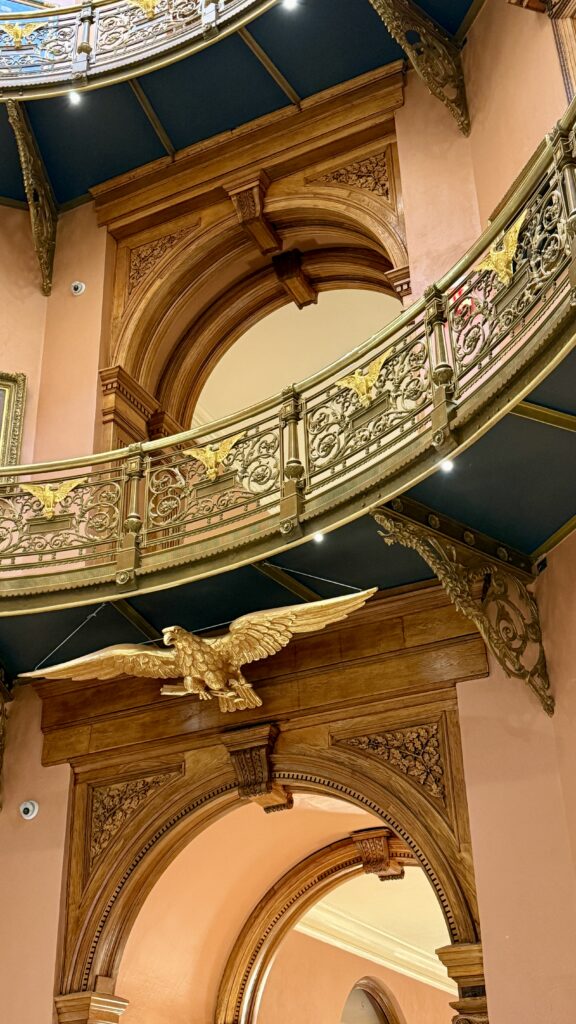
Step under the magnificent dome in the rotunda and you’re in for a treat! Our guide pointed out some quirky features, like the mysterious dragons woven into the architecture—no one really knows why, but legend has it these eastern dragons are guardians of humanity. 🐉✨ Over the door, an eagle stands watch where the main entrance used to be, although now the dome sits off-center after years of expansions. And get this: Tim swears the dome towers a whopping 140 feet overhead! Who knew state history could be so whimsical?
If you enjoyed this tour of the New Jersey State Capitol, leave a comment below and let me know your thoughts! Pretty, please! 😁 I won’t hound you. The email you will provide is to prove to AI that you are not, in fact, AI.
À la prochaine…hasta la próxima vez…until next time!
“I am the Lord, who heals you.” ~Exodus 15:26
My relationship with Jesus Christ motivates me to keep blogging. Though I have metastatic breast cancer*, my faith helps me survive, thrive, and feel alive while staying active. Without Him, I couldn’t achieve anything. With His help, well, my accomplishments speak for themselves on my blog. If you’re interested in learning about building a relationship with Jesus, feel free to comment below. I will never sell or share your email.
*Metastatic breast cancer is Stage IV cancer. Metastatic, or metastasis, means the cancer has spread beyond the original location (breast and immediate lymph nodes). In 2016 the doctors found significant metastasis to my bones, skull, liver, and lungs; then in 2018 to the brain. However, with chemo, immunotherapy, gamma knife, and of course my faith in the Lord, it is all undetectable at this point. I continue in treatment every three weeks via infusions, and receive multiple scans on a regular basis. If you or someone you know has metastatic breast cancer, I recommend these organizations for additional support:
Metavivor and Unite for Her (also for ovarian cancer)
We visited all six capitols in the six New England states within 18 days. Whew, that was a busy time! I’m combining them all into three parts, as we were traveling feverishly between states, and there are some similarities to all six states and capitols. However, there are also some unique factors to each one, which you are sure to notice. The first part will include Vermont and Maine. Part two will cover New Hampshire and Massachusetts; then the third part will showcase Rhode Island and Connecticut. This is the order in which we visited them all.
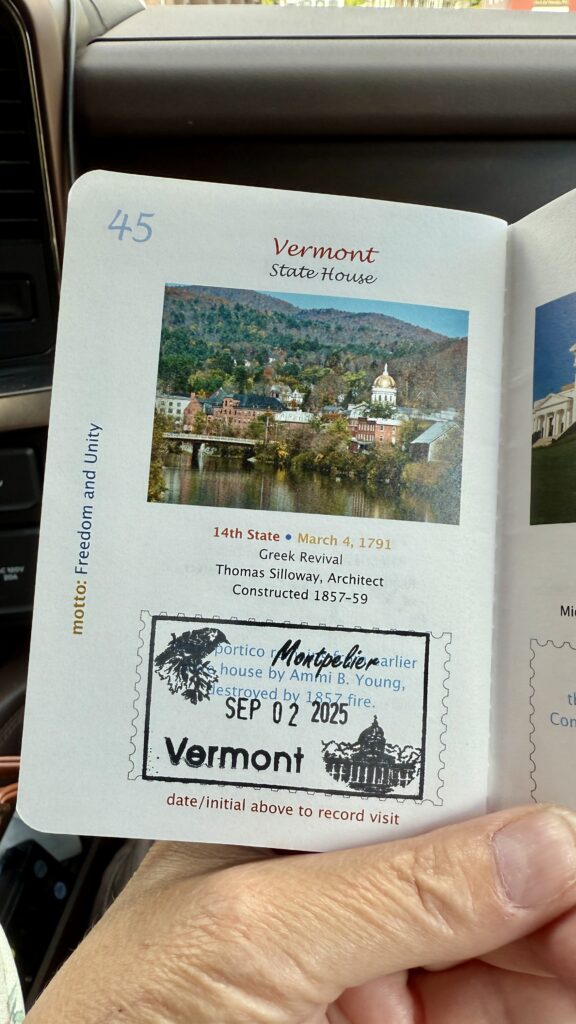
September 2, 2025. Montpelier Vermont State House
WELCOME TO VERMONT’S STATE HOUSE, featuring the nation’s oldest legislative chambers that are still used by lawmakers in the way they were originally designed and decorated. This historic capitol building showcases many original architectural and decorative finishes, including furnishings and gas chandeliers.
Montpelier is a cute little town. It’s the nation’s smallest capital city, and the only one without a McDonald’s. (Can you imagine??) We visited the State House, which is also very simple and small, got our passport stamped, and learned they conduct tours on the hour. We arrived at 20 past the hour, so we thought we’d miss it, but they weren’t busy so the guide offered to give us a private tour. Our docent took us everywhere, letting us get up close and personal to the desks, chairs, and furnishings in all the rooms we entered. (We stayed in an RV park near there, close to the town of Barre, pronounced “Barry,” also worth visiting.)
Vermont State House (Capitol). State House and Capitol are terms used interchangeably. It’s not a huge building like you will find in New York, but it has a beautiful presence. (It also cost a LOT less, at $150,000.)
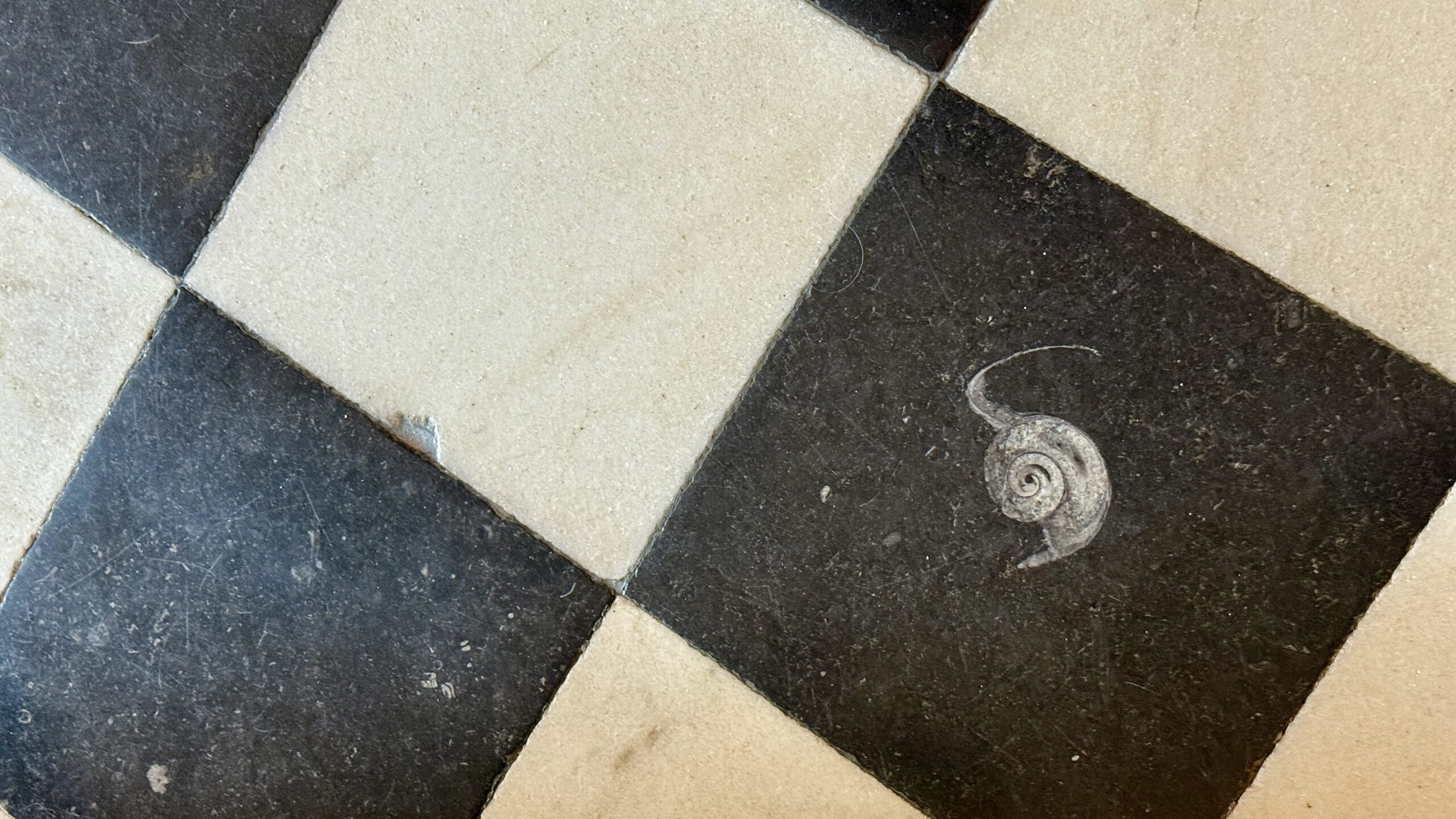
We learned many fun facts about this Capitol, some of which I’ll share in this blog. Like the fossils in the limestone flooring, the 8th grade pages who get to sign their names inside the 24K gilded dome, and the most historic gas chandelier in America.
This is the third state house in Vermont, build between 1857 and 1859. Although larger than its predecessor, it was also constructed of granite and a plan that closely resembled the previous building The columns and “porch” you see on the front are made of local granite, which is very durable. This part was salvaged from the fire that burned down the previous State House and reused here. It is the only remaining portion of the earlier Greek Revival State House of the 1830s.
If you step inside the Vermont State House, you’ll find both the House and Senate Chambers, plus the Governor’s office—though the Supreme Court has its own place elsewhere. When it comes to style, the current State House skips the traditional Greek Revival look (think big columns and perfect symmetry) and goes for the trendier (at the time) Italian Renaissance Revival vibe, with fancy details and those classic rounded arches that were all the rage back in the day. Like a lot of old public buildings, the State House has changed along the way, picking up three small additions at the back to help out with things like office space and storing important documents. Fast forward to the 1980s and 90s, and the whole place got a serious makeover—restoring it to its mid-1800s glory. That meant bringing back original carpets and drapes, and sprucing up the best parts of the building, especially the rooms where the action happens, like the legislative chambers and main public areas.
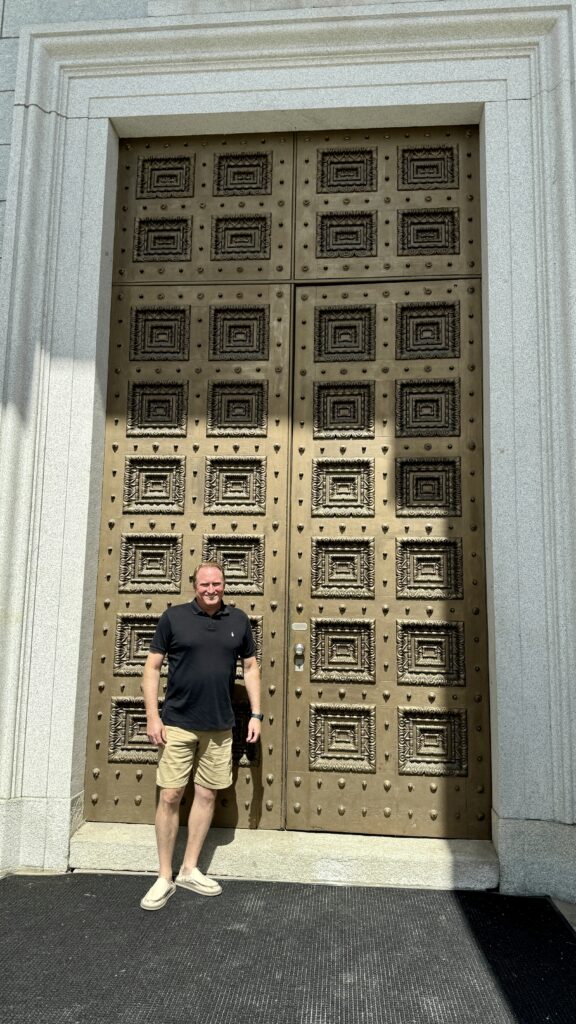
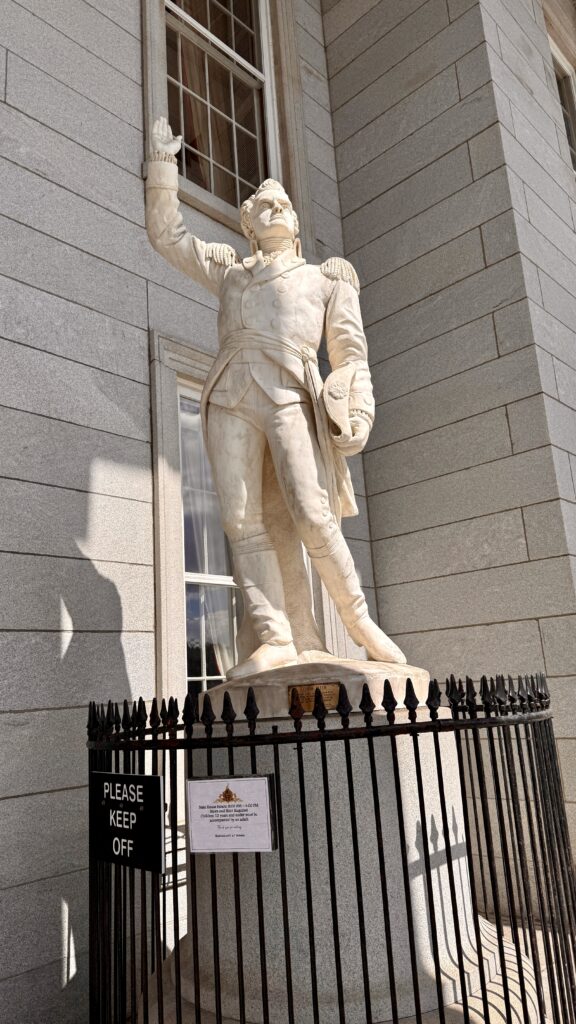
Tim is standing in front of the front doors to show perspective. They are huge! And gorgeous! The doors are made of pine to save money, but the architect painted the exterior bronze and interior mahogany to emulate a more opulent entrance.Ethan Allen, founder of Vermont, greeted us at the entrance. The statue depicts Allen invoking “the Great Jehovah and the Continental Congress,” when he surprised the British at Ticonderoga. Original sculptor Larkin Mead carved marble, using his imagination to create the image, as no portrait of Ethan Allen exists. It was replaced by a replica in 1941 due to deterioration from weather exposure.
The Golden Dome and Spidermen
Vermont is one of just nine state capitols wearing a dazzling gilded dome. The dome on top of Vermont’s third State House is a striking example of Renaissance Revival style, more ornate than its predecessor but not overly extravagant. Originally made of wood and covered in copper, the dome was painted red to resemble Italian tile and kept that color for nearly 50 years.
In 1906, legislature allocated funds to gild the dome with ultra-thin 23.75 carat gold leaf (as close to pure as possible). How thin is it? It is so thin that 250,000 sheets would stack to just an inch. The gilding process involved sanding the copper, applying coats of lead-based oil paint, and then methodically layering long sheets of gold leaf.
Sergeant-at-Arms C.H. Ferrin refused extra safety spending for “unattractive staging and scaffolding,” so the workers applied the gold while balancing on ladders 150 feet up, entertaining crowds below and showing up in the Vermont Watchman who described them like “spiders in the air.” The dome has been re-gilded several times since, with the process evolving to include more advanced safety measures like scaffolding.
The original statue of Agriculture atop the dome was carved by Brattleboro sculptor Larkin Mead. (Remember his name. It will come back again.) Unfortunately, in 1938 the wooden statue rotted and was in danger of toppling off the dome. Eighty-six-year-old Sergeant at Arms Dwight Dwinell volunteered to carve a new statue with the help of his janitorial staff. It was 14 feet tall and mounted on a six-foot pedestal. In 2018, the dome was again regilded and weatherproofed, and a new wooden statue of Agriculture was added on top.
The Dome’s Interior
The dome is supported by a double truss system, but due to changes in design during construction, the Vermont State House doesn’t feature any interior architectural expression of the dome—meaning you won’t see it from inside, and it doesn’t have a beautiful rotunda like other capitols. Bummer.
Fossils on the Floor
The black and white checkered tiles continue the vintage look throughout. The white tiles are made of granite from Danby Vermont. The black tiles are made of fossiliferous limestone (often mistaken for marble) brought in from Isle La Motte on Lake Champlain. The black tiles contain fossils seen throughout the State House; the fossil pictured below is one of the most prominent seen in the main hallway.
FUN FACT: The black fossiliferous limestone used to be part of the Chazy Reef, which is in modern day Zimbabwe, but it slowly made its way to Lake Chaplain in Vermont over the centuries. Could this be further evidence of the great flood? Things that make you go “hmmm” 🤔.
Fossil. Some type of snail maybe?Staircase outside the Senate
We went up the spiral staircase to see the senate chambers on the second floor. Vermont Statehouse has twin spiral staircases rather than one grand staircase as seen in capitol buildings with large rotundas beneath the dome.
The stairs are made of cast iron, which you can tell when you walk on them. No creaking and very sturdy. However, they are painted to look like wood to keep with the original design. Cast iron was chosen to make it more fireproof. Lesson learned from past experiences.
Vermont Senate Chambers
Step into the Senate Chamber and you’re instantly transported back to the mid-1800s—time machine optional! This stunning room has been lovingly restored to its original glory, and almost all the furnishings date back to the 1850s. With just 30 senate members, it’s an unusually cozy space that still manages to feel grand and impressive. Imagine Renaissance meets Rococo Revival, all wrapped in a classically elliptical design, accessible elegance at its finest.
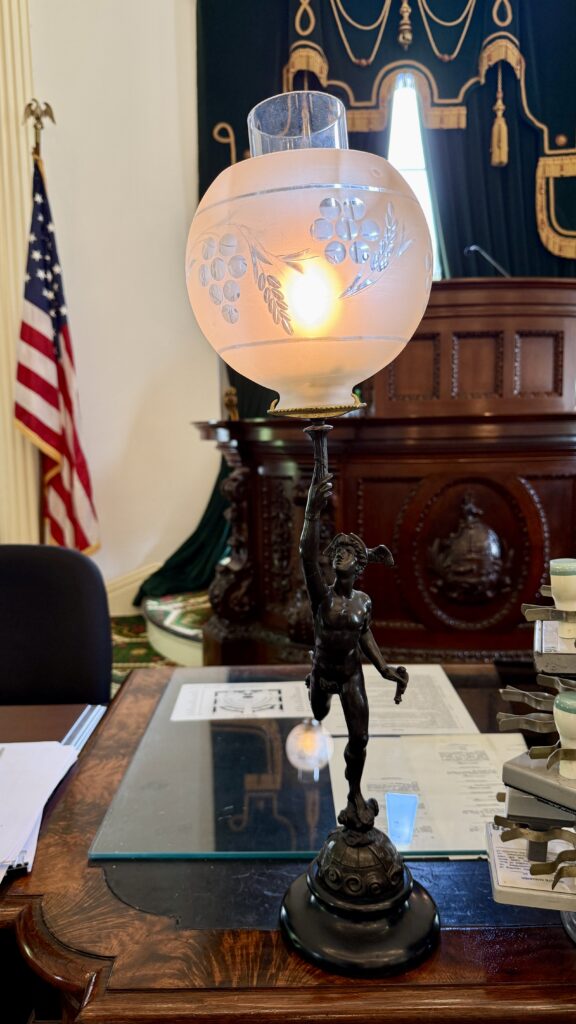
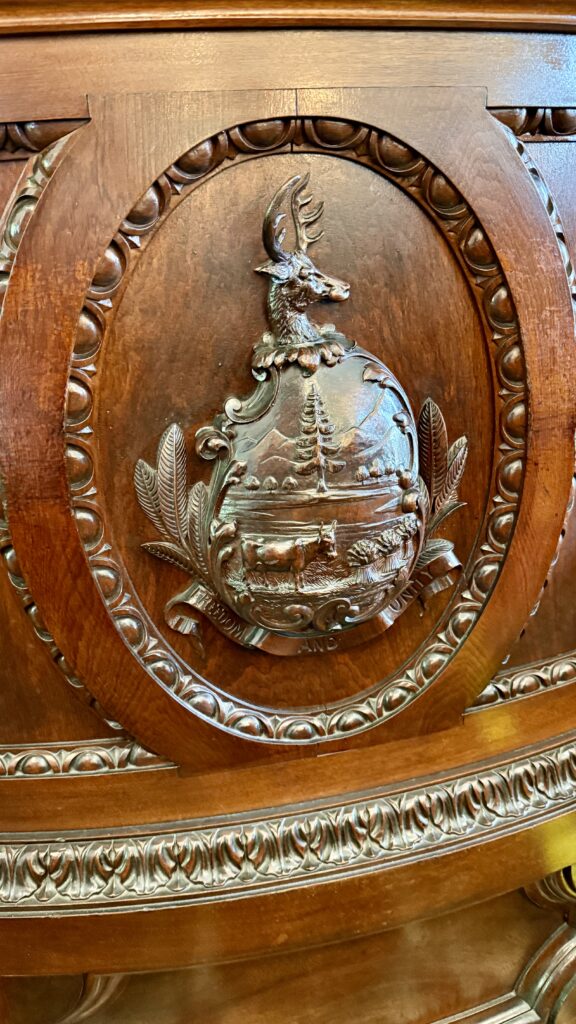
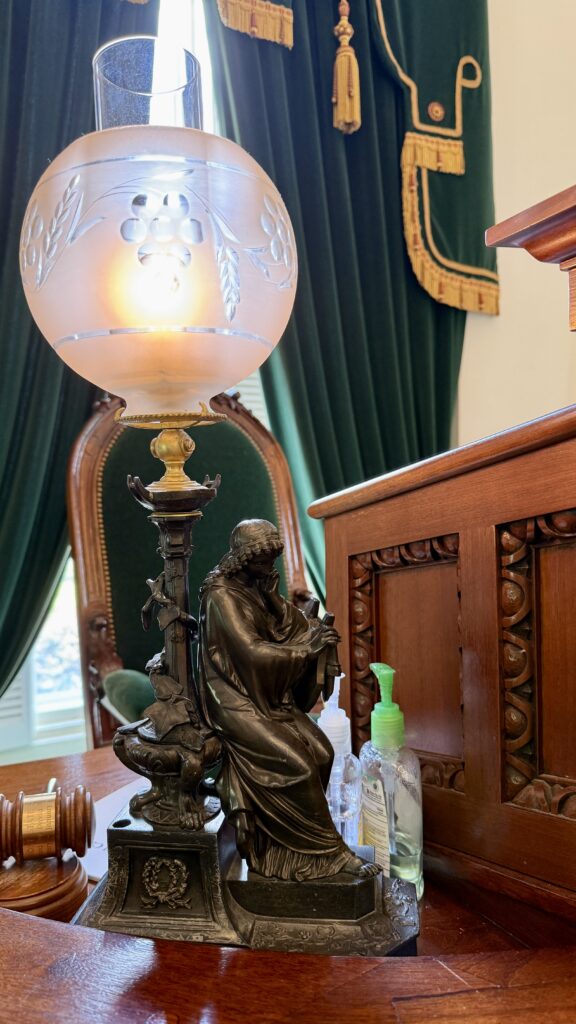
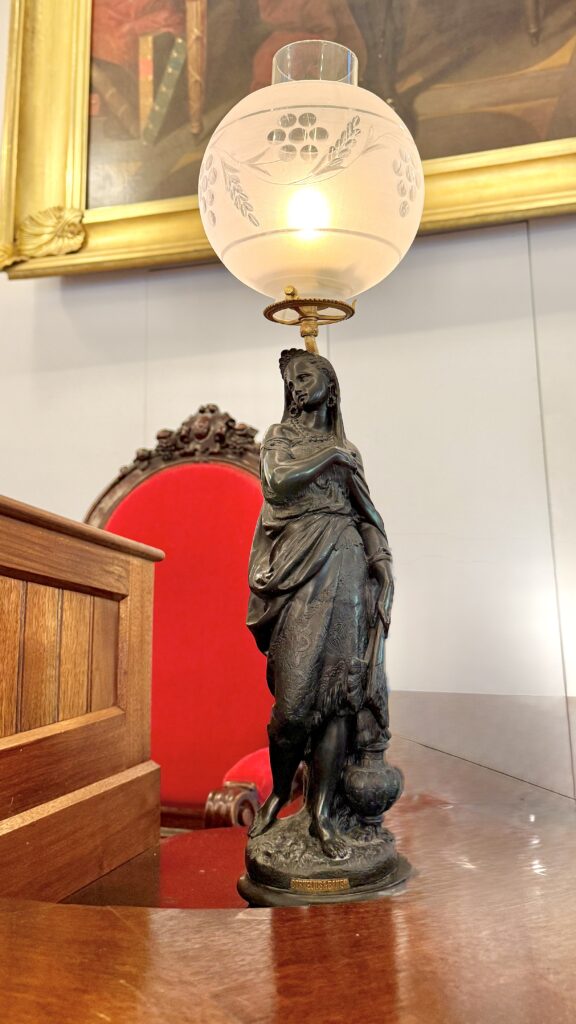
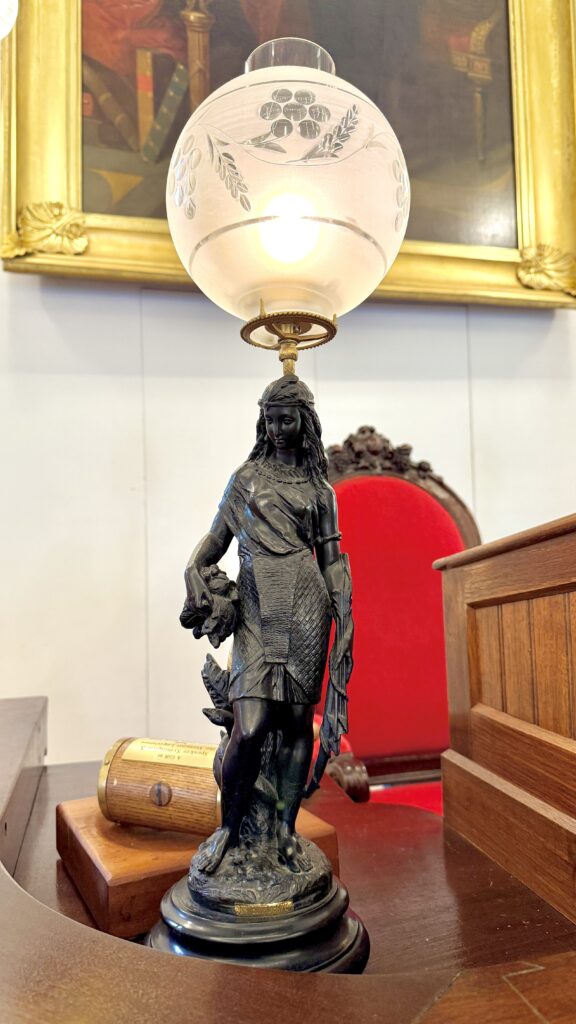
Take a look at the rostrum: it’s a showstopper, hand-carved with Vermont’s Coat of Arms right in the center and topped with gas lamps symbolizing Inspiration and Meditation. And don’t miss the chandelier overhead! It’s evidence that history can be seriously stylish (and maybe even a little bit magical).
FUN FACT: Notice the green carpet. It took the senators 7 years to decide on a pattern during the restoration project.
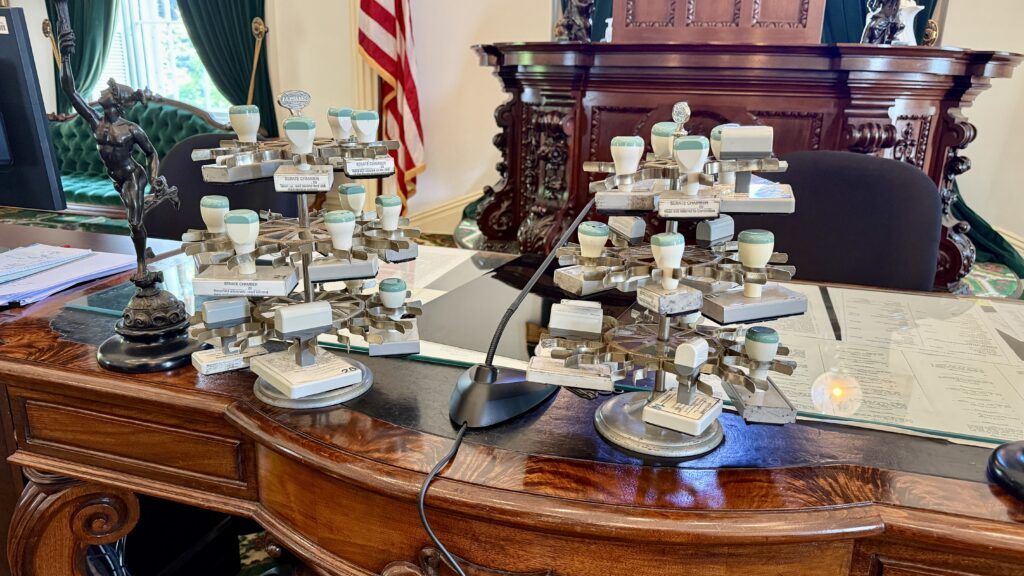
Vermont Senate Chambers. Tim is admiring the chandelier. This is not THE chandelier, but it is certainly is admirable. After disappearing for more than six decades, this chandelier made a dramatic comeback in 1981. This chandelier is a masterpiece with its maritime flair—picture seahorses, delicate water lilies, and Neptune himself looking down from above. Keep reading to learn about THE historic gas chandelier.Muse “Inspiration”Vermont coat of arms carved onto the front of the rostrumMuse “Meditation”Have you ever seen so many stamps?
Vermont is where I learned about pages. The Senate is very restrictive. Senators are not permitted to have food or drink in the Chambers. They can’t even have water. They can’t leave or connect with others unless they ask a page. Little stools are for the eighth graders who serve as pages for six-weeks at a time, rotating in and out while sessions run from January through May. Senators will write a note, knock, on their desk, then a page will pick up the note and run in the state house to find the person or thing they need. Pages are there Tuesday through Friday, go to school on Mondays, and do school work in between. It’s a great learning opportunity for these kids!
FUN FACT: At the end of their 6-week term, Vermont pages get to go up into the dome and sign their name! This is a unique privilege as the inside of the dome is typically off-limits.
Vermont House of Representatives
The first thing you notice when you enter this room is the magnificent chandelier. Right in the middle of Representatives’ Hall, you’ll find the original bronze and gilt chandelier in the center of a ginormous lotus flower; it’s a real showstopper. What’s cool is that this isn’t just any old light fixture; it’s actually one of the most significant surviving gas chandeliers in America. They call it a two-tiered electrified gasolier (which basically means it was originally lit by gas), made in Philadelphia by Cornelius and Baker. Take a closer look and you’ll spot allegorical figures representing Prudence, Eloquence, and Science, mixed in with four copies of Hiram Powers’ famous Greek Slave sculpture. The latest thinking is that the inclusion of the Greek Slave was meant as a quiet nod to abolitionism, especially given this was a pre-Civil War building. If you’re curious, there’s a fascinating article about this, which is definitely worth checking out.
The House Chamber has been fully restored to the way it looked when first created in 1859. The carpet, draperies, and upholstered furniture are all just as they were originally.
FUN FACT: Vermont was the first state to abolish slavery, doing so in its constitution on July 2, 1777. This made it the first colony to completely ban the practice before it joined the United States.
The most significant surviving gas chandelier in America.The House Chamber. Look up and notice the lotus flower; each pedal weighs 500 pounds. There are 16 pedals, making it an 8,000 pound flower! Siri just informed me that’s 4 tons! 😳 Ceilings throughout the building are made of plaster, reinforced with steel beams, so it shouldn’t be falling on anyone’s head anytime soon. You still might cross your fingers when you walk underneath. 🤞🏻This picture of George Washington miraculously survived the fire in the previous building, along with the frame. Frame and all, this 1837 copy of Gilbert Stuart’s original was rehung in the same location in the present State House, above the Speaker’s rostrum. Above it is the Vermont Coat of Arms, carved of pine, painted, and gilded for the chamber in 1859.Vintage lamps on the rostrum.I don’t recall the names of these muses.I so badly wanted to bang this!
The Vermont Governor’s Office and the Constitution Chair
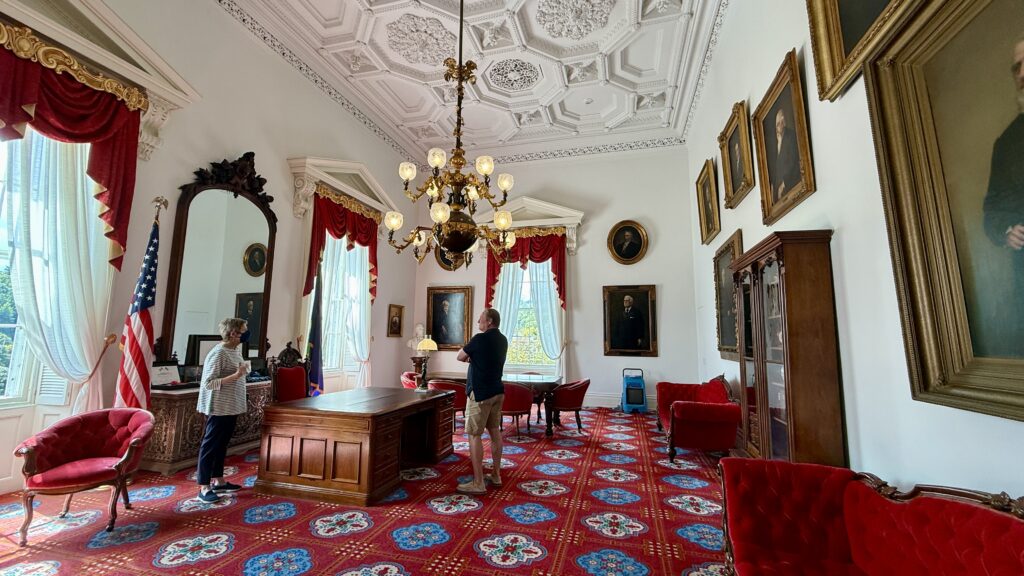
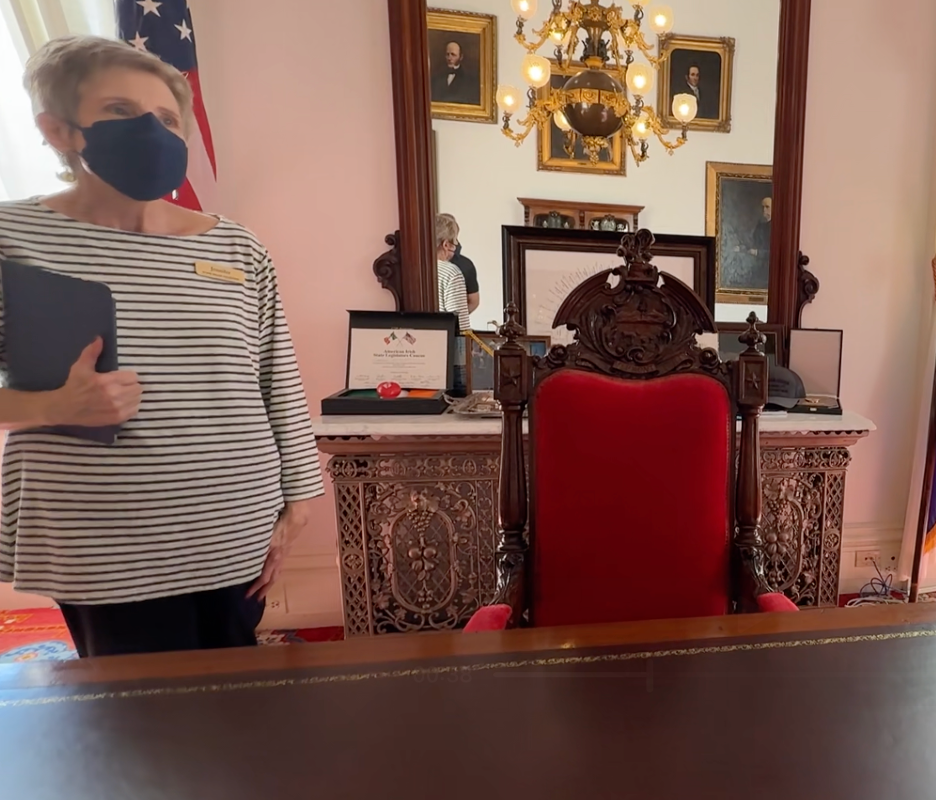
The Governor’s Office is primarily used when the Legislature is in session or for special ceremonial occasions. The Governor does not have a residence here. This office was also meticulously restored to its original look of 1859 by the Friends of the State House in 1984 with replicas of the original carpet, draperies, gaselier, and some furniture. Most intriguing is the Constitution Chair, which has served as Vermont’s Governor’s chair since its presentation to the State in 1858.
Our tour guide is very impressed with the Governor’s Office. We were too.
A Governor’s Chair with Sea Legs
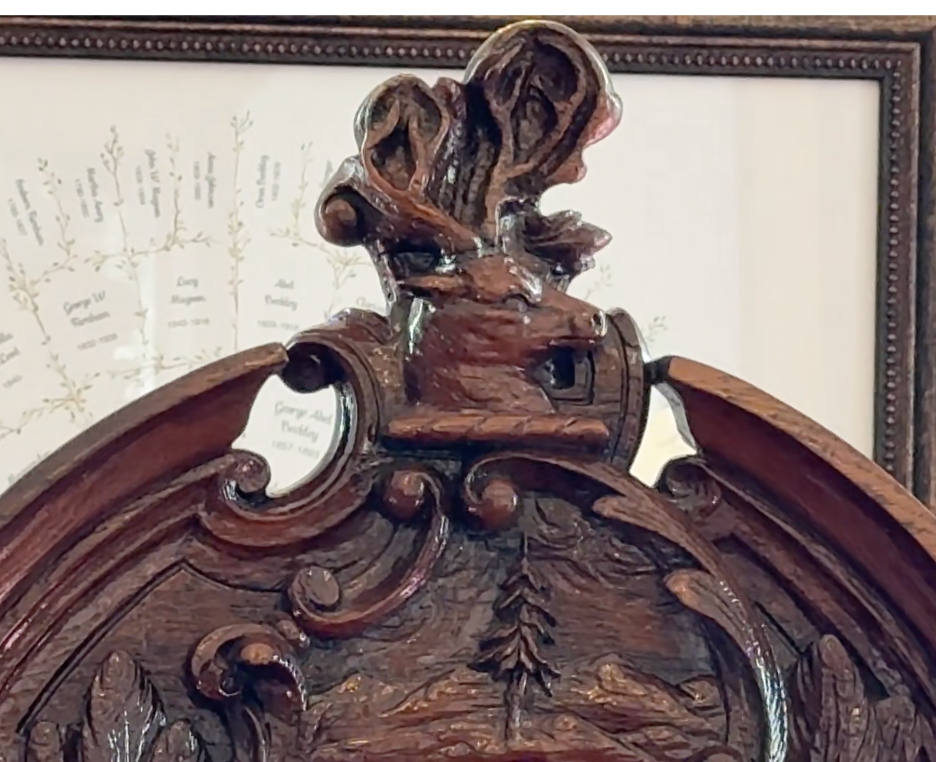
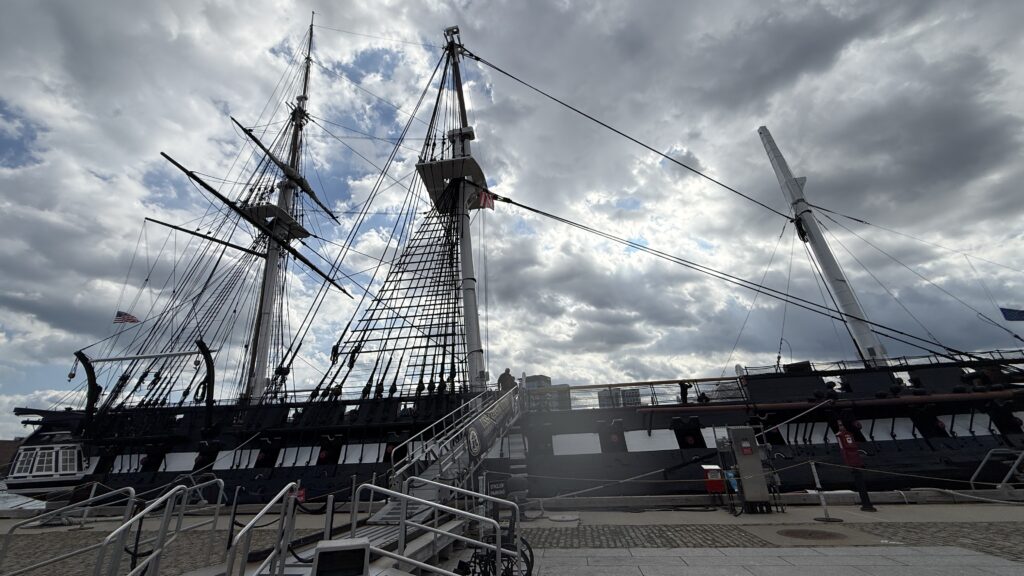
The USS Constitution is the world’s oldest commissioned warship still afloat. Horace Powers, who served aboard the legendary frigate, wasn’t content with just memories. He asked for—and was granted—a special favor: enough wood from “Old Ironsides” to craft a chair fit for Vermont’s governor. That chair isn’t just a seat—it’s a piece of naval history, presented by Powers himself, connecting landlocked Vermont to the high seas with every polished timber. Talk about a chair with serious sea legs (and a whole lot of history).
Sadly, the antlers broke off of the deer in storage, and when they hired someone to restore it during the renovation project, the man who restored it wanted to add the antlers back. He drove to Boston and asked for a little more wood from the USS Constitution so he could restore it properly. This shows the lengths people will go to when they are restoring something back to its original state.
FUN FACT: Ironically enough, we toured the USS Constitution with our friends ten days after we left Vermont, yet I didn’t make the connection until I was posting this blog! She sits at the end of the Freedom Trail in Boston if you ever get a chance to go there.
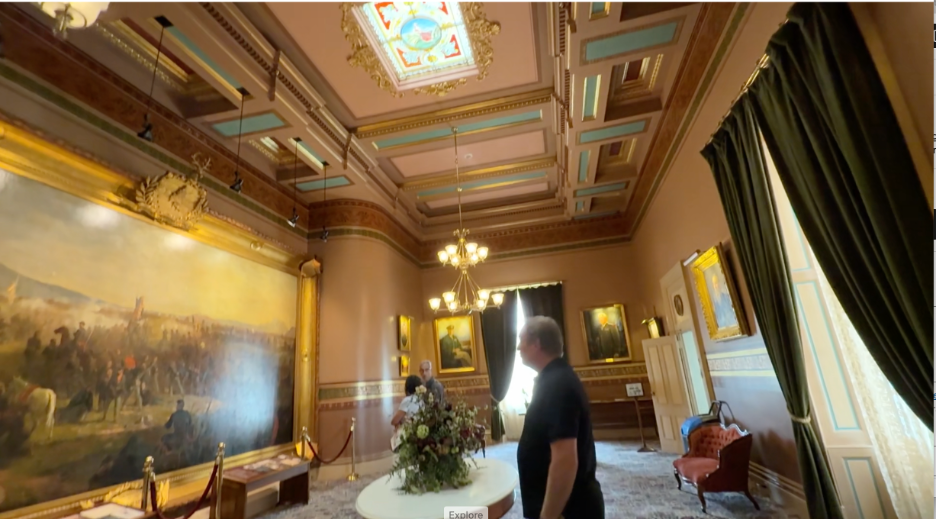
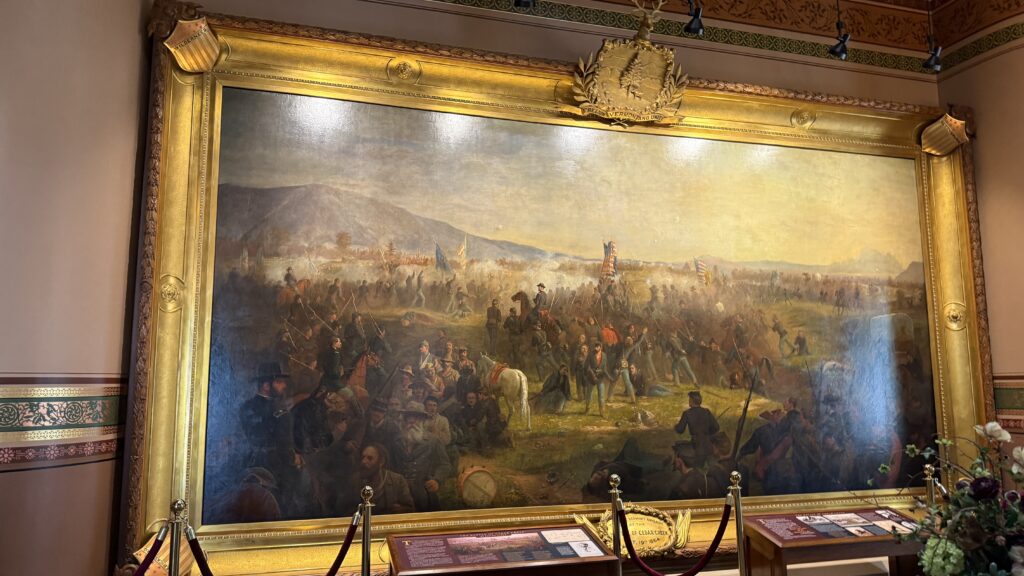
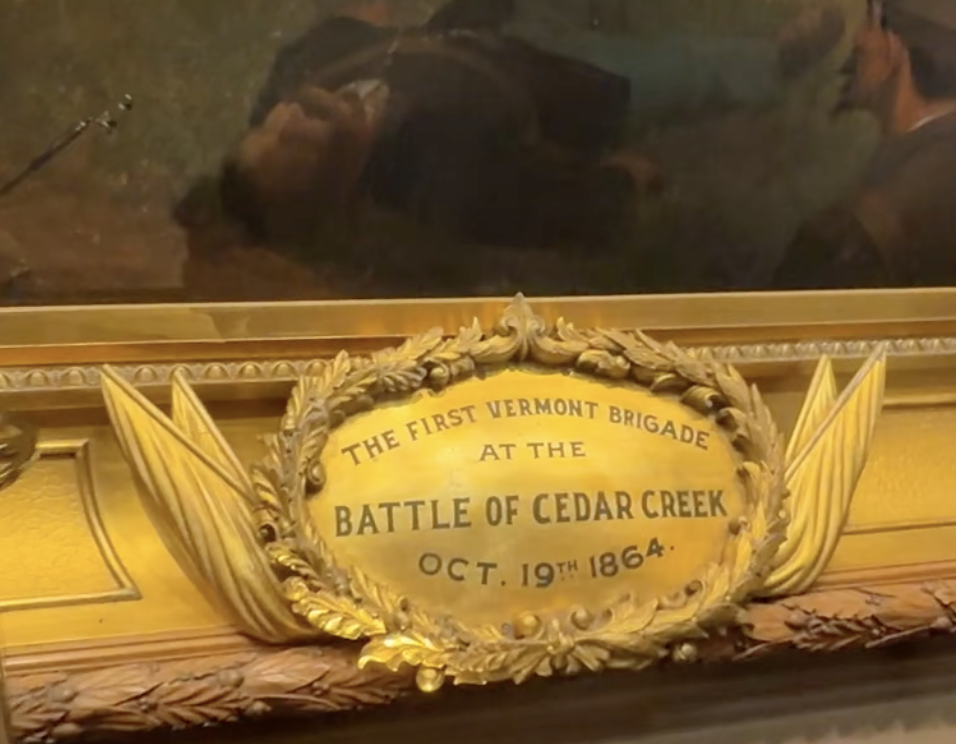
If you wander around on the second floor, you’ll stumble into one of my favorite spaces in the Vermont State House: the Cedar Creek Reception Room. It’s the only room up there that’s been restored to a later chapter of State House history. The star of the show? A jaw-dropping, wall-consuming painting, The Battle of Cedar Creek, stretching a dramatic 20 by 10 feet. This room was once the State Library, lined with shelves and secrets, before it morphed into a Gilded Age reception lounge in 1888. Once the books were evicted, this place got a Gatsby makeover: elaborate wall stencils, brass gas chandeliers that bend and swirl, a lavish Oriental-inspired carpet, and stained glass skylights that throw rainbows across the floor.
But here’s where things get a little Scooby-Doo. When they cleared out the library, they also removed those magical skylights, and nobody seems to remember why. Fast forward. A worker’s crawling through the attic, probably hunting for insulation gremlins, when—crunch—his foot lands on something suspiciously glassy. Lo and behold, he’s uncovered the lost treasure of the Vermont State House: every single piece of those original skylights, just chilling in the attic for decades! They sent the glass shards to a restoration company near Boston, but here’s the kicker: there were zero photos, nada, to show what the skylights used to look like. The restoration team basically had to play the ultimate game of “puzzle without a picture on the box.” Now that’s State House magic at work!
The Artist Behind the Painting.
Let me introduce you to Julian Scott—a true legend with a backstory worthy of a Hollywood blockbuster movie. At just 15, Scott fibbed about his age and signed up for the Union Army in the Civil War. He wasn’t old enough to fight, so they handed him a fife and later made him a drummer boy, sending him into the thick of battle with nothing but rhythm and nerves of steel. Here’s where things get heroic. In the chaos at Lee’s Mills, Julian didn’t hesitate. With bullets flying, he made three daring trips across a creek to rescue wounded soldiers, earning himself the Medal of Honor—even though he was still basically a kid. He is one of the youngest people in the country to have received America’s highest military decoration.
After the war, Scott’s story took a more creative turn. He hopped over to Paris to hone his craft and returned as a top-tier Civil War artist. The Vermont State House tapped him to capture the Battle of Cedar Creek, choosing that moment because it’s where Vermont troops really made their mark. But Julian wasn’t about painting glorified, heroic poses; instead, he focused on the grit and sacrifice—the real, raw side of war. He didn’t actually fight at Cedar Creek himself, so he went full detective mode. He wrote to veterans and their families and asked for photos, eventually collecting images of 21 Vermont soldiers who took part in the action. So, if you’ve got family ties to Cedar Creek, there’s a chance their actual faces are immortalized in Scott’s masterpiece.
Julian didn’t just stop at the painting. He personally designed the frame, decorating the corners with shields that honor other battles where Vermont’s brigade made history. Every detail is a salute to real people and real stories, a true State House treasure.
More Paintings and a Famous Head
As if that wasn’t enough information overload, our tour guide took us through a few more spaces, sharing stories about various paintings and sculptures. For such a small building, Vermont State House is packed with history! She was not in a hurry, spending plenty of time answering our questions as well as entertaining discussion. For example, after the tour she told us about a local creamery where we could go and buy one of the local favorites. That was worth remembering!
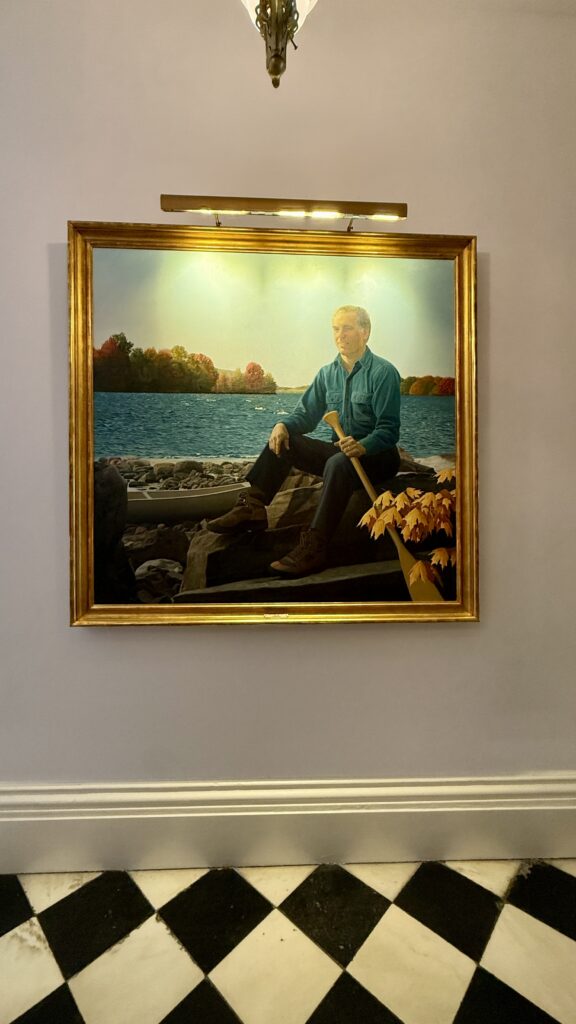
Gov. Howard Dean, M. D., 1991 – 2003, painted by Carroll Jones.
Gov. Dean loved the outdoors, and since governors get to choose how they will be depicted in their portraits, he chose a scene he likely spent a good amount of time in. They pay for it after all, so it’s only right they should get to pick their style. The State House staff lovingly (jokingly) refer to this portrait as the “L.L. Dean.” This could be on a magazine cover for sure!
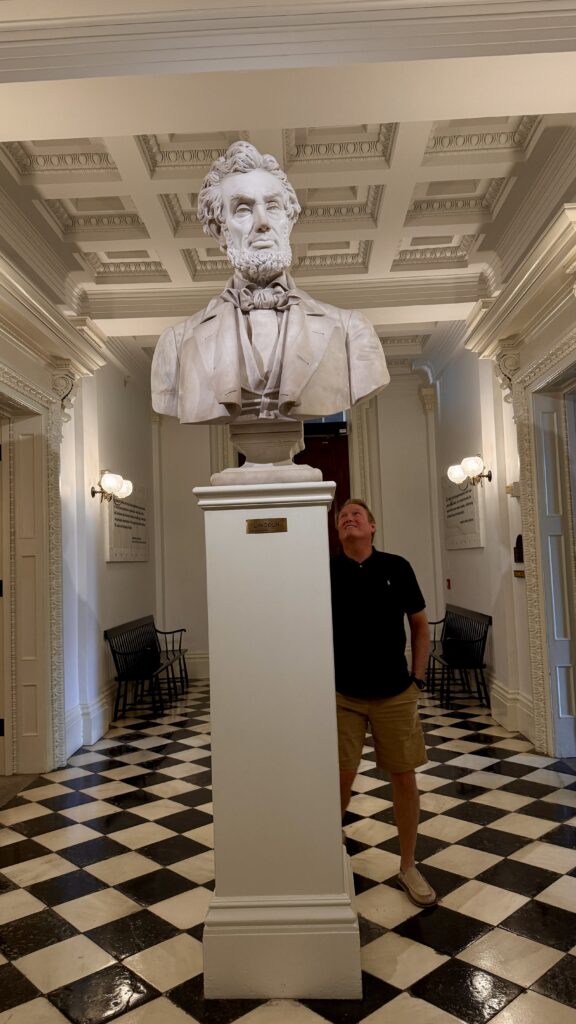
Bust of Lincoln.
In the main lobby of the State House, she pointed us to the only work of art by Larkin Mead that remains in the Capitol, the marble bust of Abraham Lincoln in the Hall of Inscriptions. This bust was done in preparation for the large bronze statue Mead created for Lincoln’s tomb in Springfield, Illinois. So many condolences were given by Vermonters to Lincoln’s wife when he passed, she gave Vermont the bust of marble which Mead had “practiced” with. Can you imagine practicing with a block of marble?
Mead is the same sculptor who carved the original Agriculture for the top of the dome. The same one who sculpted the original Ethan Allen out of marble.
Vermont Wrap-Up
The Vermont State House stands as a testament to the small state’s values—welcoming, accessible, and community-focused. Unlike the grandiose capitols found elsewhere, Vermont is intimate, blending historic charm with functional beauty. Its modest size means visitors and locals alike enjoy close proximity to lawmakers and the governor, making it easy for citizens to engage directly in the legislative process. More than just a government building, the State House serves as a living museum, proudly shared with guests year-round.
One entertaining form of sharing the building with guests, unique to State Capitols, is the use of the Vermont State House for community gatherings. The Farmers Night Concert Series is a longstanding State House tradition. If you happen to be in Montpelier on a Wednesday during legislative season, you can attend a concert here for free. Artists from around the state, in genres ranging from classical music to bluegrass to barbershop, perform at 7:30 pm in the well of the House Chamber each Wednesday night! And yes, you can sit in the comfy legislative chairs as you enjoy the music.
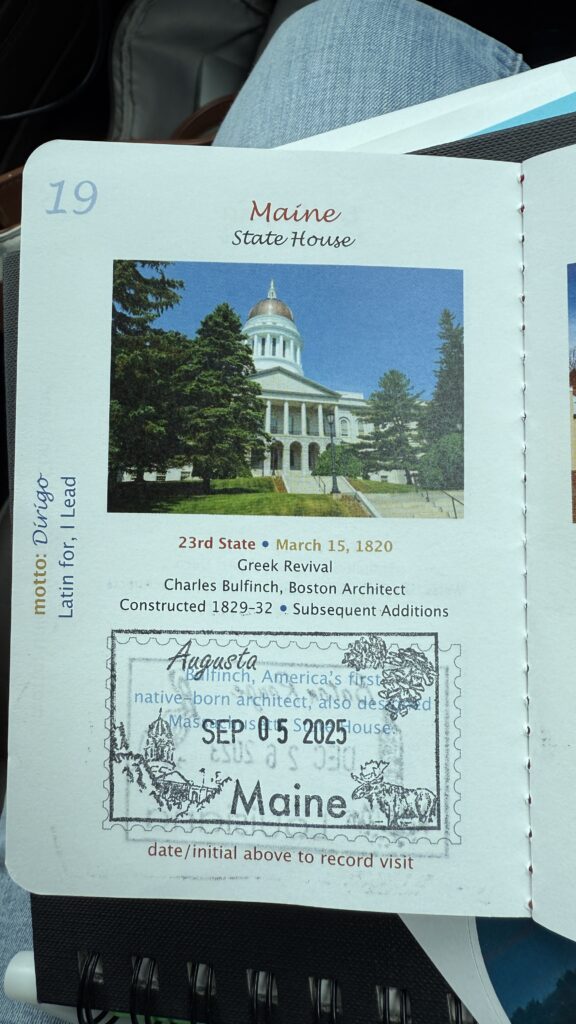
September 5, 2025. Augusta Maine State House: The Heart of Maine’s Government
Maine State House
Let’s talk about the State Capitol. After all, that’s what you came for, right? Just so there’s no confusion, we’re in Augusta, Maine, not its southern namesake in Georgia. With a cozy population of around 19,000, Augusta is one of America’s smallest state capitals. Only Pierre, South Dakota and Montpelier, Vermont can claim tinier city vibes.
We stopped on the way from Vermont to our RV Park, not knowing we would pass through this town a few more times on our drive paths.
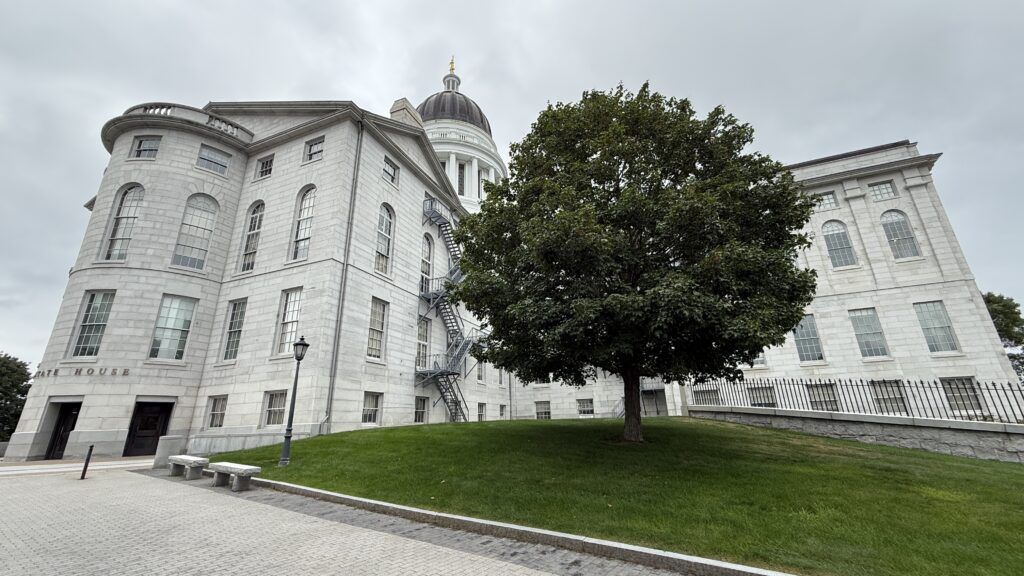
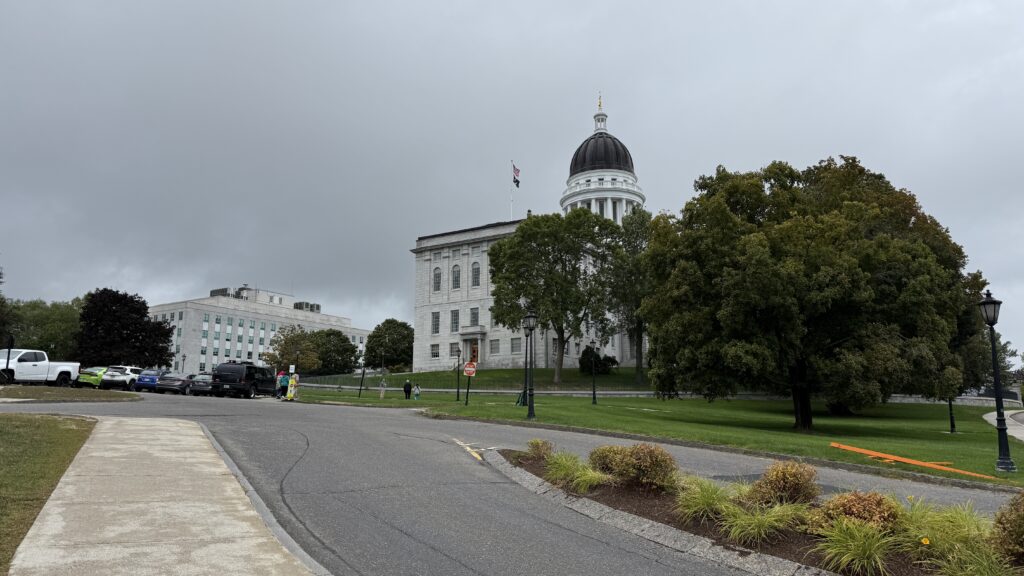
Maine’s first capital was Portland, but the state quickly realized it needed a spot smack in the middle of the state for everyone’s convenience. Enter Augusta! When the stately State House, built from Hallowell granite and delivered by trusty oxen, was finished in 1832, one year after August was made the capital of Maine.
Originally capped by a cupola, it was replaced by the current dome rising 185 feet. The Lady of Wisdom statue stands 15 feet from toe to torch and was recently restored to her 20th century majesty. The building has grown and changed so much over the years, you might not recognize the original!
Maine State House, Augusta
While it may appear to be, the Maine State House does not have a black dome. The dome is made of copper, but it was recently replaced and will initially appear brown. Over time, as the copper oxidizes, it will eventually turn green, similar to many other copper structures.
If you read my blog about South Dakota’s dome, which is also made of copper, the only truly black dome is found there (it turned black instead of green due to the perfectly clean air).
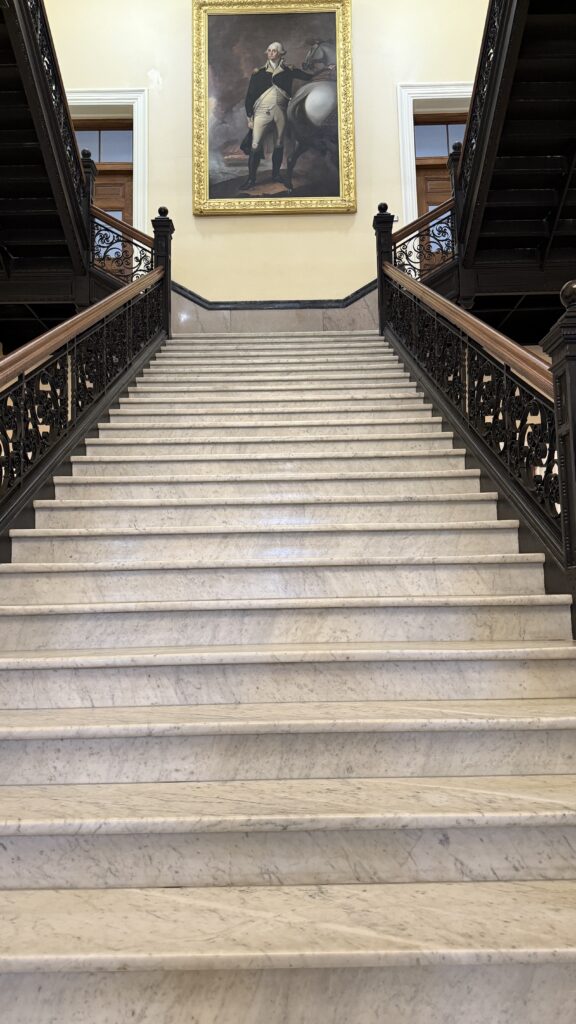
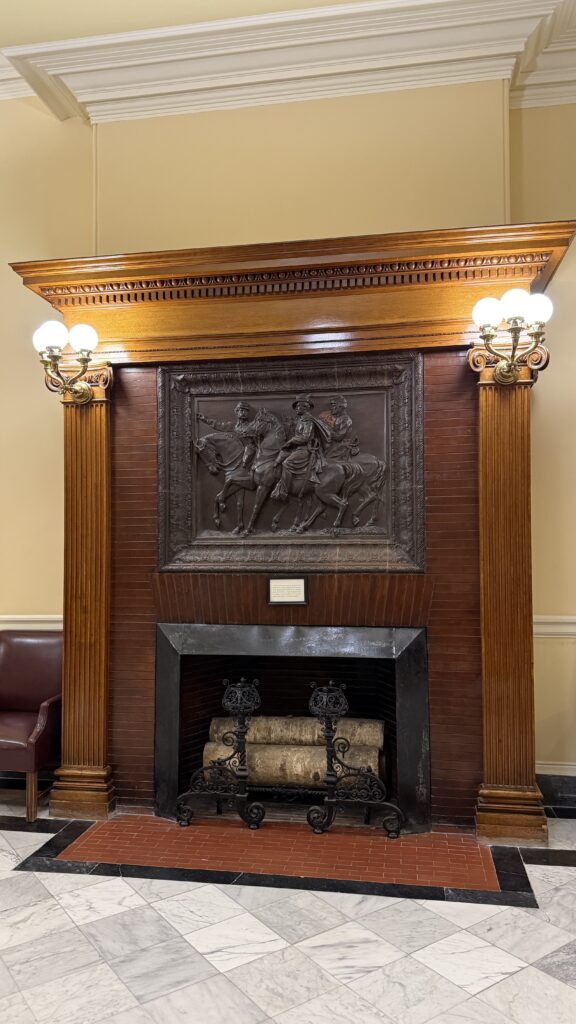
Portrait of George Washington stands at the top of the grand staircase, painted in 1836.Magnificent fireplace once used to heat this part of the building.
Maine loves celebrating its governors—just flip through the small tour pamphlet to find out! The Hall of Flags is decked out with portraits of legendary Mainers, including the first woman to serve in both houses of Congress and have her name floated for a major party’s presidential nomination. Look around, and you’ll also spot plaques honoring Maine’s brave soldiers from across the ages.
Head to the third floor for government in action: the House of Representatives, Octagon Hall (step outside onto the veranda but before you do, be sure to peek up for a view of the dome!), and the Maine Senate Chambers. For a peculiar touch, check out the West Wing’s black limestone floors. They’re streaked with ancient fossils, just like the ones we saw in Vermont’s State House. History is right underneath your feet!
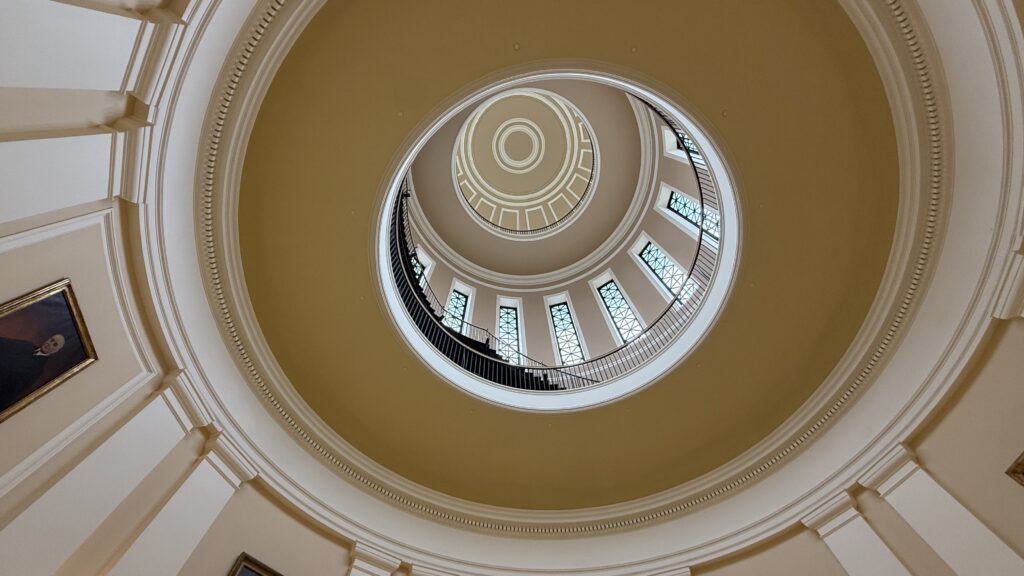
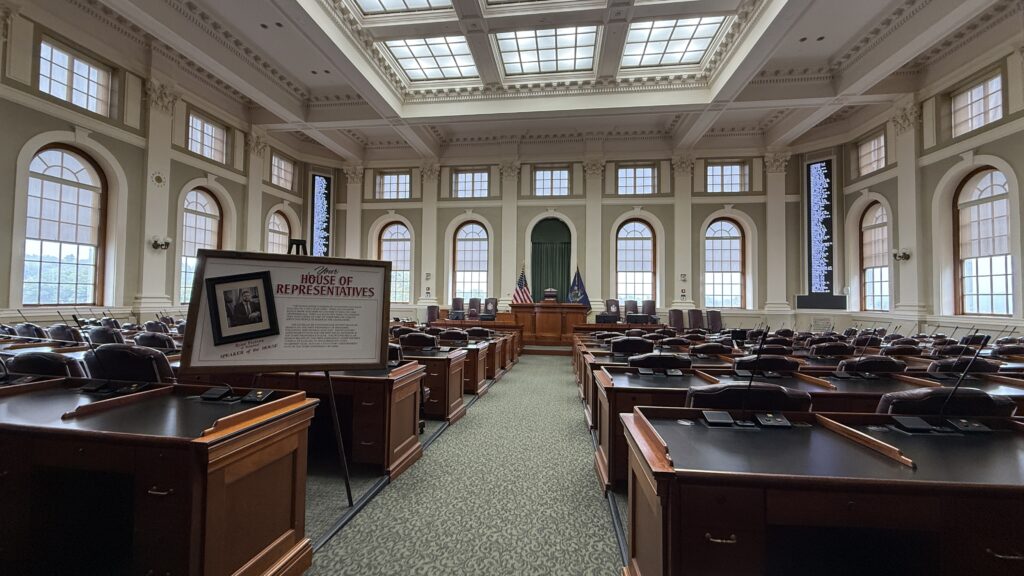
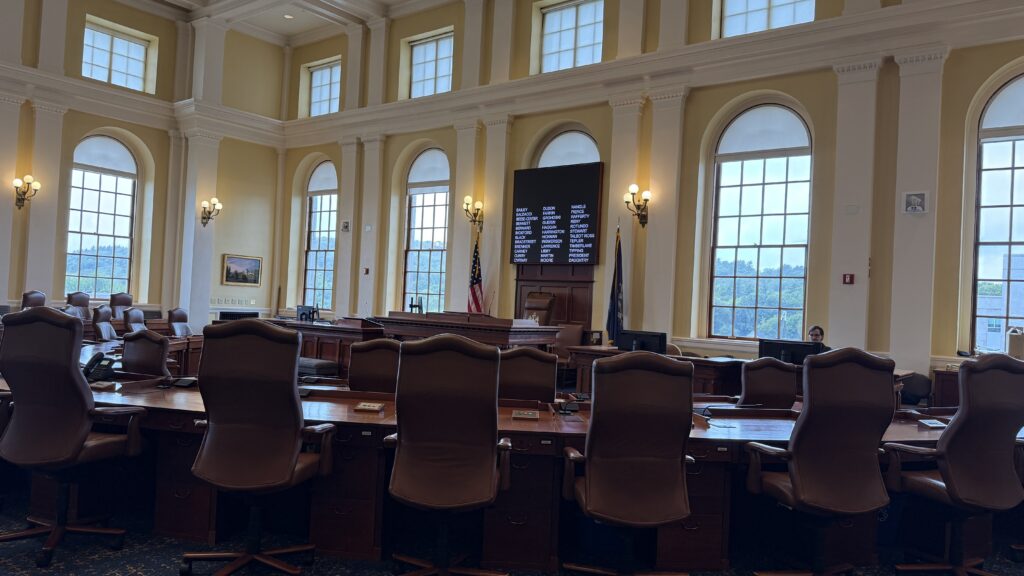
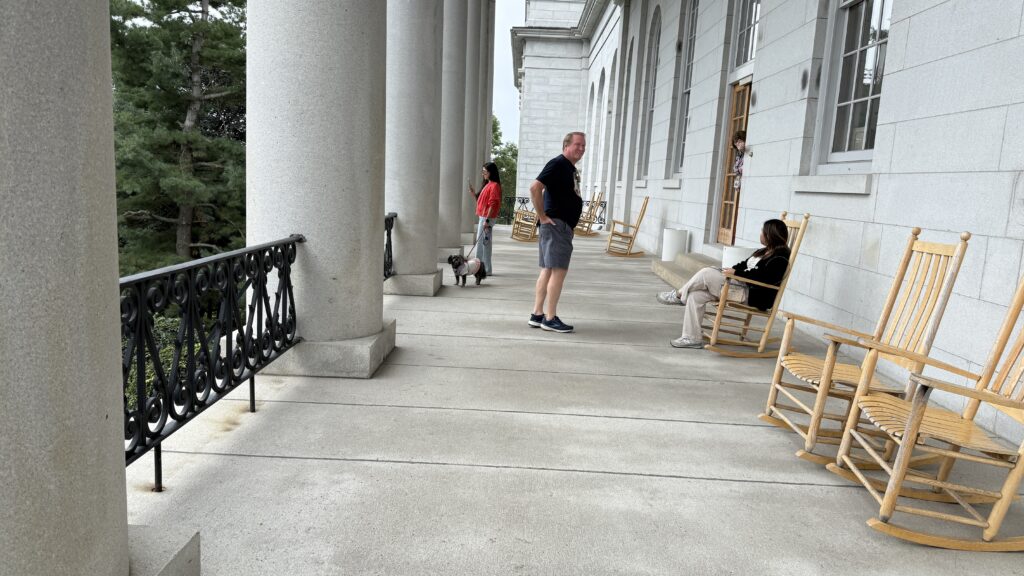
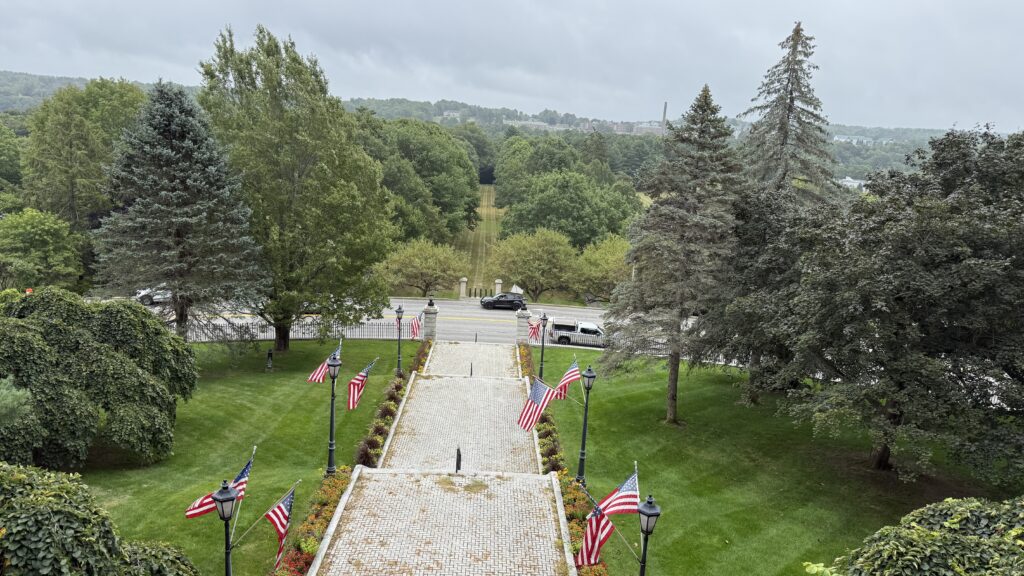
View of the rotunda from the Octagon Hall.House of Representatives.Senate Chambers. Notice the semi-circles.On the veranda with our tour guide and some random stranger. The eight columns are solid granite and weight 20,000 pounds each! Getting them up there was quite a feat.View from the veranda. The park across the street is Capitol Park. The Maine State House and surrounding park is on 34 acres of land. This is a lot of land compared to many others we have seen.
Government: A Maine Event!
Maine’s political history is full of drama and firsts! The state boasts one of the nation’s oldest constitutions, standing strong since 1819. But did you know Maine was once just a district of Massachusetts? Locals wanted more control over their own destiny (and safety!), so statehood was put to a vote—so close, it squeaked by with a single “yes.” On March 15, 1820, Maine officially became the 23rd state, with Missouri joining the club a year later.
Trailblazers live here: Maine let women vote in school elections way back in 1874, nearly half a century before the rest of the country caught up! The state also played a heroic role in the Underground Railroad, helping those escaping slavery find freedom across the Canadian border. And here’s a fun literary twist for my book club friends: Abolitionist Harriet Beecher Stowe penned her iconic “Uncle Tom’s Cabin” back in 1852 while calling Brunswick, Maine home.
And in true Maine fashion, the state shook up the system in 2016 by being the very first to roll out ranked-choice voting for major elections. When it comes to government, Maine loves to do things its own way.
And now for a few more (or maybe more than a few) FUN FACTS about MAINE. I really should look these up before we visit a state. There is so much to see that we missed on this trip, but at least now we have more than one reason to go back. It’s an amazing state with a more moderate climate than one might think.
Maine: A State of Firsts and Only’s
Did you know? Maine officially joined the United States as the 23rd state on March 15, 1820, a milestone that shaped its unique place in the nation’s story. Step back even further in time to 1641, when York, Maine made history by becoming America’s first chartered town! That’s right, this coastal gem was blazing trails centuries ago.
Maine’s Native American heritage remains strong, with tribes like the Passamaquoddy and Penobscot preserving their traditions. Uniquely, Maine is the only U.S. state with a single-syllable name and borders just one other state (New Hampshire) the rest of its three boundaries meet Canada. As New England’s largest state (almost as big as all the other New England states put together), Maine offers a lot of room for adventure!
Maine dazzles with over 4,000 islands, but only 15 islands have year-round residents. It’s the largest New England state, yet the most rural and least populated east of the Mississippi (approx. 1.4 million), with approximately 44 people per square mile. Living here is pricey. Mainers spend 91% of their income on expenses, well above the national average of 81%. Still, cyclists love Maine’s scenic routes and endless adventure. Whether you’re here to visit or stay, Maine’s wild beauty and outdoor spirit make it largely unforgettable.
Maine knows how to party! From funky local music, quirky accents, and wild charity events to legendary sportfishing, the bone-chilling New Year’s Eve Polar Plunge, the towering Paul Bunyan, and even wife-carrying races, there’s never a dull moment. Explore beyond the top ten cities, and you’ll find epic national and state parks, top-notch ski resorts, the Maine Wine Trail, classic amusement parks with wooden roller coasters, and a Stonehenge replica for good measure.
Nature, Nature, and More Nature
Freeport is famous for L.L. Bean, an outdoor lover’s paradise since 1912. This picture was inside of one of the stores we visited. Freeport is where it all started. This was a smart adventure in a state known for its beautiful natural landscapes. Nicknamed the “Pine Tree State,” it’s a forest wonderland with nearly 90% covered in trees and thousands of lakes, rivers, and streams.
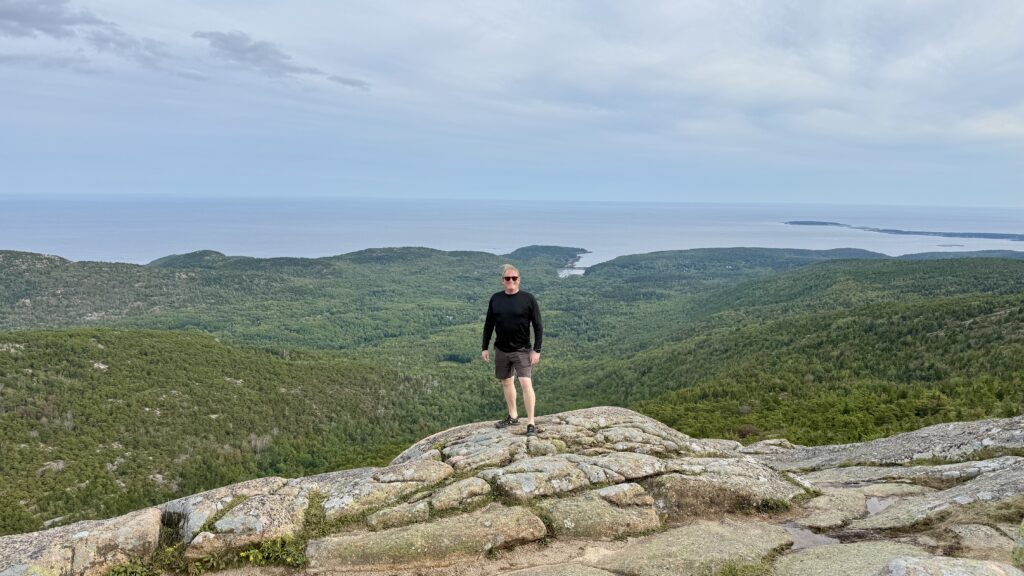
Acadia National Park was the first national park designation east of the Mississippi and now it boasts as the country’s second busiest. We came to Maine primarily to go there (and to eat lobster, and of course to see the Capitol). This park draws almost 4 million visitors per year, with its stunning coasts and wildlife like black bears, bald eagles, and puffins.
Outside of Alaska, Maine has the largest population of Moose in the United States (we never saw any 😢), which explains its designation as their state mammal. The cheerful black-capped chickadee rules as their state bird (they’re everywhere 😁).
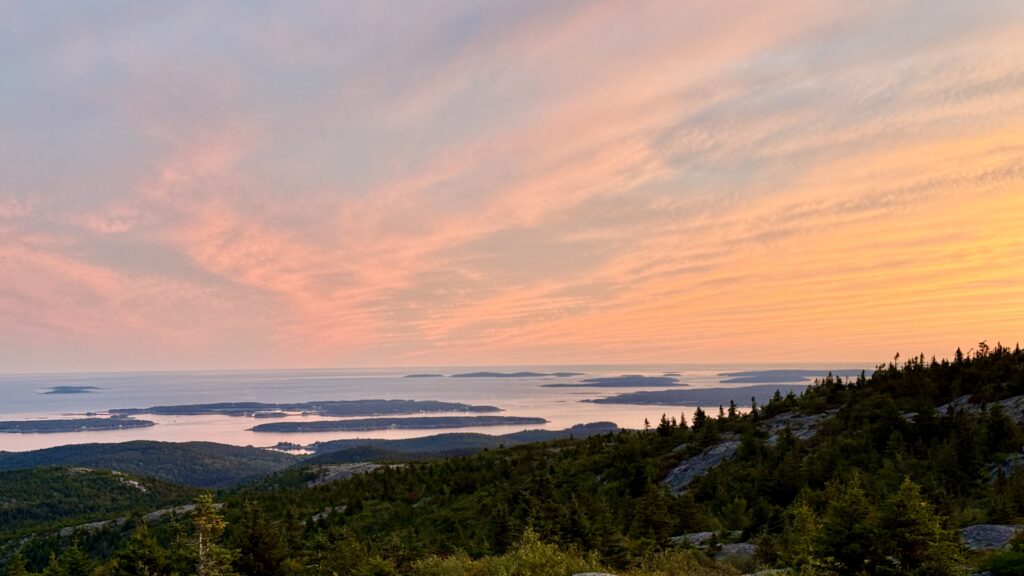
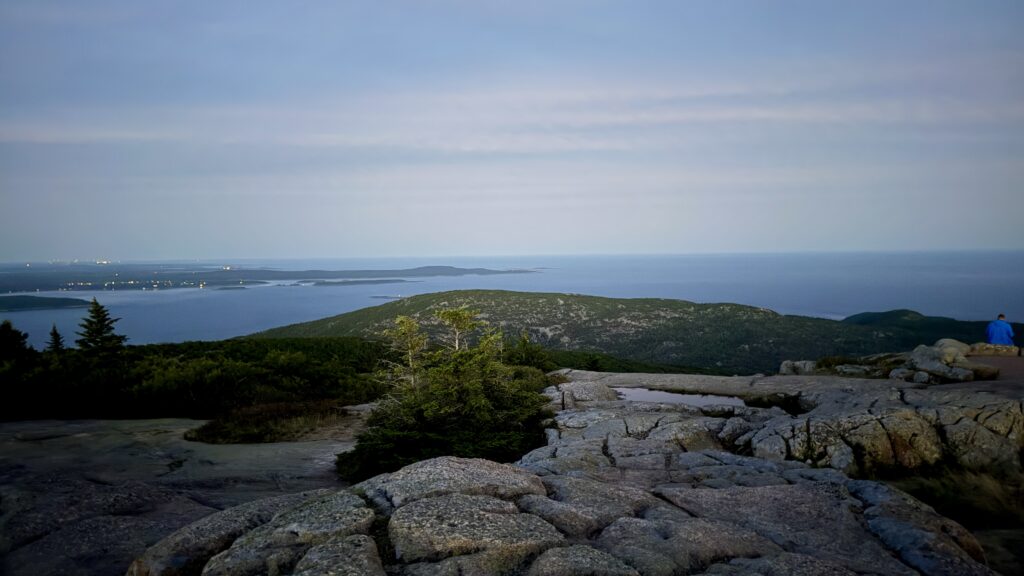
The rocky hills of Acadia, especially around Cadillac Mountain, sport wild shapes like ice cream cones thanks to erosion. Hmmm, Cadillac Mountain must send a subliminal message as our ice cream craving unquestionably increased while we were there. A few hours away, Mount Katahdin rises tall at 5,268 feet, nicknamed the “Greatest Mountain,” and marks the epic finish line of the 2,180-mile Appalachian Trail.
Lighthouses, Islands and Downeast
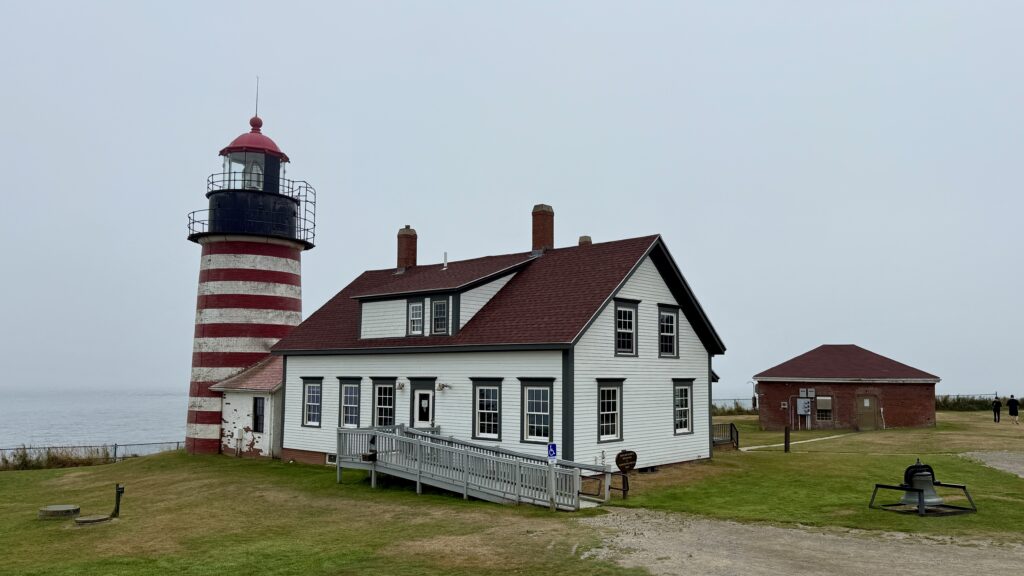
If you’re up for unique sights, check out Lubec, Maine, like we did, where you’ll find America’s only candy cane-striped lighthouse. West Quoddy Head Lighthouse is perched at the easternmost tip of the United States. With its bold red and white stripes, it’s more visible in snow and fog and the very first spot in the country to greet the morning sun. The original lighthouse started guiding ships in 1808, with the current one taking its place 50 years later. Talk about a bright history!
Quoddy Head Lighthouse, Easternmost point of the U.S.A.
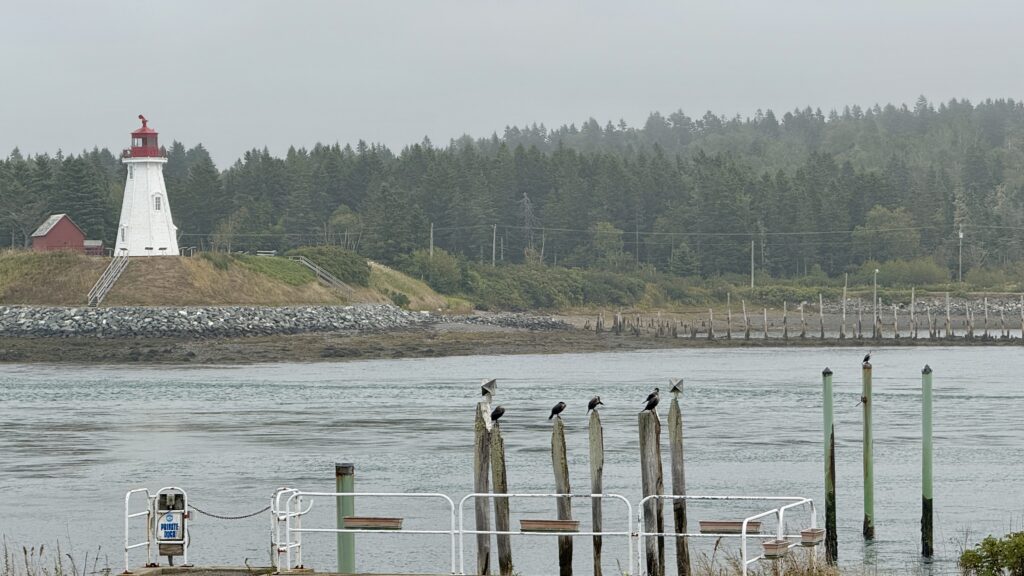
Campobello Island sits just off Lubec, Maine. It is the site of the Roosevelt Campobello International Park, Head Harbour Lighthouse, and Herring Cove Provincial Park. It’s officially Canadian, but the only way to drive there is through Maine! Sitting at the entrance to Passamaquoddy Bay and covering 27 square miles (70 km²), it’s got a quirky passport twist. We spotted this gem during our Lubec trip and took a picture from the mainland, but Tim’s expired passport kept us stuck on the American side—maybe next time!
Mulholland Point Lighthouse, situated at the southwestern tip of Campobello Island. It is no longer in active service. Mulholland Point Lighthouse was built in 1885 and served as a guide for the many small coasters, passenger ships, and freighters traversing the narrow Lubec Channel en route to or from the United States or Canadian ports on Grand Manan Island, just south of Campobello Island.
Commissioned by none other than George Washington in 1791, the iconic Portland Head Light claims the crown as the world’s most photographed lighthouse! After perusing the website, I definitely plan to photograph that one if we go back to Maine’s rugged coastline. I picture another road trip touring all of the state’s 65 history-packed lighthouses, each with its own story to tell.
Ready for some coastline bragging rights set to a quirky title? “Downeast” is synonymous with coastal Maine. People sailing from Boston head downwind to Maine in short, “downeast” (even though it’s technically in the northeast direction). A person from this area may be called a “down-easter.”
Including all its twisty inlets, islands, and tidal nooks, Maine’s shoreline stretches a whopping 3,478 miles—that’s longer than California’s coast! It’s the fourth longest in the country, and rumor has it, every navy on the planet could anchor in Maine’s deep harbors. Now that’s coastal cool!
Famous Inventions and World’s Largest
Did you know Maine is the birthplace of earmuffs, Lewis’ Arabian Hair Oil, the genius machine that churns out flat-bottomed paper bags, and even the first transatlantic radio transmission? That’s right! Maine’s got your ears cozy, your hair glossy, your lunches secure, and your global messages sent!
And for transit fans, Kennebunkport is home to the Seashore Trolley Museum—the oldest and largest museum devoted to mass transit on the planet. Maybe you’ll run into Sheldon Cooper there. Hop aboard for a trolley trip through time!
Ready for a wild water ride? Meet the Old Sow, the biggest tidal whirlpool in the entire Western Hemisphere, and one of the largest in the world, swirling just off the coast of Eastport, Maine. This natural marvel churns and twirls like nature’s own giant blender. Whatever you do, don’t ever triple-dog dare a friend to dip a toe!
Maine doesn’t just go big with scenery—check out its world-record sculptures! In Strong, you’ll spot a whopping 16-foot-tall wooden toothpick outside the hardware store, honoring the town’s epic run as the “Toothpick Capital,” churning out 75 billion toothpicks a year back in the day. Meanwhile, Rockland boasts the world’s largest lobster sculpture, celebrating Maine’s claim to 90% of the country’s lobster haul and its claw-some place in seafood history. We missed the sculpture, but we did eat an entire lobster in Bar Harbor for my birthday! From mammoth toothpicks to colossal lobsters, Maine knows how to make a giant impression!
My birthday dinner came with corn and crackers.
Feeling worldly? Head to Yarmouth, Maine and check out Eartha—the planet’s biggest rotating and revolving globe. This mega-map measures over 41 feet across and tips the scales at nearly 5,600 pounds. It took two years just to build this whopper, and yes, it totally outshines that 33-foot-wide globe in Italy!
A Few State Favorites
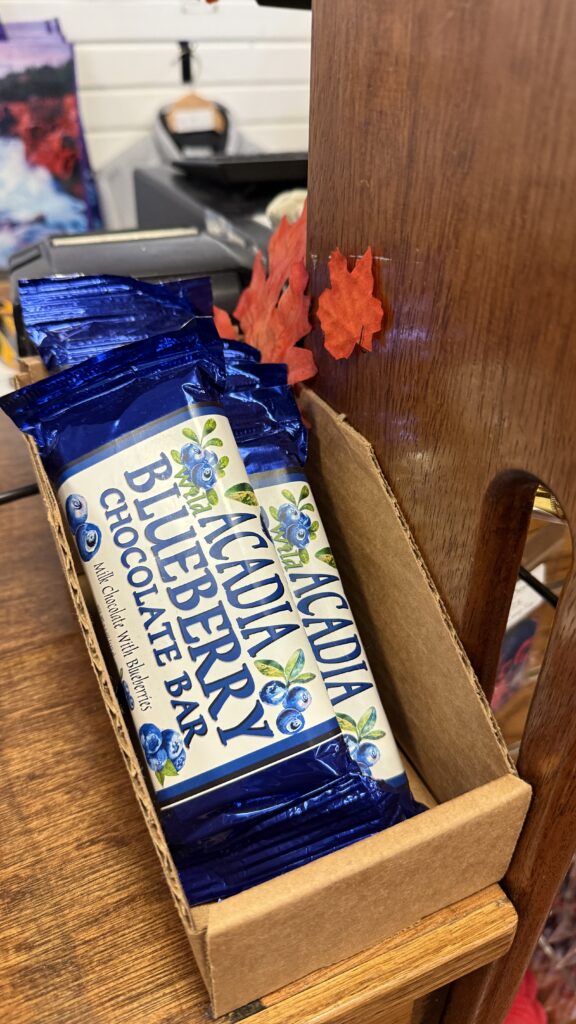
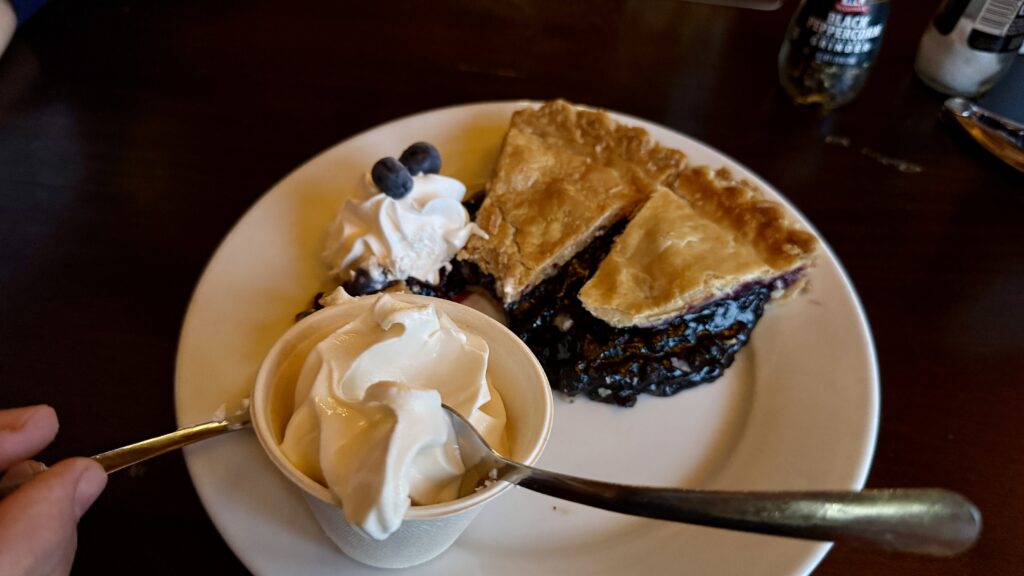
Antioxidants anyone? Maine is the largest producer of blueberries in the U.S., contributing to 99% of the nation’s yield. Did you catch that? Locals use these delightful berries to make blueberry pies, pancakes, oatmeal scone, gelato, syrup, muffins, ketchup, cake, chocolates, and more. When in Maine, eat blueberry pie. We did…twice!!
Can you give me a “whoopie?!” The Whoopie Pie was designated the state treat of Maine in 2011. “Mainers” love it so much they hold an annual Whoopie Pie Festival, featuring the best creations by local bakers. We had one of these as well and, yes, they are delish!
Cat lovers, listen up! Maine has a designated state cat! The Maine coon is a smart and fluffy giant that can grow up to 48.5 inches (wow 😳) and behaves a lot like dogs. Dogs that like to be in control, that is. Coon cat, anyone? Believe it or not, this is one of the oldest natural cat breeds in the US. I had to Google it just to see what they looked like, and I imagine you will want to do the same. I’m pretty sure we saw more than one of these crossing a road, and we thought it was a bobcat. They are HUGE!
Maine Wrap-up
From savoring farm-fresh produce at the historic Portland Farmers’ Market to exploring Augusta’s unique role as Maine’s state capital, this blog captures the state’s vibrant blend of tradition and innovation. Maine’s rich political history highlights its early strides in democracy, from adopting one of the oldest constitutions to pioneering ranked-choice voting and supporting women’s suffrage well ahead of the curve. The State House stands as a testament to Maine’s evolving identity, filled with tributes to trailblazers and reminders of the state’s enduring commitment to independence and community. Whether you’re a history buff or a curious traveler, Maine’s legacy of doing things its own way shines through every story, site, and tradition explored in this journey.
Pop on over to New England Part 2, where you will read about New Hampshire and Massachusetts State Capitols.
À la prochaine…hasta la próxima vez…until next time!
“I am the Lord, who heals you.” ~Exodus 15:26
My relationship with Jesus Christ motivates me to keep blogging. Though I have metastatic breast cancer*, my faith helps me survive, thrive, and feel alive while staying active. Without Him, I couldn’t achieve anything. With His help, well, my accomplishments speak for themselves on my blog. If you’re interested in learning about building a relationship with Jesus, feel free to comment below. I will never sell or share your email.
*Metastatic breast cancer is Stage IV cancer. Metastatic, or metastasis, means the cancer has spread beyond the original location (breast and immediate lymph nodes). In 2016 the doctors found significant metastasis to my bones, skull, liver, and lungs; then in 2018 to the brain. However, with chemo, immunotherapy, gamma knife, and of course my faith in the Lord, it is all undetectable at this point. I continue in treatment every three weeks via infusions, and receive multiple scans on a regular basis. If you or someone you know has metastatic breast cancer, I recommend these organizations for additional support:
Metavivor and Unite for Her (also for ovarian cancer)
*Credits: The tour guides present some great stories which you may or may not catch on your own. I also obtained historical information from plaques inside the State Houses, tour brochures, Capitol websites, and good ol’ Wikipedia. There is also an excellent document written by the Vermont Sergeant at Arms and Capitol Police, which I assume they give to legislators to inform about the building as well as provide rules for conduct and usage of the Vermont State House. Maine fun facts were collected from a variety of sources including this one.
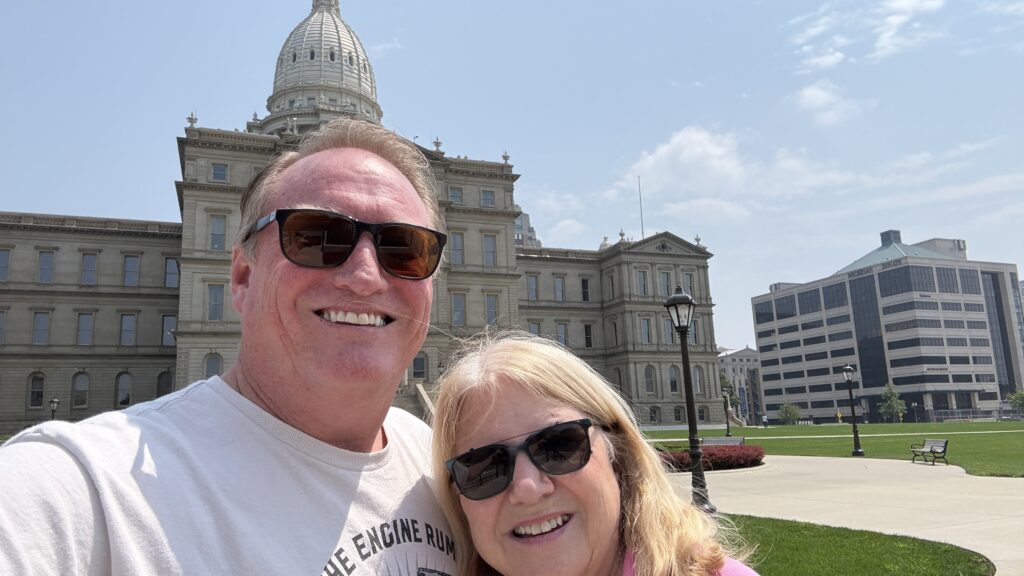
This is not your typical capitol tour. We were unable to connect with a guided tour (timing was off and we were pulling the Airstream), so Tim served as our tour guide. Again. 😂
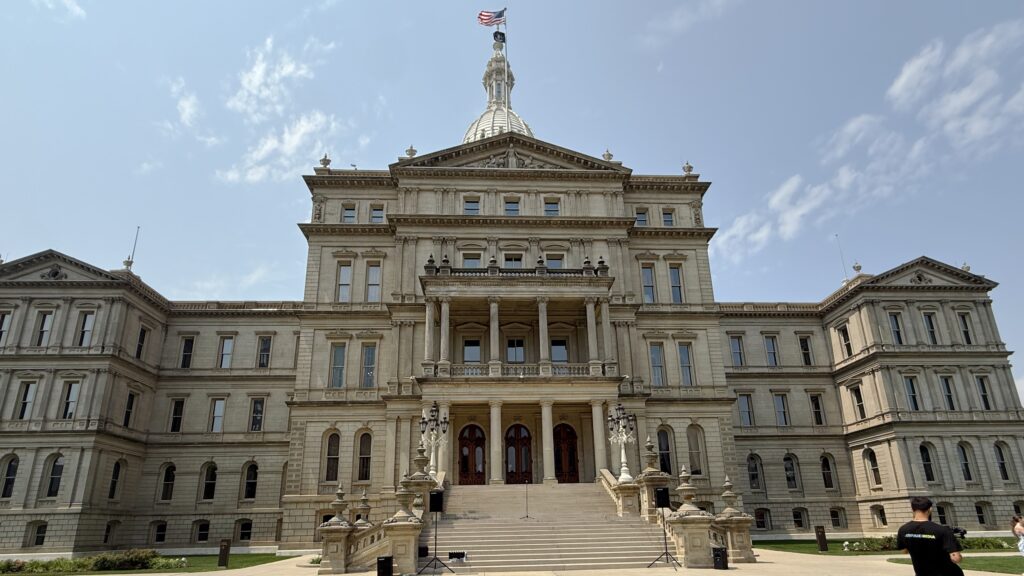
This building does have some interesting history, as well as beauty. Listen to the videos as Tim shares some of the highlights from the Full Color Michigan State Capitol Tour Guide.
Driving by, looking for a place to park.On our way from Grand Rapids to Detroit.
For the History Buffs
The Michigan State Capitol recently opened its new welcome center, Heritage Hall. The facility serves as a multi-purpose space featuring an Atrium for luncheons and ceremonies, a Stateroom for meetings and events, and an Exhibit Ramp with museum displays for visitors and tour groups. Included in the exhibit cases are over 200 artifacts, documents, and photographs that show the chronological history of Michigan’s Capitol.
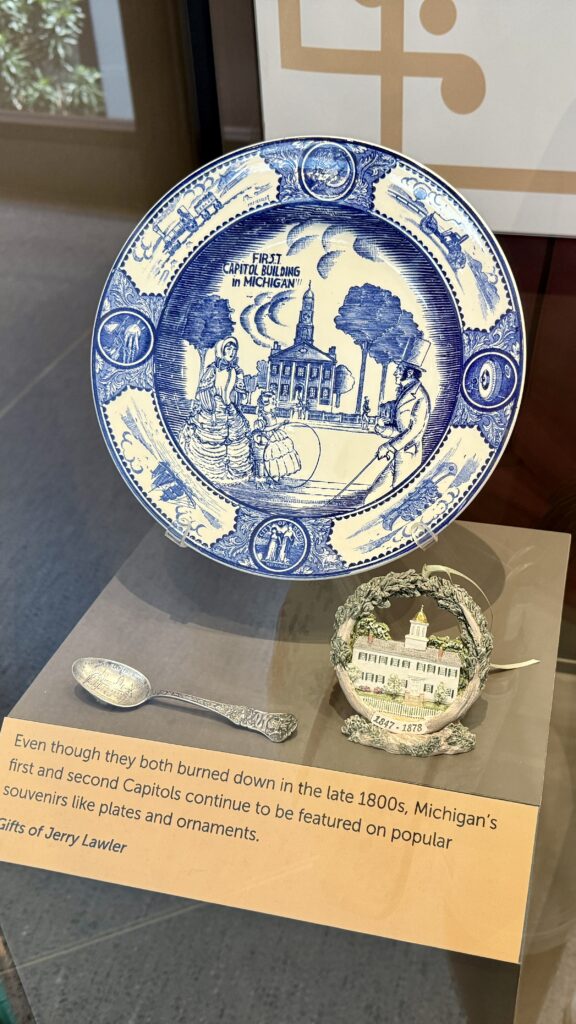
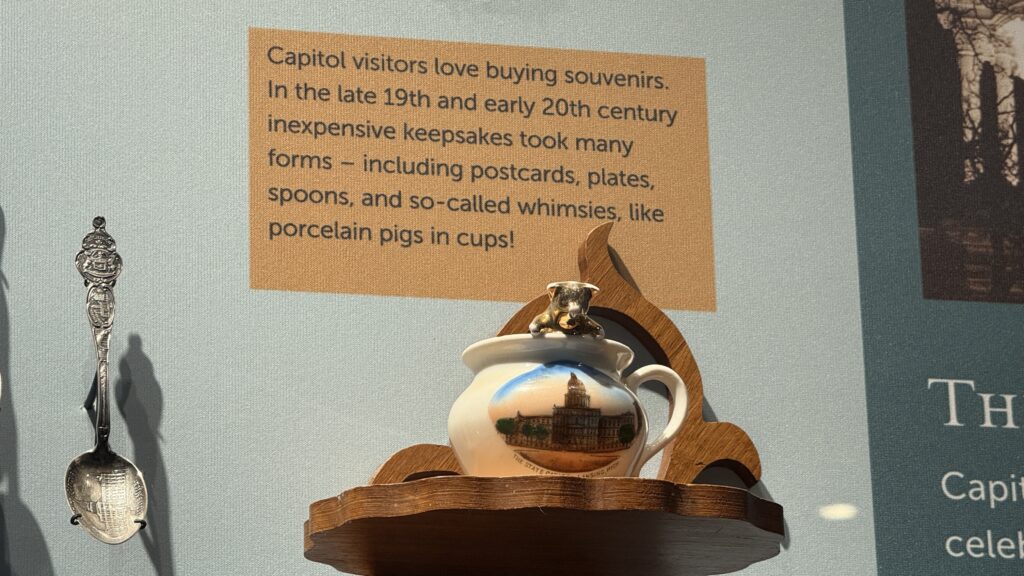
This is the third capitol building since Michigan declared herself a state in 1835 and was subsequently admitted to the Union as the 26th state in 1837. The first two Capitol buildings were destroyed by fire, but they are still displayed on souvenir plates and ornaments.
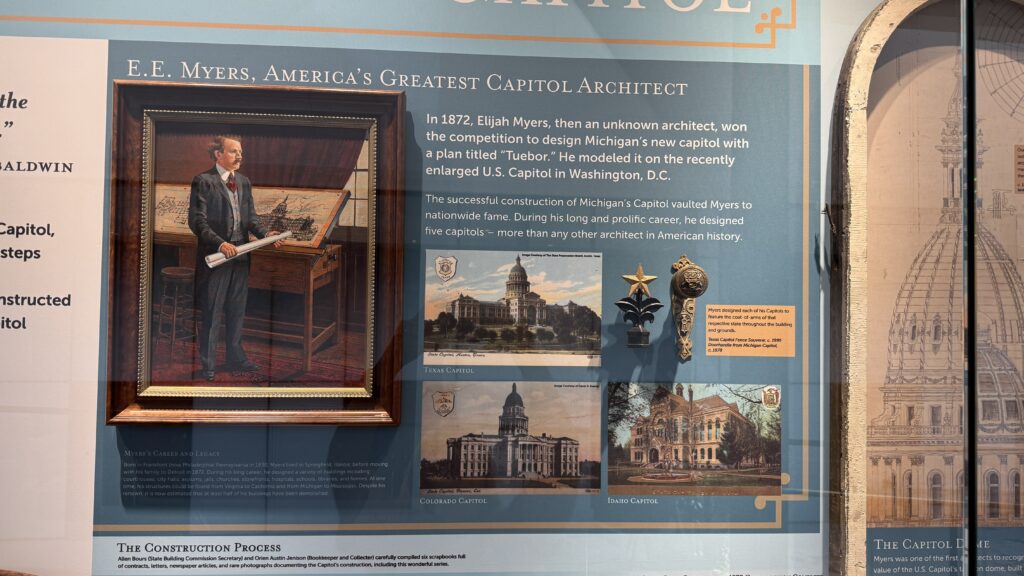
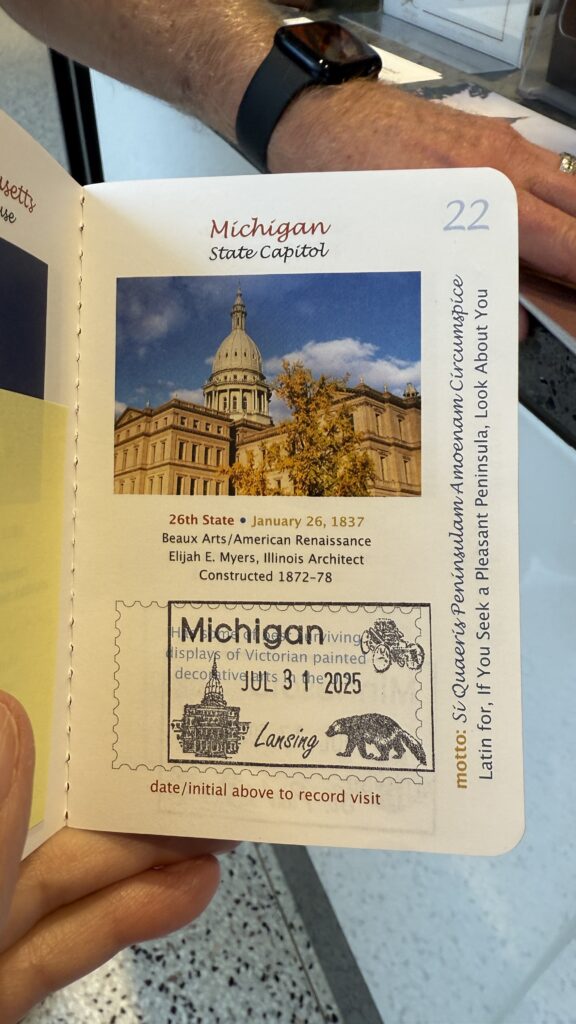
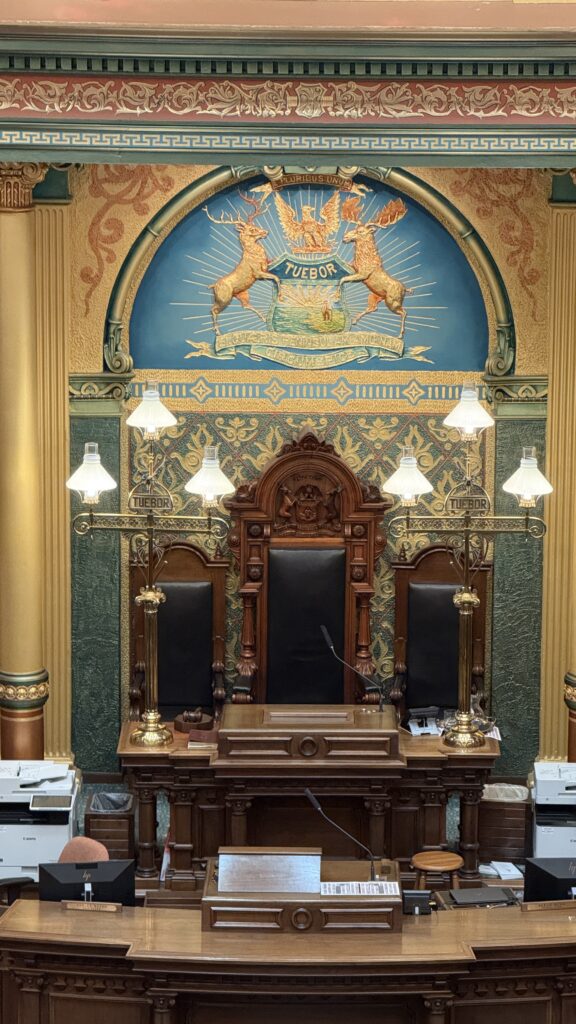
The current Capitol was designed in Beaux Arts/American Renaissance style by Eljah E. Myers, Illinois Architect, constructed 1872-78. He was relatively unknown at the time, but won the bid with his plan titled “Tuebor,” meaning “I will defend.” This would be his first capitol, but certainly not his last. The successful construction of Michigan’s Capitol vaulted Myers to nationwide fame. During his long and prolific career, he designed five capitols – more than any other architect in American history. He modeled this structure on the recently enlarged U.S. Capitol in Washington, D.C. The final cost of the Capitol totaled $1,427,738.78, which was about $200,000 over budget but a modest cost for capitols of that day. (According to one inflation calculator, $1,427,739 of 1878 dollars would be worth: $57,109,551.20 in 2025.)
Although the millions of bricks that make up its walls and ceilings were locally made in Lansing, the stone facade came from Ohio, the cast iron for the dome and floor beams from Pennsylvania, and the marble and limestone floors from Vermont.
Tim tells us about the walls.And he shares some interesting facts about the chandeliers.
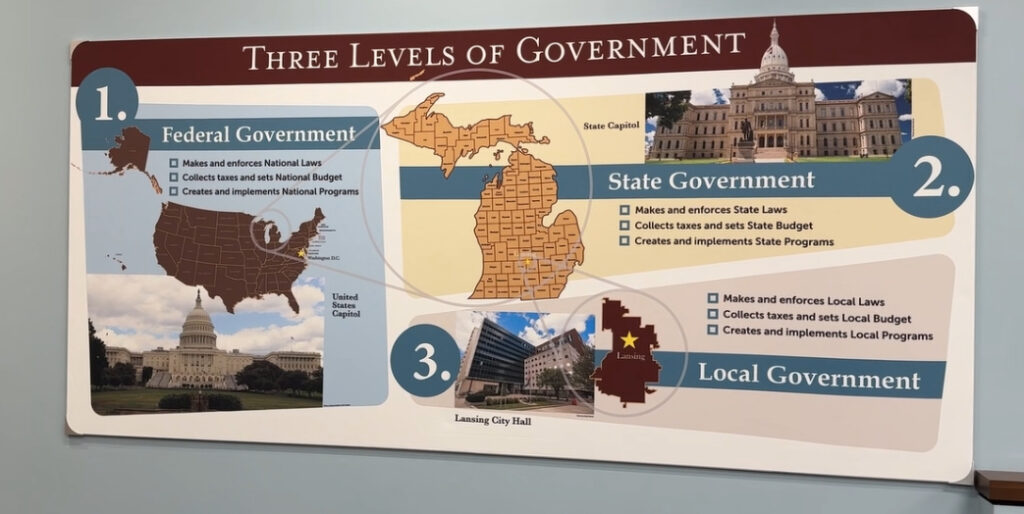
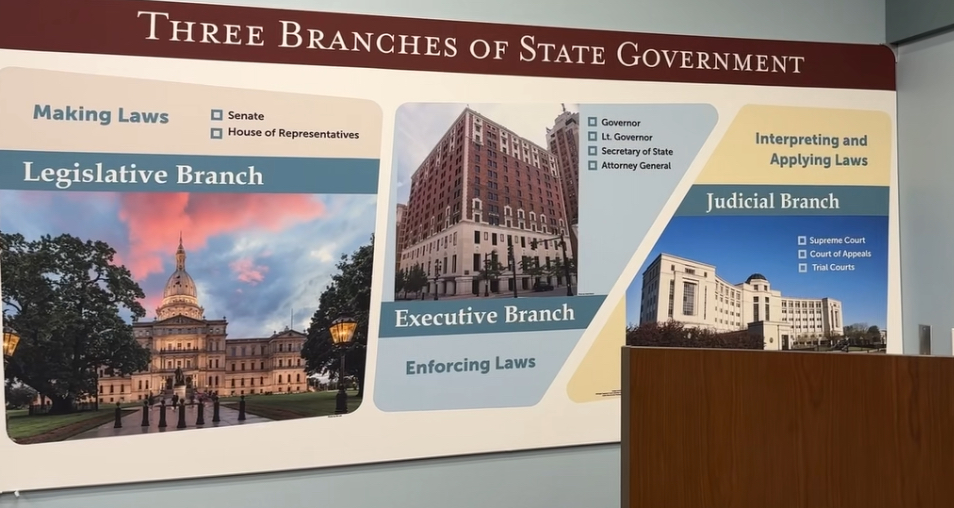
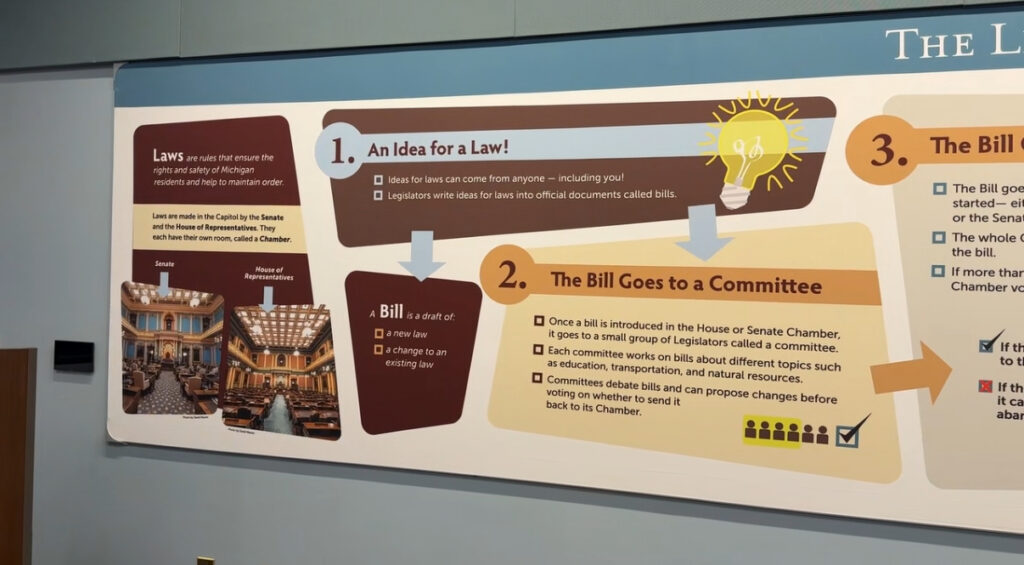
How the Government Works
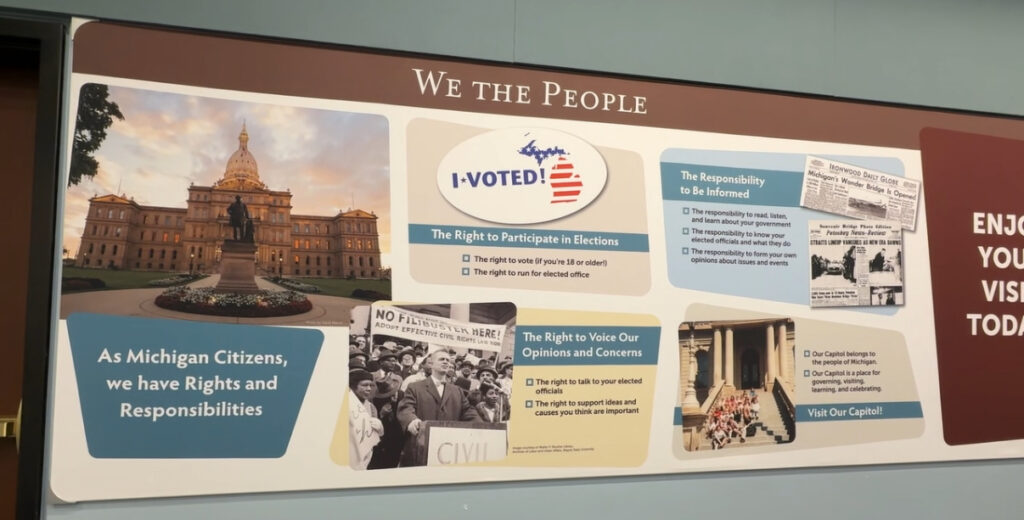
Michigan has an entire room set up to educate its citizens on civics, including the Levels of Government, Branches of State Government, and Legislative process. (I should have paid better attention in high school.) This is probably the best visual I have seen describing our governmental functions. Not all states do it exactly the same way (e.g. some have fewer Senators or more Representatives; Nebraska is unicameral), but this is an excellent visual to best understand the overall process. So often people get confused about why our states do not intervene in some matters, or why the federal government doesn’t touch others, etc. Maybe this visual can help someone who reads this blog.
Three Levels of Government.Three Branches of State Government.The Legislative Process.The Legislative Process continued.Executive Branch.Don’t forget to vote!
Preserving the Colors
The following information was found on the plaque in front of a worker who was preserving a flag behind a glass enclosure. It’s a tedious process!
“Battle flags played an important role in Civil War combat, serving as a rallying point amid the confusion of battle. Soldiers performed incredible acts of bravery to protect their tattered, bullet-ridden flags.
“During the Civil War Centennial (1961-1965), the State of Michigan had the flags stabilized by stitching them between layers of polyester netting on a sewing machine. While state of the art at the time, this method put thousands of tiny holes in the flags and the abrasive net is beginning to damage the original fibers.
“To preserve the flags for future generations, this netting must be removed by cutting each individual zig-zag stitch. Next, the flag can be gently vacuumed to remove dust and other loose particles. Finally, the flag can be conserved with more modern techniques.”
On to the Tour
The tour starts here (after Heritage Hall).NOT the Rotunda. It’s actually the floor below the Rotunda. You can see people walking on the glass floor above. In the next video Tim describes the Block Glass and Dome.THIS is the Rotunda. Also notice the Hall of Flags that surround the Rotunda.
THE CHAMBERS
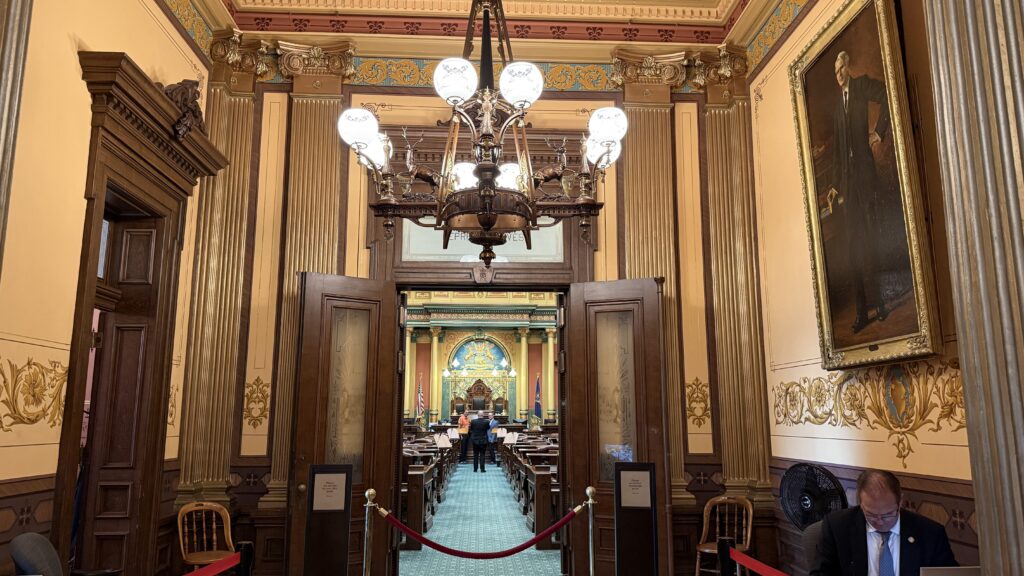
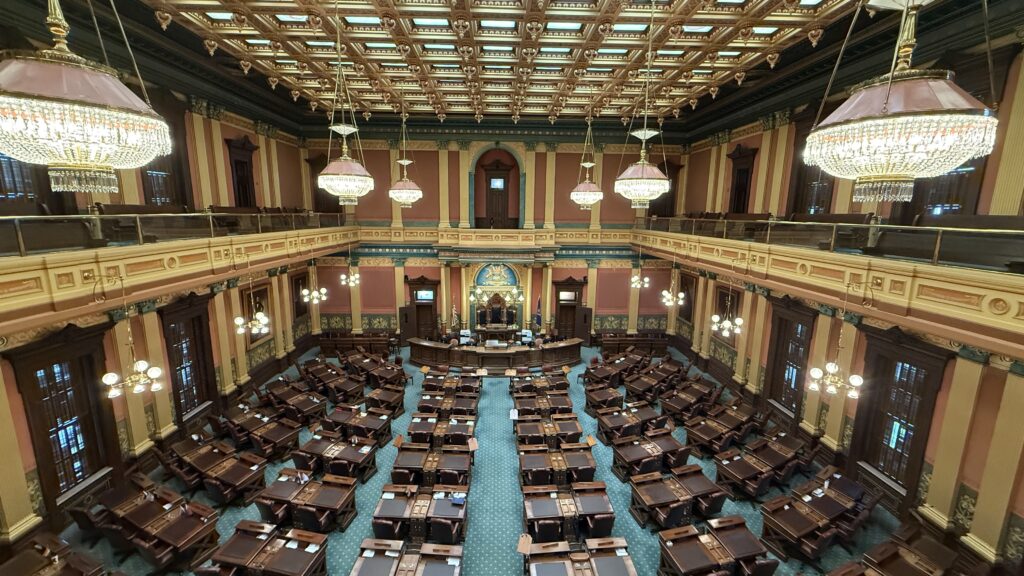
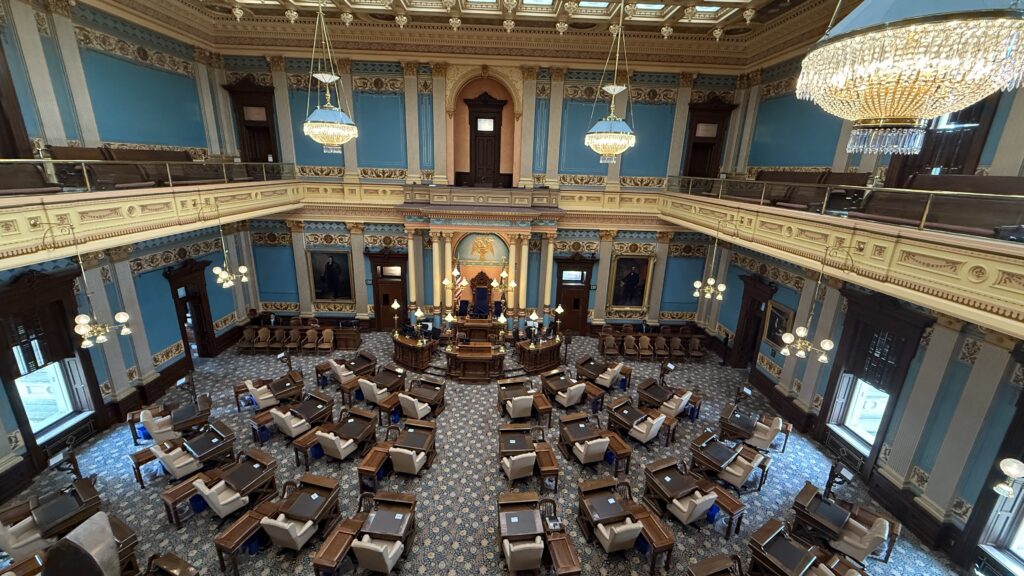
Now that you know how the legislative process works, no tour would be complete without a peak inside the chambers. Legislatures were in the rooms when we went through Lansing, so we were not permitted to go inside the House on the main floor. However, if you go up one floor and step into the Gallery, you can get a bird’s eye view of the entire room.
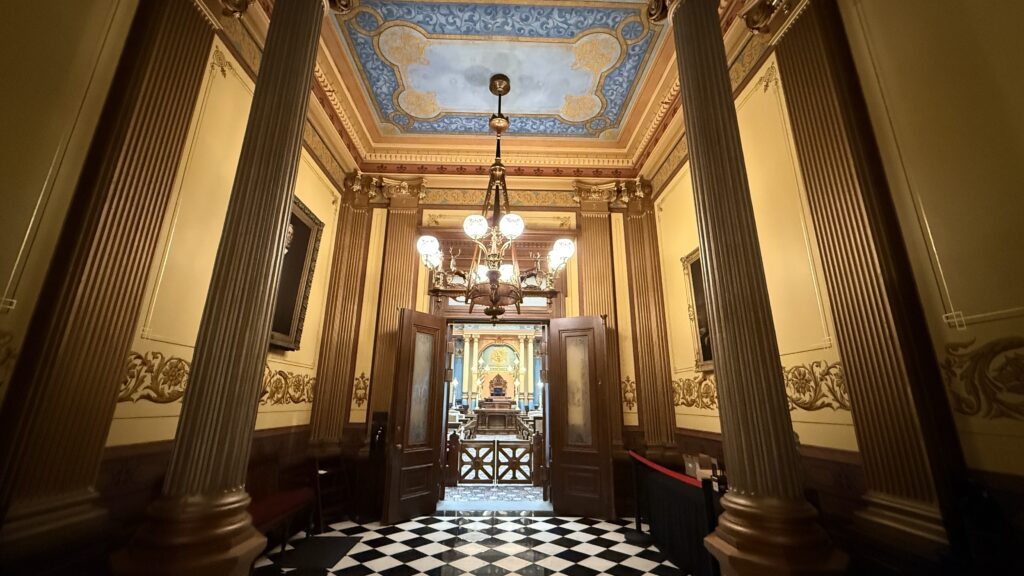
The Michigan State Capitol has a foyer leading to each Chamber, designed to compliment one another. We haven’t seen this type of entry in other State Houses thus far.
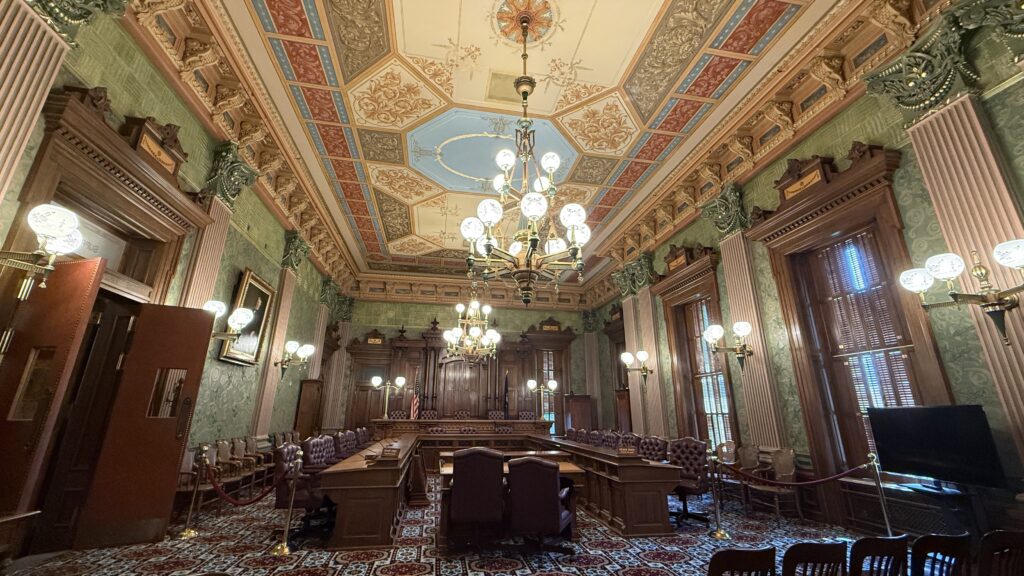
House of Representatives.Senate Chambers.
Senate Chamber ceiling contains ninety pieces of glass to make up the skylights overhead. The skylights were originally installed to bring more natural light into the room. The original tiles started creating safety concerns and the mid-20th century era had also come to an end. Builders took out the hand-etched glass tiles and (unfortunately) threw them in a dumpster. During restoration (years later) they were able to bring the ceilings back to its original design, but instead of including 38 states as were present when Michigan entered the Union, all 50 states seals were included.
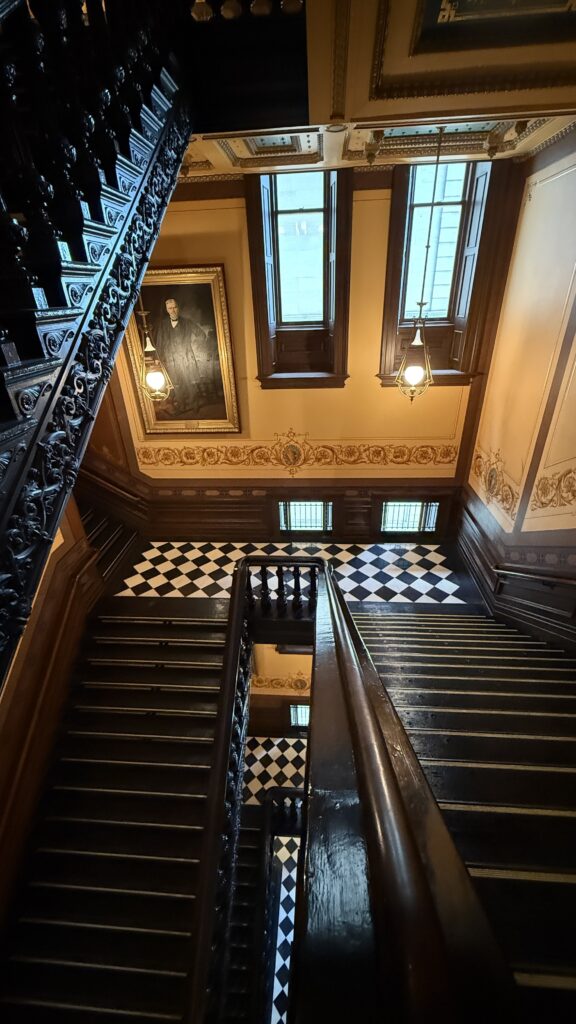
Don’t forget your stamp!Senate Majority LeaderIntricate DoorsLove the scroll woodwork and checkered tile on the staircase.Old Supreme Court Chamber, currently serving as the Senate Appropriations Committee Room.
A FEW FUN FACTS
Although it has been Michigan’s capital since 1847 (it was in Detroit before that), Lansing was not actually incorporated as a city until 1859.
Some of the best surviving displays of Victorian painted decorative arts in the U.S. are found here.
The Capitol has led the state in technological advancement, from the lighting of the dome in 1905 to show off the power of the new electric light bulb, to installation of the nation’s largest state capitol geothermal system in 2019.
The glass and crystal chandeliers in the Senate Chambers are the original ones installed in 1878. They were converted from gas to electric, and now have 42 lightbulbs each, which have to be changed by dropping the chandeliers 40 feet to the floor and disassembling the unites.
SO-LONG LANSING
Hopefully you enjoyed this tour of Michigan State Capitol and learned a few things about our government as well. On the way out of town, I asked Tim to tell his what he thought of this Capitol, and here was his reply. He later said he liked the walls, and the design of the building as part of his reasoning for ranking it so high. What did you think?
À la prochaine…hasta la próxima vez…until next time!
“I am the Lord, who heals you.” ~Exodus 15:26
My relationship with Jesus Christ motivates me to keep blogging. Though I have metastatic breast cancer*, my faith helps me survive, thrive, and feel alive while staying active. Without Him, I couldn’t achieve anything. With His help, well, my accomplishments speak for themselves on my blog. If you’re interested in learning about building a relationship with Jesus, feel free to comment below. I will never sell or share your email.
*Metastatic breast cancer is Stage IV cancer. Metastatic, or metastasis, means the cancer has spread beyond the original location (breast and immediate lymph nodes). In 2016 the doctors found significant metastasis to my bones, skull, liver, and lungs; then in 2018 to the brain. However, with chemo, immunotherapy, gamma knife, and of course my faith in the Lord, it is all undetectable at this point. I continue in treatment every three weeks via infusions, and receive multiple scans on a regular basis. If you or someone you know has metastatic breast cancer, I recommend these organizations for additional support:
Metavivor and Unite for Her (also for ovarian cancer)