
State Capitol 34: Tennessee

the metastatic breast cancer journey banner

October 6, 2025. Nashville Tennessee State Capitol

Finally, a city where one might expect it to be a state capitol (haha). We visited the Tennessee State Capitol on this 551st day of our full-time Airstream journey.

The cornerstone was laid on July 4, 1845, but the building was not completed until 14 years later in 1859. The building is designed in the Greek revival architectural style, with a Cupola typical of that style. Therefore, it has no dome or rotunda as we see in the Roman style. 

William Strickland was the first architect on the Capitol; he also built the downtown Presbyterian church, which he designed in Egyptian style. You can see some of that influence on the inside of this building as well.
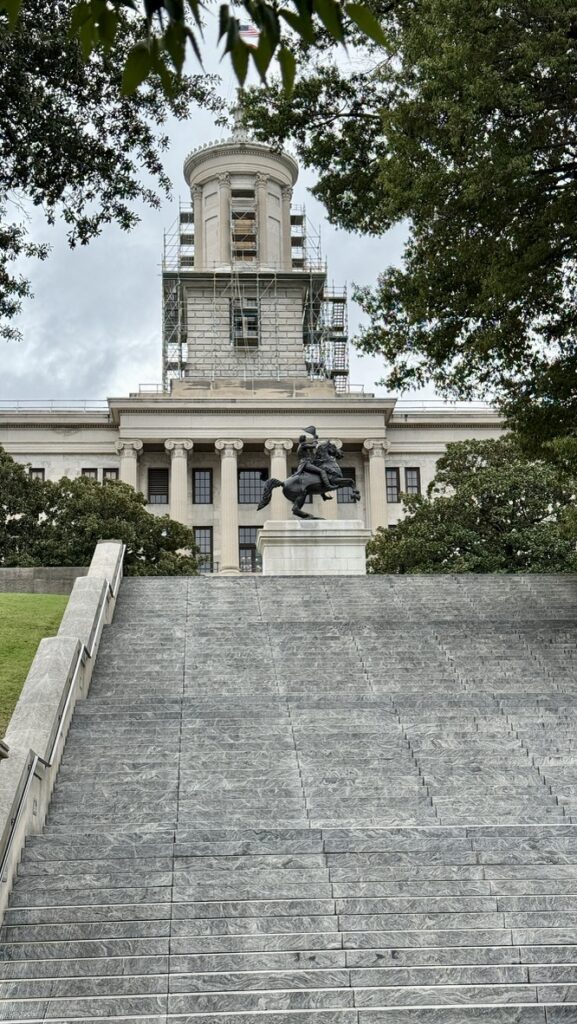
The tower (cupola) is patterned after the Choragic Monument of Lysicrates in Athens.

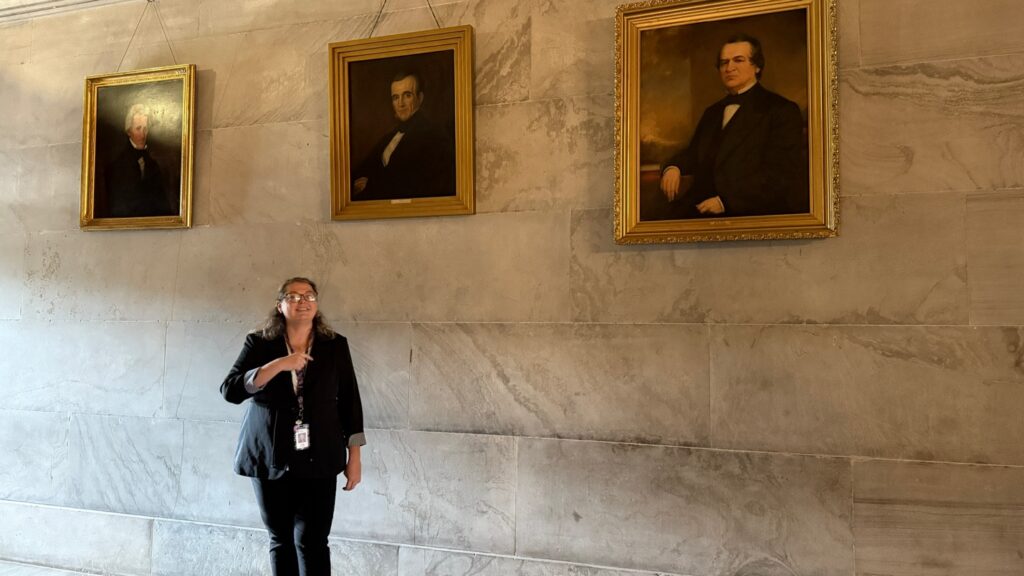
Our tour guide Hannah was a great teacher, entertainer, and seemed to really enjoy interacting with the crowd. She told us Nashville became known as the “Athens of the south” due to all the schools and learning surrounding the city.  Each of the blocks of limestone that makes up this wall weighs four to six tons. The limestone came from a local quarry. The walls are several feet thick, heavy load bearing, and the floor is made of marble. The Capitol has withstood several tornadoes throughout the years. 
Fifteen enslaved men worked here. They were hired out for a year. All 15 reached emancipation later. The second group of workers consisted of prisoners. They were responsible for digging stone and moving it. A third group of Irish and German Immigrants were stonecutters and painters who painted frescos on the ceiling. The frescos got dirty from gas lamps and cigars, and they whitewashed over the frescos. Many years later, during restoration, they found the frescos under the whitewash and refurbished them. Sadly, I can’t find my pictures of the frescos.
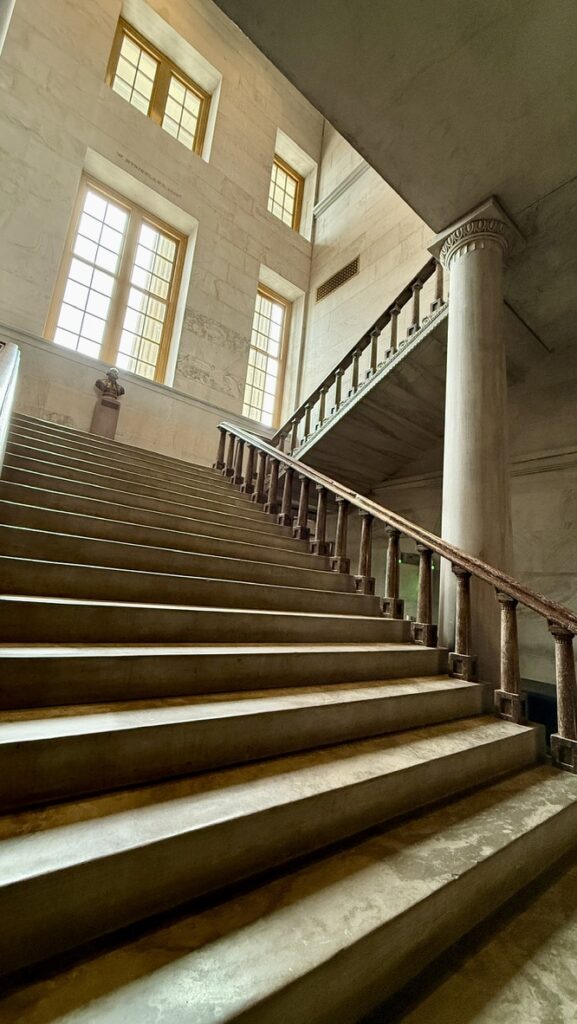
Unlike some Capitol buildings with rotundas, you won’t find an elaborate staircase here. Instead, the staircase highlights marble flooring and an intriguing tale. A chip in the handrail is said to have been caused by a bullet shot from above during a heated dispute over the 14th Amendment in 1866. 

Old Supreme Court

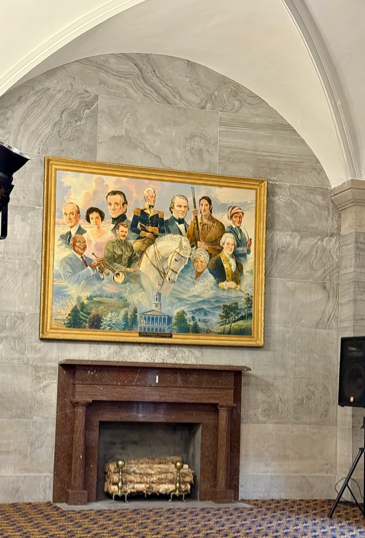
The Old Supreme Court Room, located on the first floor of the Tennessee State Capitol in Nashville, features a prominent 6′ x 8′ oil painting titled “The Pride of Tennessee.

The painting features eleven Tennesseeans notable for their unique contributions to the state and to the nation. Andrew Jackson’s horse is my favorite.
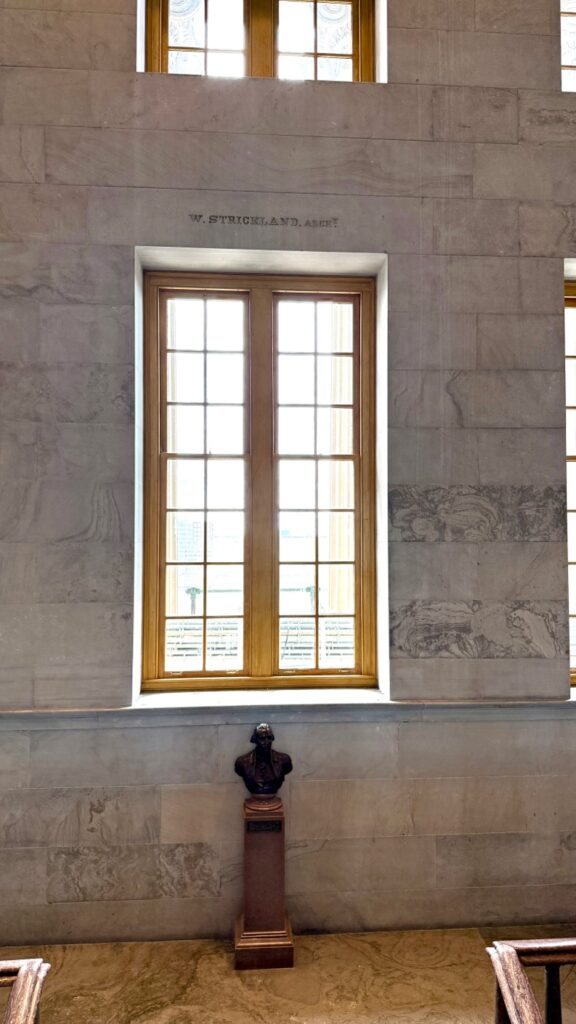
Fun fact…This is the only Capitol building to have someone buried in the wall. The architect (Strickland) didn’t want to leave, and because he felt this was his grandest achievement he made plans to be buried on the Northeast end. He died before the project was finished and was buried in the Capitol after his wishes. The second architect got the same honor, as he didn’t want to be outdone by his predecessor. He was buried in the wall on the southeast end.

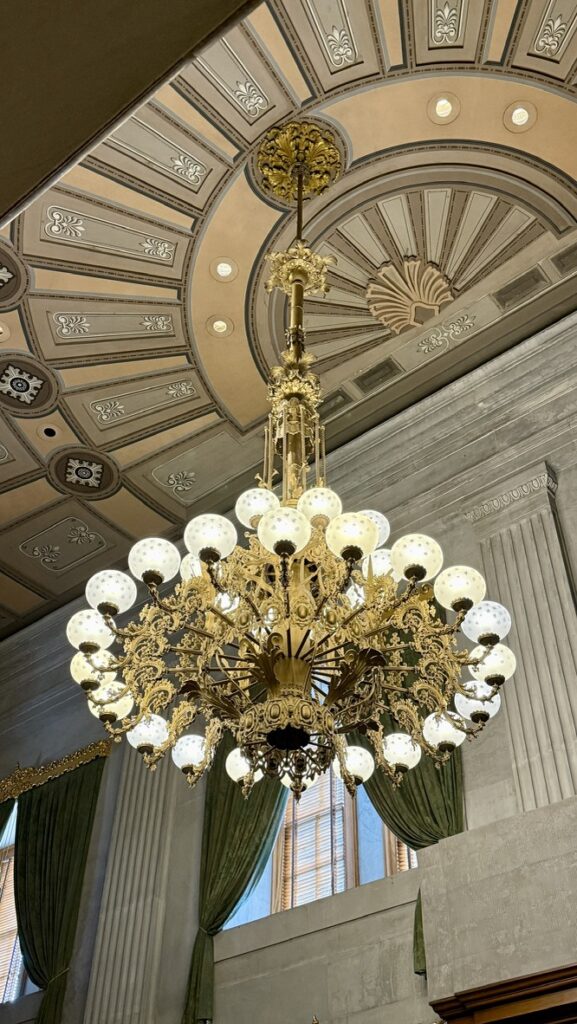
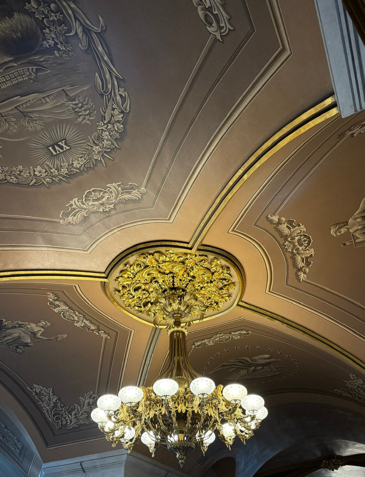
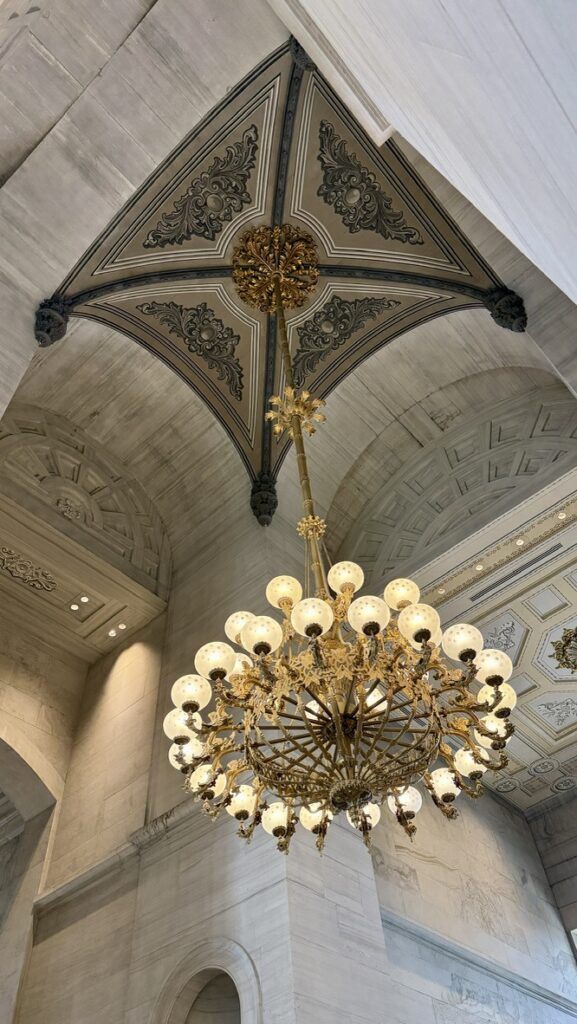
They had gasoliers versus chandeliers throughout the building until late 1880s when they installed electricity. The original chandeliers still hang in the hallways and chambers, except for one in the center of the House, which I’ll tell you about in a minute.
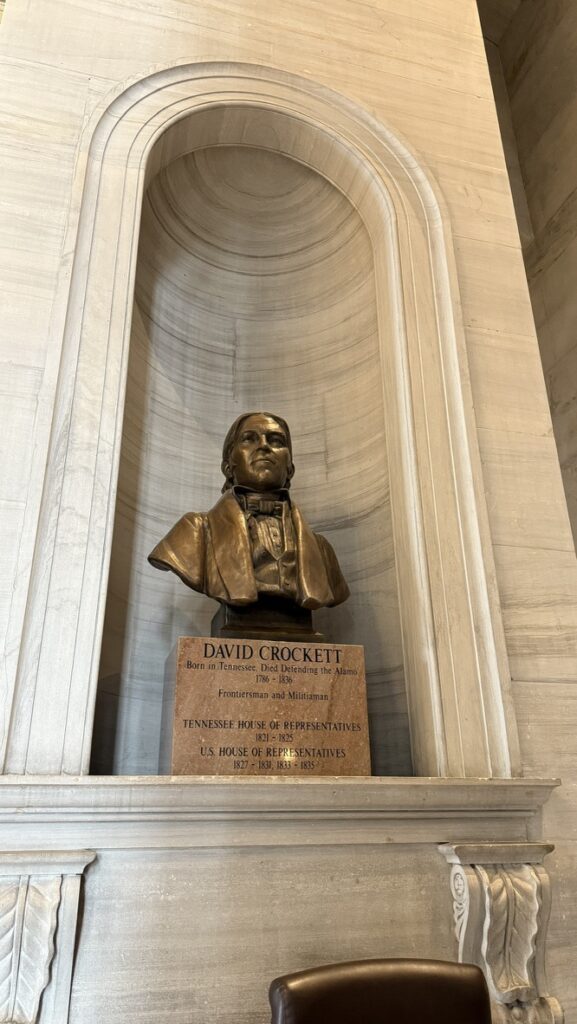
Davy Crockett was born in Tennessee. Of course, he’s also famous in Texas. Remember the Alamo.

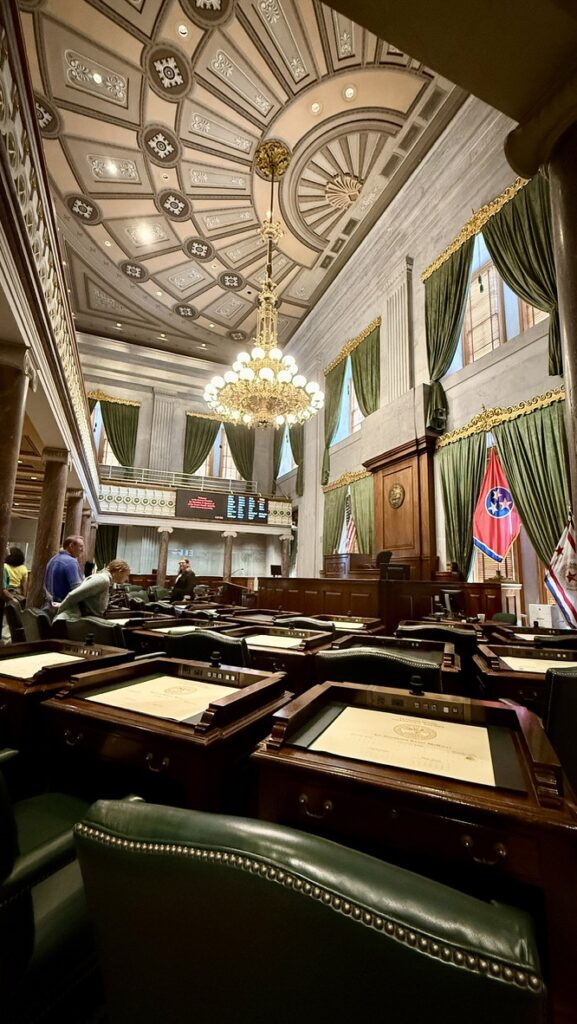
House of Representatives

The House of Representatives was our tour guide’s favorite room because of the following story about the 19th Amendment (remember which one it is?), which she told so eloquently. Here’s a recap of the story…
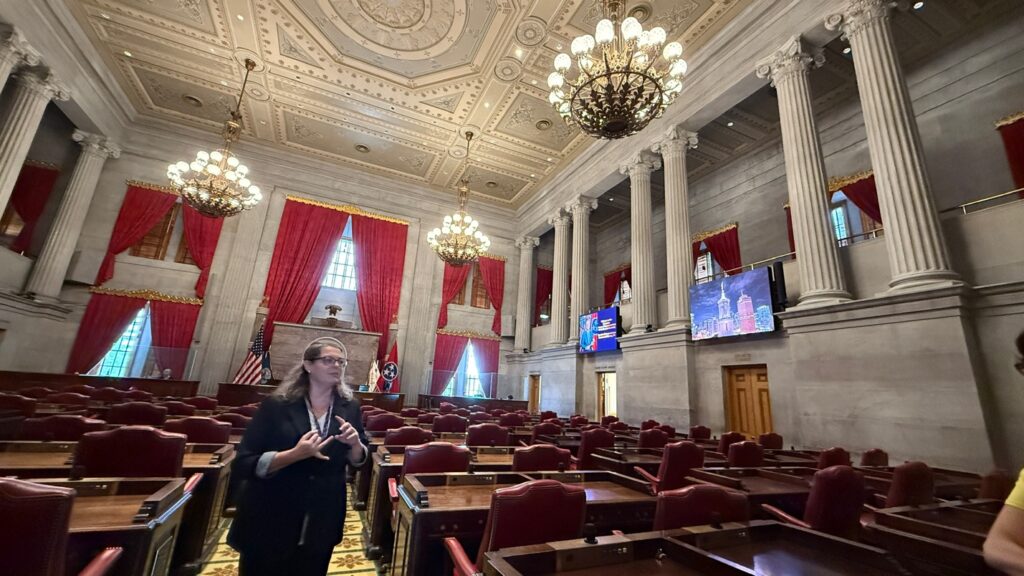
The House Chambers has 16 columns, because Tennessee was the 16th state.

Multiple unrelated historical events in Tennessee have been called the “War of the Roses,” borrowing the name from the 15th-century English dynastic conflict. The most notable instances in Tennessee occurred during the 1886 gubernatorial race and the state’s ratification of the 19th Amendment in 1920. 

The 1920 Women’s Suffrage “War of the Roses” was the dramatic final battle over the ratification of the 19th Amendment, which gave women the right to vote. 

  • The conflict took place in Nashville in August 1920, with supporters of the amendment wearing yellow roses and opponents wearing red ones.
  • With 35 states having already ratified the amendment, Tennessee’s vote was the last one needed for it to become law nationwide.
  • The vote in the state House of Representatives was tied 48–48. The stalemate was eventually broken by 24-year-old Harry T. Burn, who had been wearing a red rose.
  • After receiving a letter from his mother urging him to “be a good boy” and “you know what to do,” (e.g. vote for the amendment), Burn switched his vote to “aye,” making Tennessee the “Perfect 36” and securing the right to vote for women across the country. After the vote, he went up into the cupola and hid from the press for four days. He was questioned and challenged, as they thought he was paid off or threatened, but his response was that he did what every man should do, “listen to his mother.”

Hannah also shared an interesting story about the original chandelier in the House, which was 14 feet wide and hung in the center (see ceiling picture below). When the windows were open, the chandelier would swing from side to side. This scared people who sat beneath it, so in the late 1800s they voted to take it down—after which they learned it was architecturally sound and would not have fallen—but it was too late as the vote was final. Getting it out the door was a challenge, and they ended up breaking it into pieces with axes. So sad, and would have been a site to see, but the historic society did recover some of the beautiful carvings that were a part of that chandelier and it’s in the Tennessee museum. 

Senate Chambers

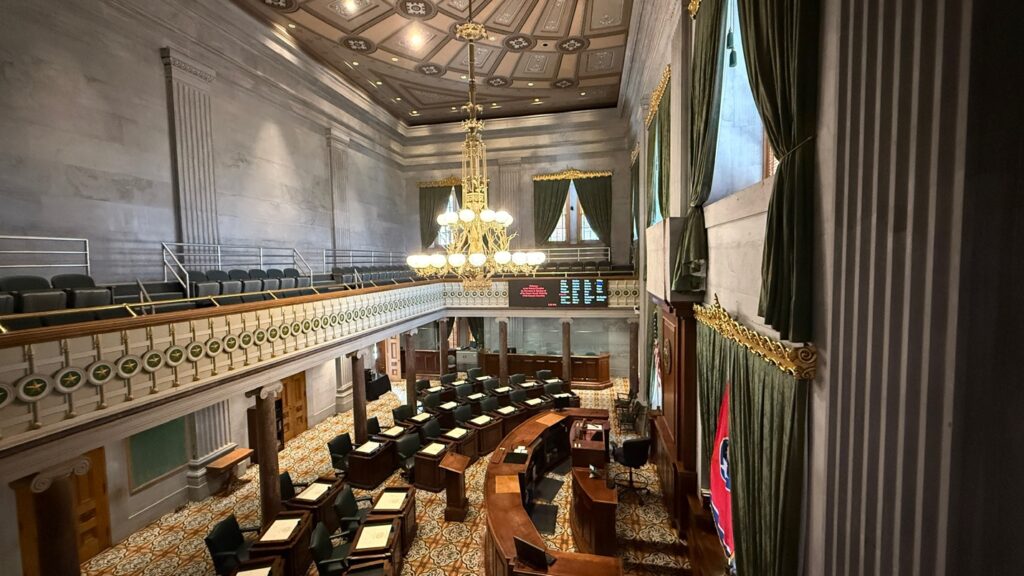
The Senate Chambers is much smaller than the House, as is typical in State Capitols. The columns are made of Tennessee limestone (a/k/a chocolate marble). You can find corn, cotton, and tobacco (three main crops) carvings in the original chandelier, which is still hanging in the chamber. 
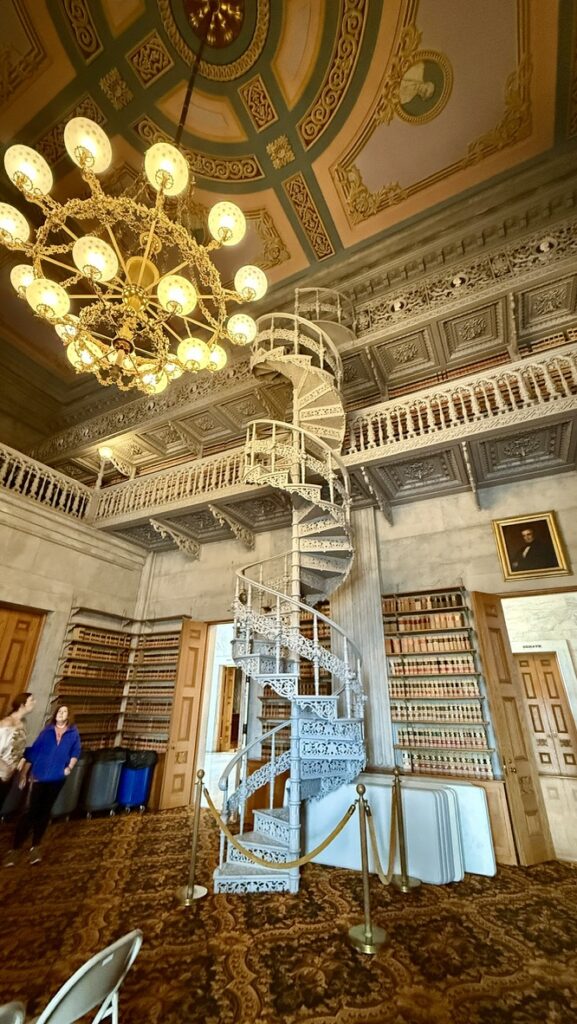
Legislative Lounge

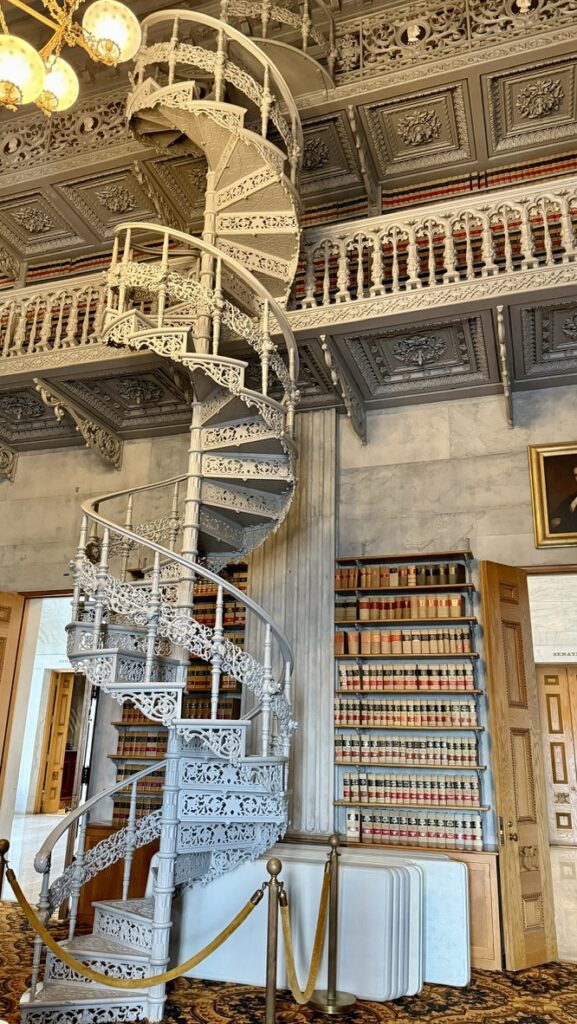
This intriguing room used to be the state library. About 250 tons of books were moved to another building across the street. This was the last room to be finished and by then Strickland was dead, so the new architect designed it in the Gothic revival style, very different from the rest of the building. It looks like something from Harry Potter! The Chandelier is original. Its design contains elements of the purple passionflower, which is the state wildflower and native to Tennessee.
Sequoyah Bust 

Sequoyah was a Cherokee, which of course was interesting to me since my great-grandmother was a Cherokee. I love the story about him developing the Cherokee syllabary. Here’s Hannah telling us the story in a 3-minute video, if you’d like to hear more of the history. Or you can read the plaque below for brevity.
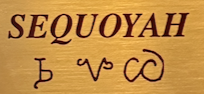
The plaque says, SEQUOYAH, Griffin Chiles, Sculptor, 1994, Bronze

Sequoyah, or George Gist, born in the late 1700s near the Cherokee town of Tuskegee in present-day Monroe County, invented the first form of written communication for his people. Comprised of 85 characters, each representing a syllable of the spoken language, Sequoyah’s syllabary was adopted in 1821 and widely used by 1823 among the people of the Cherokee Nation. Sequoyah died in August 1843 near San Fernando, Tamaulipas, Mexico, while seeking a band of Cherokee he thought had migrated to the Southwest.

Capitol Grounds

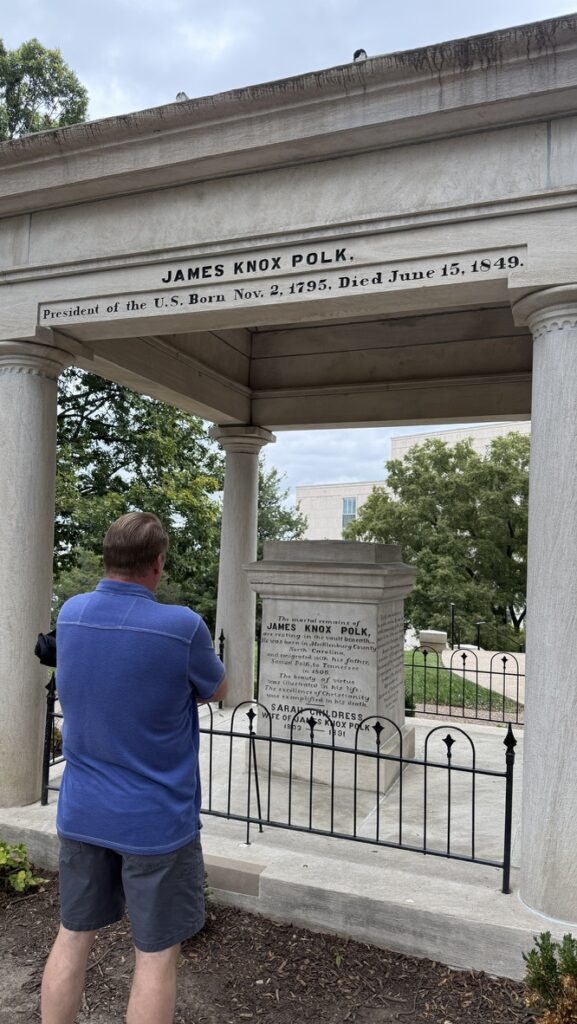
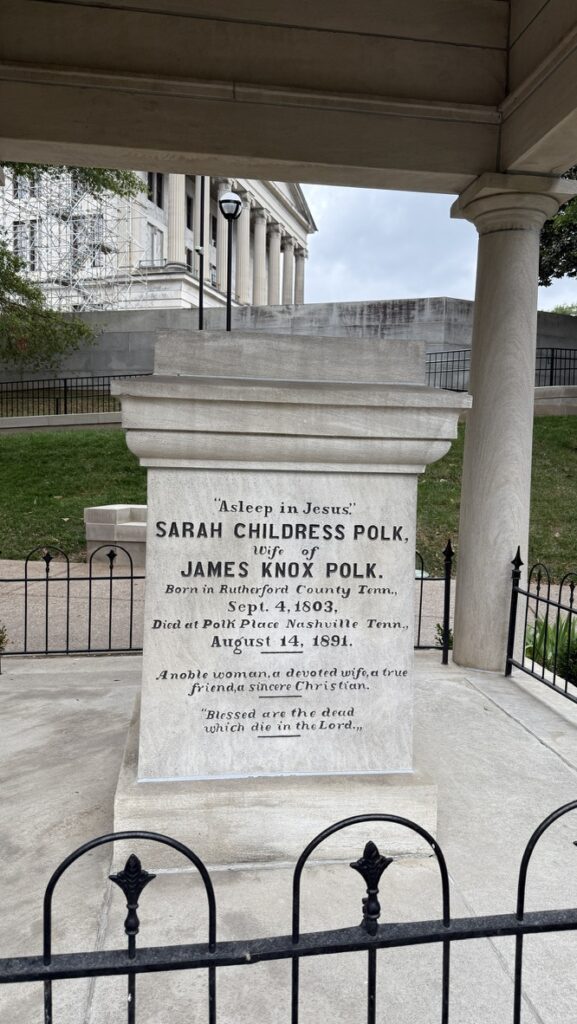
A walk around outside is pleasant on a day like today. There are several monuments, markers, and statues to see outside as well. An equestrian statue of Andrew Jackson, statues of Andrew Johnson and Sergeant York, and the tomb of President James K. Polk and his wife are just a few. Polk and his wife Sarah are buried on the property, underneath a beautiful monument. His body had to be moved several times after his death before its final resting place here. He moved to Nashville after he left office where he planned to live out his life. Sadly, they were battling a cholera outbreak in Tennessee, which he died of just three months later.

I love the inscriptions on Sarah’s grave, “Asleep in Jesus” and “Blessed are the dead which die in the Lord.” It’s so comforting to know when your loved ones die they are going into the arms of Jesus.
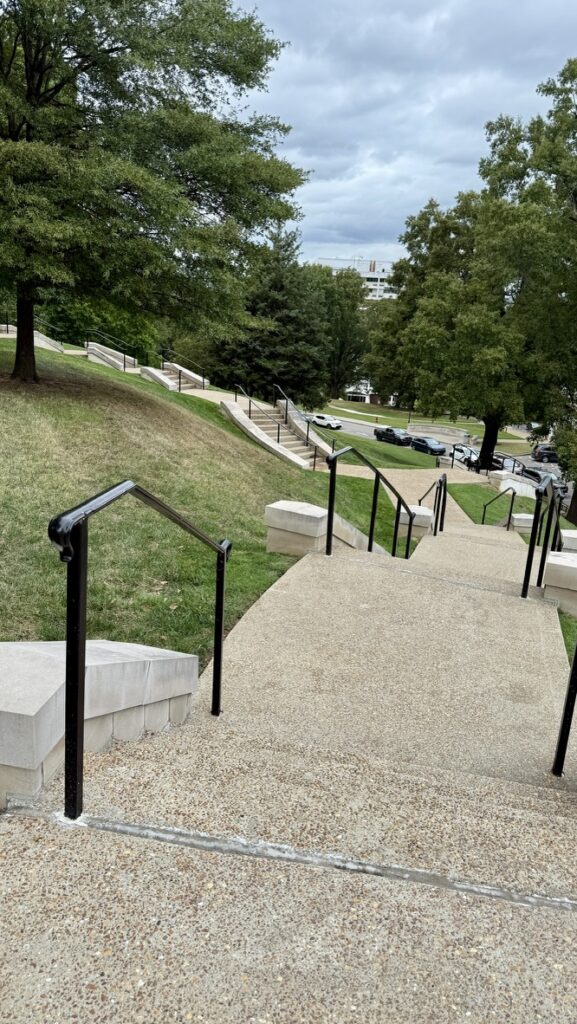
Heading back to the truck. There is a way to get to the Capitol without climbing all these stairs, as they have dug a tunnel for ADA access with elevators, but we didn’t know it sits on the highest hill in downtown Nashville when we started walking there from our parking spot. 🥴 The Tennessee State Capitol is built on Cedar Knob, a prominent elevation overlooking the Cumberland River. The site was selected in the 1840s to ensure a commanding view of the city. The first Catholic Church was originally built here and had to be demolished to make room for the Capitol (there’s a marker on the Capitol grounds where it stood). There is no private parking for the Tennessee State Capitol. During the week, visitors must park in paid lots or at street parking meters. 


I hope you enjoyed this little tour of Tennessee’s State Capitol in Nashville. It would be great if you would leave a comment and let me know if there is something else (of less) you would like to know, as we have several more capitols to see before we complete our bucket list. Thanks for following my blog!


À la prochaine…hasta la próxima vez…until next time!


“I am the Lord, who heals you.” ~Exodus 15:26

My relationship with Jesus Christ motivates me to keep blogging. Though I have metastatic breast cancer*, my faith helps me survive, thrive, and feel alive while staying active. Without Him, I couldn’t achieve anything. With His help, well, my accomplishments speak for themselves on my blog. If you’re interested in learning about building a relationship with Jesus, feel free to comment below. I will never sell or share your email.

*Metastatic breast cancer is Stage IV cancer. Metastatic, or metastasis, means the cancer has spread beyond the original location (breast and immediate lymph nodes). In 2016 the doctors found significant metastasis to my bones, skull, liver, and lungs; then in 2018 to the brain. However, with chemo, immunotherapy, gamma knife, and of course my faith in the Lord, it is all undetectable at this point. I continue in treatment every three weeks via infusions, and receive multiple scans on a regular basis. If you or someone you know has metastatic breast cancer, I recommend these organizations for additional support: 
Metavivor and Unite for Her (also for ovarian cancer)
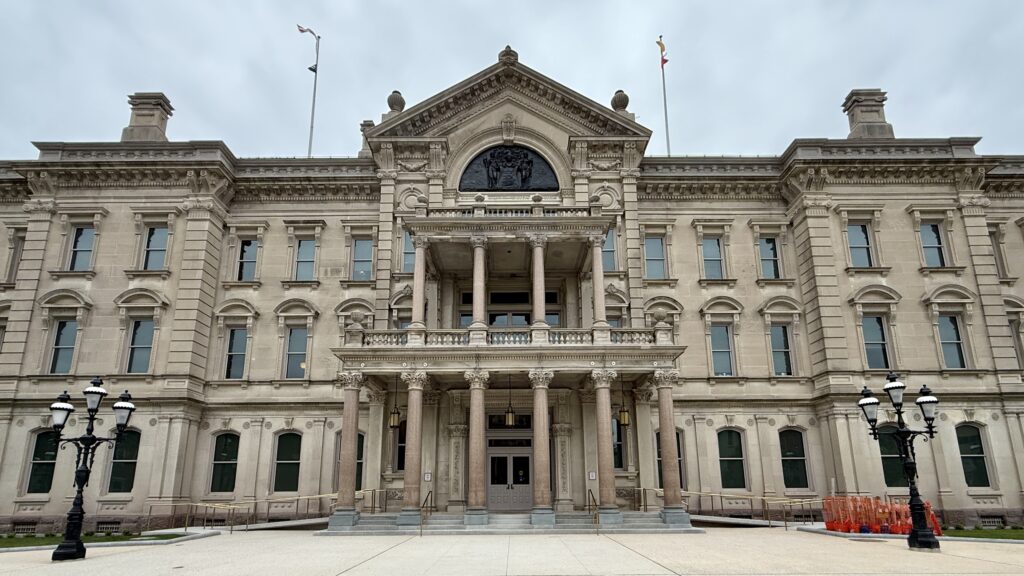
State Capitol 32: New Jersey

the metastatic breast cancer journey banner
New Jersey State Capitol

Planning ahead is absolutely key for this State House adventure! Security here is on another level—more intense than any Capitol we’ve visited yet. No wandering on your own; you’ve got to pre-register in advance for a guided tour. When you arrive, get ready to flash your photo ID, pass through security, and pose for a sticker-worthy headshot to wear during your visit. It almost felt like visiting my granddaughter in the NICU—except with a bit more official flair.

Fun Fact: This building is the third oldest State Capitol in America and claims the silver medal for longest continuous use! Trenton snuck into second place when Virginia’s streak got interrupted—they seceded during the Civil War, officially pressing pause on their run. Maryland still reigns supreme as the oldest and most continuously used statehouse, but New Jersey’s State House isn’t far behind. History loves a good comeback story! 🙃

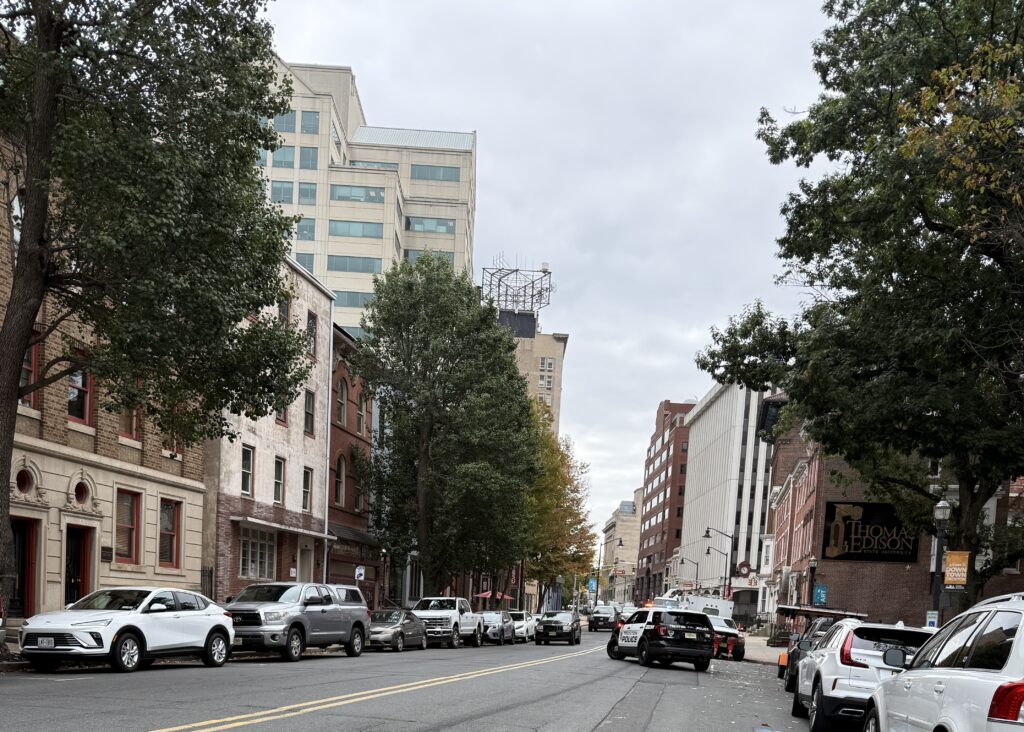
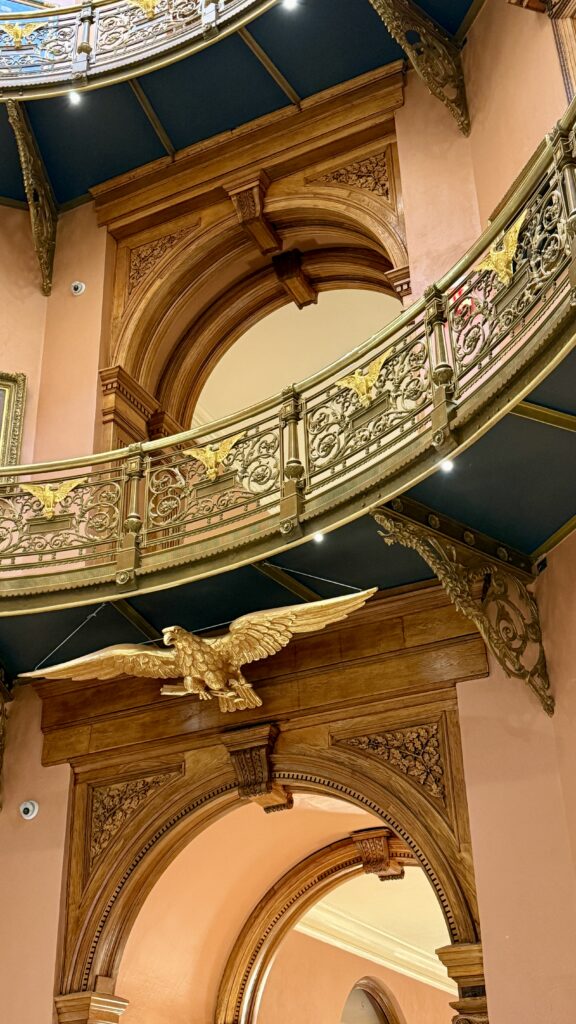
Unlike those stately capitols perched on sprawling lawns, New Jersey’s State House is smack in the heart of downtown—hugging historic State Street and flanked by its legislative neighbors. From State Street, you’ll have to squint to spot the dome peeking out—blink and you might miss the building’s true size and style! See the first picture in this blog.

Parking was an adventure of its own. With our big truck (and that pesky hitch), we were thankful we’d left the Airstream behind—otherwise, parking would’ve been impossible. We lucked out with a parallel spot by a busted meter, right next to a police car with flashing lights. We asked the officer what to do; he just smiled and said, “Don’t worry about it.” We returned after our tour to find no ticket and our truck exactly where we left it. Small victories!

After sticker duty, we were corralled into the courtyard—security watching us through giant windows—until our tour guide came to collect us. Exploring freely isn’t allowed; when the tour ended, we had to exit right away (though our guide kindly let us stop off at the restroom first). The strict rules? Our guide said it’s all because of 9/11, New Jersey lost more people in the attacks than any other state except New York, so security has stayed extra tight ever since.

It’s official now. We have stickers. I’m glad they didn’t use my driver license photo – it looks like a mug shot LOL.
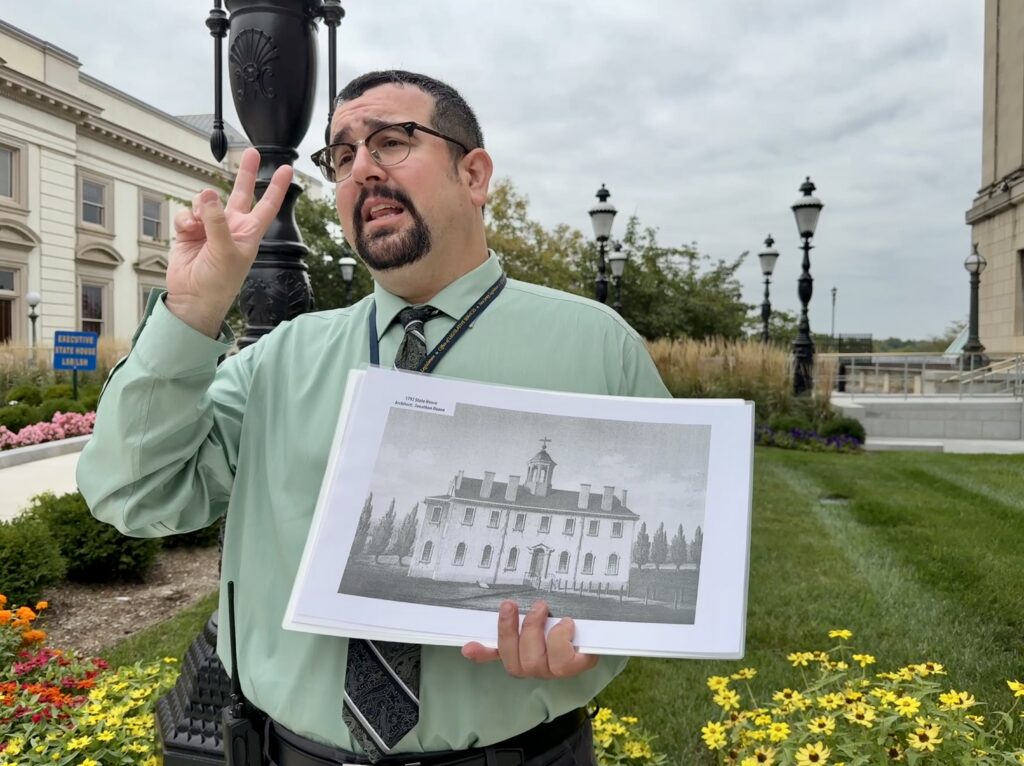
Our tour guide shows us the progression of the original building to what it is now. Different architects with different styles built the add-ons, so it is a bit of a maze inside. This is another reason they do not let you go on your own. Even the legislators get lost in the hallways.

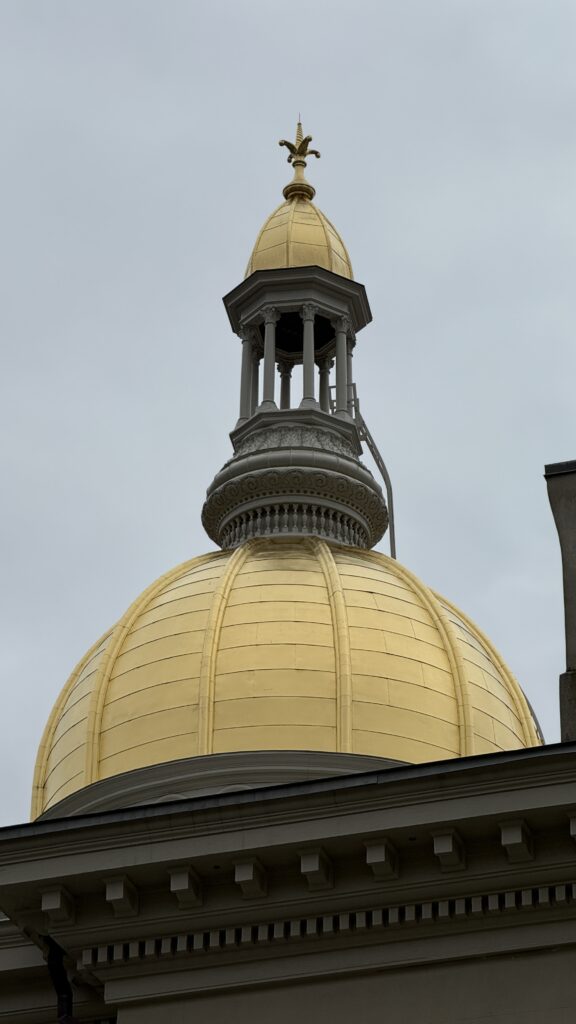
In 1996, the New Jersey State House began renovations of its golden dome. That project wasn’t completed until 1999, but was no simple job. The dome is covered with 48,000 pieces of gold leaf.

Each piece of gold leaf cost $1.00 and was paid for with money raised by New Jersey school kids through the “Dimes for the Dome” program.

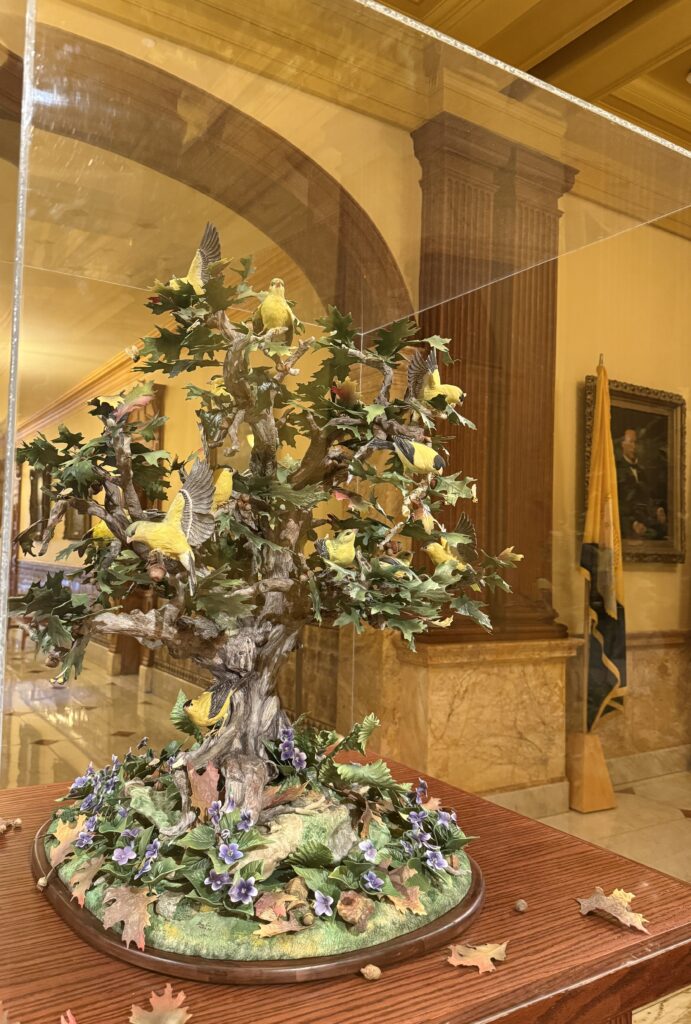
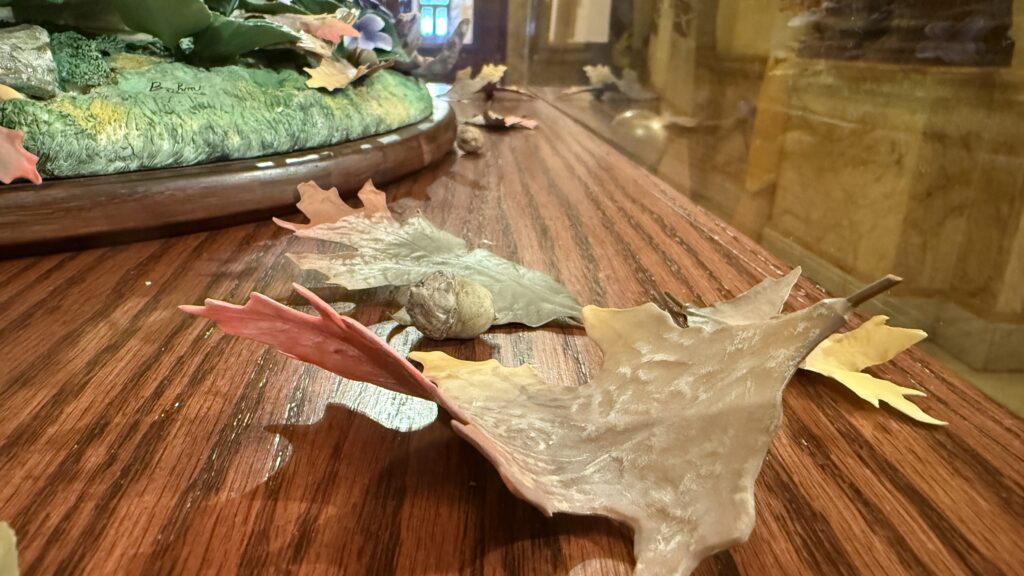
Step into the crossroads of the State House halls and you’ll spot a dazzling showstopper: a glass case holding “The Glory of New Jersey,” a porcelain masterpiece by Boehm Studio, crafted right in Trenton in 1995. This isn’t just any sculpture—it’s a vibrant northern oak (NJ state tree) loaded with 21 goldfinches (NJ state bird), each one representing a different New Jersey county. Look closer and you’ll find violets (NJ state flower) blooming at the roots, 13 honeybees symbolizing the original colonies, cranberries, horseshoe crabs, and—here’s a quirky touch—a single ladybug saluting New Jersey’s first female governor, Christine Todd Whitman. The whole thing stands three feet tall, weighs in at 75 pounds, and was brought to life by 12 artisans using 129 molds and 326 individual pieces. Now that’s Jersey pride, captured in porcelain!

Not only does this piece add a splash of local pride to the building, but it also serves as a playful centerpiece for school groups and curious guests, serving as a fun scavenger hunt. Everyone loves gathering around to learn the stories behind the symbols and snap photos for their own collections of Garden State memories, including us!

Yes, it’s all made of porcelain!
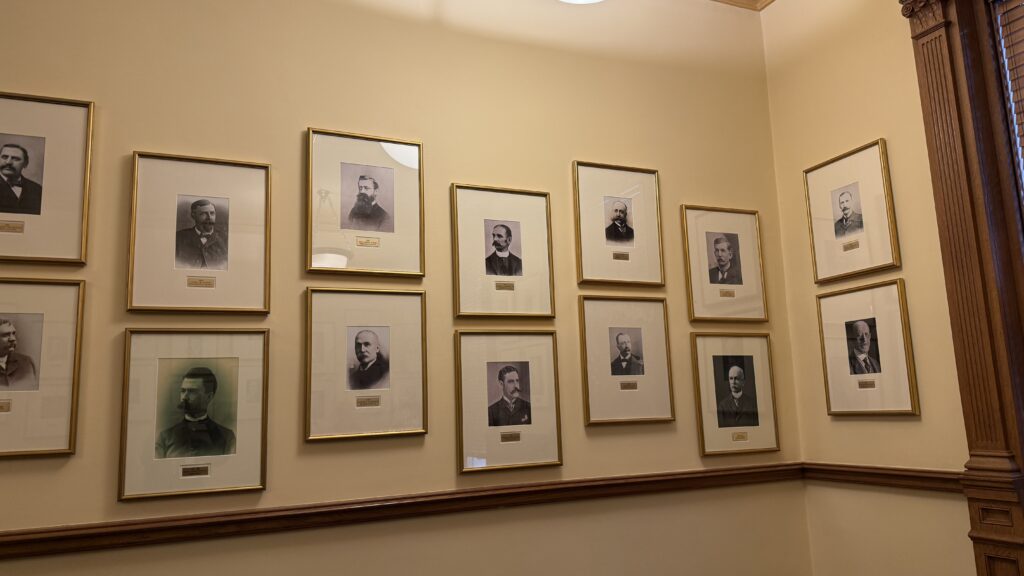
According to our tour guide, younger visitors have pegged this hall the “Room of Epic Mustaches.” Zoom in if you mustache yourself why. 😂 These are portraits of the Speakers of the House. There are 80 assembly members for 40 voting districts. 

House of Representatives (General Assembly)

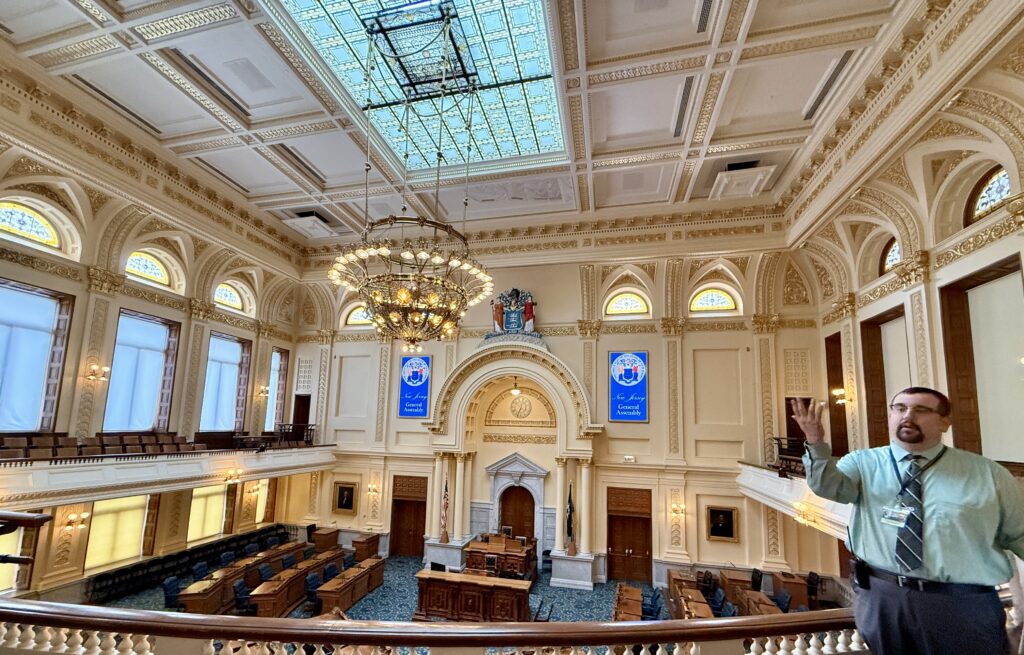
When we stepped into the General Assembly Chamber, it was like taking a trip back in time—right to the moment when Thomas Edison’s Electric Light Company installed a gleaming brass chandelier in 1891. Imagine how exciting that must have been: New Jersey’s Assembly filled with brand-new electric bulbs, like young teenagers at just thirteen years old. Just in case the bulbs fizzled out, the upper wall sconces could switch back to gas light, a clever gesture to remember the old days, or maybe a distrustful nod to the new electric lights. You decide!

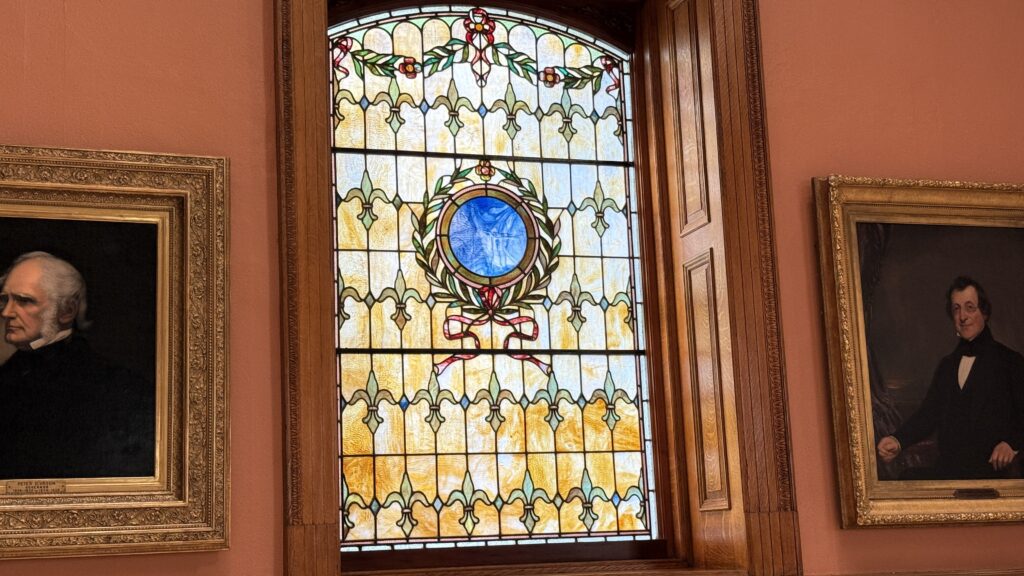
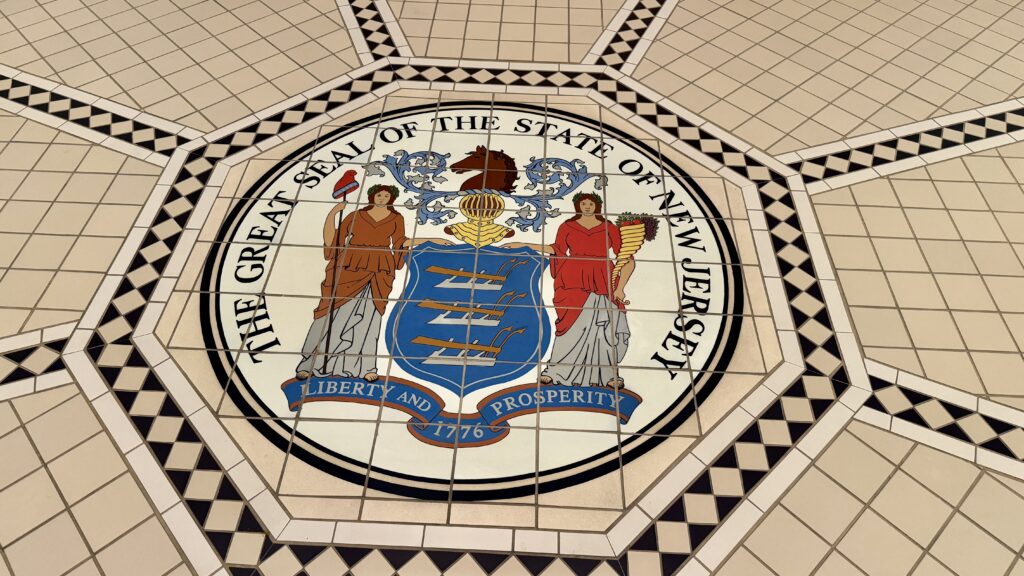
Look up and you’ll see stained glass lunettes and a huge skylight, letting sunlight pour in across the hall. The gold-leaf details shimmer over the ornate plasterwork, giving the place a touch of grandeur. Above the Speaker’s dais, there’s a colorful wooden statue of New Jersey’s great seal—hard to miss and impossible not to admire.

Even the carpet gets in on the action, decorated with New Jersey’s state symbols: the Purple Violet, Eastern Goldfinch, Red Oak Tree, and Honey Bee. Blue is my favorite color, so I really like this even though we only saw it from the gallery. I imagine it is a fun detail for anyone walking through, like a hidden scavenger hunt for Garden State pride woven right into the floor.

House of Representatives (General Assembly)

Notable stories from our Tour Guide

Welcome to New Jersey—a state where most folks are packed up north like sardines in a subway car! Seriously, about 70-75% of New Jerseyans call the northern cities home, with hotspots like Paterson, Elizabeth, Newark, and Jersey City buzzing with energy. Central Jersey holds its own with industrial hubs (hello, Trenton!), but venture south and you’ll find sprawling farmland, earning the “Garden State” name with pride.

But let’s talk about southern Jersey, where the legend gets wild. Meet the “Jersey Devil” (or “Leeds Devil,” if you want to sound fancy)—the state’s most infamous cryptid. Picture this: a creature that’s part kangaroo, part horse, part goat, with bat wings, scary claws, and a tail that’s forked like it’s ready for a barbecue. Where does it lurk? In the Pine Barrens, of course—a place so ecologically bizarre that our guide called it a “weird hybrid,” with only one other similar spot on earth, and that’s somewhere in Africa!

The Pine Barrens are pretty much New Jersey’s own enchanted forest—spanning a mind-blowing 1.1 million acres over seven counties. It’s rural, mysterious, and somehow sits close to bustling cities like Philadelphia and New York. If you love botanical oddities, you’ll be thrilled: Venus fly traps snap up unwary insects, cranberries dot the landscape, and who knows—you might just spot the Jersey Devil (or at least a hammerhead bat) soaring overhead!

So whether you’re a city dweller or prefer the quirky wilderness, New Jersey is ready to surprise you with every mile. Pack your bags, keep your eyes peeled, and remember: in the Garden State, even your myths come with wings! 

Let’s dive deeper into the wild tale of the Jersey Devil, also known as the Leeds Devil! Picture this: it’s 1735, and Mrs. Leeds—a 25-year-old mother—finds herself expecting her 13th child. Exhausted and overwhelmed, she supposedly exclaims, “Let this one be the devil!” After the baby arrives, everything seems normal—until five minutes later, when it transforms into a winged monster and shoots up the chimney, vanishing into the mysterious Pine Barrens. Since then, more than 700 people claim they’ve spotted the beast, with sightings stretching from the days of Napoleon Bonaparte (yes, he was in New Jersey!) all the way to 2023. Like any good legend, the Jersey Devil’s story keeps evolving with every “encounter.” 

Some say the Pine Barrens is filled with wild creatures—including the hammerhead bat, which could easily spook someone into thinking they’ve seen a monster. But honestly, why spoil the fun? Whether you’re searching for the Devil in the woods, or cheering for the Jersey Devils at a hockey game, this state monster keeps New Jersey’s imagination alive! 

No act of Congress made it official, but ask anyone in New Jersey—the Jersey Devil is absolutely the state’s monster.

The legend has even more twists: the Leeds family, famous for publishing astrological almanacs back in colonial New Jersey, supposedly had their own run-ins with the Devil. Some say the creature got its bad reputation because the family supported the American Revolution. And with all those bats swooping through the Pine Barrens, it’s easy to see how a hammerhead bat—feeding on mosquitoes by the thousands—could be mistaken for a dinosaur-like beast by anyone wandering the woods at night. So next time you’re in South Jersey, keep your eyes peeled… you never know what you might spot! 

Our guide was incredibly knowledgeable and shared plenty of interesting tidbits throughout the tour. Here’s another fun fact: New Jersey’s capitol is the only one in the country where you can look out and see another state. From the building, you can gaze across the Delaware River and spot Pennsylvania.

The Rotunda

Step under the magnificent dome in the rotunda and you’re in for a treat! Our guide pointed out some quirky features, like the mysterious dragons woven into the architecture—no one really knows why, but legend has it these eastern dragons are guardians of humanity. 🐉✨ Over the door, an eagle stands watch where the main entrance used to be, although now the dome sits off-center after years of expansions. And get this: Tim swears the dome towers a whopping 140 feet overhead! Who knew state history could be so whimsical?

If you enjoyed this tour of the New Jersey State Capitol, leave a comment below and let me know your thoughts! Pretty, please! 😁 I won’t hound you. The email you will provide is to prove to AI that you are not, in fact, AI.


À la prochaine…hasta la próxima vez…until next time!


“I am the Lord, who heals you.” ~Exodus 15:26

My relationship with Jesus Christ motivates me to keep blogging. Though I have metastatic breast cancer*, my faith helps me survive, thrive, and feel alive while staying active. Without Him, I couldn’t achieve anything. With His help, well, my accomplishments speak for themselves on my blog. If you’re interested in learning about building a relationship with Jesus, feel free to comment below. I will never sell or share your email.

*Metastatic breast cancer is Stage IV cancer. Metastatic, or metastasis, means the cancer has spread beyond the original location (breast and immediate lymph nodes). In 2016 the doctors found significant metastasis to my bones, skull, liver, and lungs; then in 2018 to the brain. However, with chemo, immunotherapy, gamma knife, and of course my faith in the Lord, it is all undetectable at this point. I continue in treatment every three weeks via infusions, and receive multiple scans on a regular basis. If you or someone you know has metastatic breast cancer, I recommend these organizations for additional support: 
Metavivor and Unite for Her (also for ovarian cancer)